Facts
The respondent sought engagement as a Sikhya Sahayak (Telugu) in Gajapati district. His claim was rejected by the Collector-cum-Chief Executive Officer, Zilla Parishad, Gajapati, by order dated 25 June 2018, principally on the ground that he had not passed the H.S.C. examination in Odia medium.
Source reference: para. 3The respondent challenged the rejection in W.P.(C) No. 15613 of 2018. By judgment dated 17 January 2025, the learned Single Judge quashed the rejection and directed the authorities to issue the necessary engagement order against an available vacancy.
Source reference: para. 2The State preferred the present writ appeal, contending that the respondent had passed H.S.C. in Telugu medium and therefore did not satisfy Clause 6.2 of the Government Resolution dated 26 December 2016.
Source reference: para. 4It was undisputed that the respondent had studied Odia as a subject up to Class X and that the relevant institution was a bilingual Telugu-Odia school.
Source reference: paras. 6–7Issues
Whether Clause 6.2 of the Government Resolution dated 26 December 2016 required a candidate seeking engagement as a Sikhya Sahayak (Telugu) to have passed the H.S.C. examination specifically in Odia medium.
Source reference: paras. 4–5Whether a candidate who passed H.S.C. in Telugu medium but studied Odia as a subject up to Class X fulfilled the eligibility requirement for engagement as a Sikhya Sahayak (Telugu) in a bilingual school.
Source reference: paras. 6–7Law Applied
The Court applied Clause 6.2 of the Government Resolution dated 26 December 2016 issued by the School and Mass Education Department, Odisha.
Source reference: para. 5The clause requires candidates seeking engagement as Urdu, Bengali or Telugu Sikhya Sahayaks to have passed the respective language as a Modern Indian Language up to the H.S.C. standard and further requires production of a certificate showing that the candidate passed H.S.C. in Odia medium; it also recognises that such engagement is likely to be in bilingual schools.
Source reference: para. 5The Court held that the clause must be construed as a whole, with the Odia-medium requirement read in the context of the candidate’s ability in the concerned regional language and the bilingual nature of the intended school.
Source reference: para. 7Reasoning
The Court rejected the State’s isolated reading of the Odia-medium requirement.
Source reference: para. 7It interpreted Clause 6.2 in its entirety, noting that the provision simultaneously requires proficiency in Telugu up to the H.S.C. standard and contemplates engagement in bilingual schools.
Source reference: para. 7Since the respondent had studied Odia as a subject up to Class X and possessed knowledge of both Odia and Telugu, his Telugu-medium education did not defeat the object of the provision. His qualifications were therefore held to satisfy Clause 6.2, particularly because the proposed engagement was in a bilingual Telugu-Odia school.
Source reference: paras. 6–7Holding
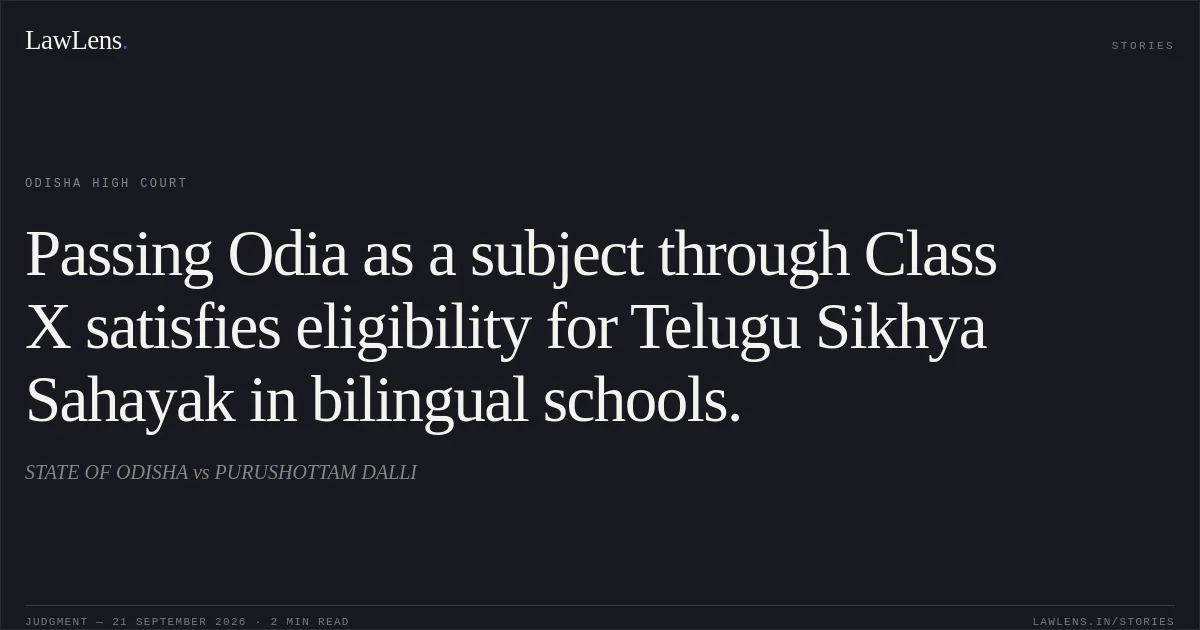
The Court held that the respondent was eligible for engagement as a Sikhya Sahayak (Telugu), notwithstanding that he had pursued his studies in a Telugu-medium school, because he had studied Odia up to Class X and was intended to serve in a bilingual school.
Finding no merit in the State’s challenge, the Division Bench dismissed W.A. No. 1282 of 2025 and thereby upheld the learned Single Judge’s direction to issue the necessary engagement order against the available vacancy.
Source reference: para. 8Original Court PDF
STATE OF ODISHAvsPURUSHOTTAM DALLI
Click to open original judgment
Original judgment, available to read, download and summarize on LawLens.in