Facts
The Petitioner, a co-owner of property No. 21/24, West Patel Nagar, applied for conversion from leasehold to freehold in 2006, depositing ₹70,000.
Source reference: p. 2, para. 3(i); p. 3, para. 3(iii)The Land Development Office (LDO) rejected the application on 08.11.2006, citing an inspection from 1974 that allegedly showed encroachment and unauthorized construction.
Source reference: p. 5, para. 3(vi); p. 15, para. 9(ii)The Petitioner applied again in 2011, asserting that encroachments were removed.
Source reference: p. 6, para. 3(viii)In 2013 and 2016, the Respondents issued demand notices for ₹24,16,362 and ₹35,76,629 respectively, calculated retrospectively from 1974.
Source reference: p. 6, para. 3(viii); p. 7, para. 3(x)During the pendency of the writ, a fresh demand for ₹58,25,976 was issued in December 2024.
Source reference: p. 9, para. 6(5)Issues
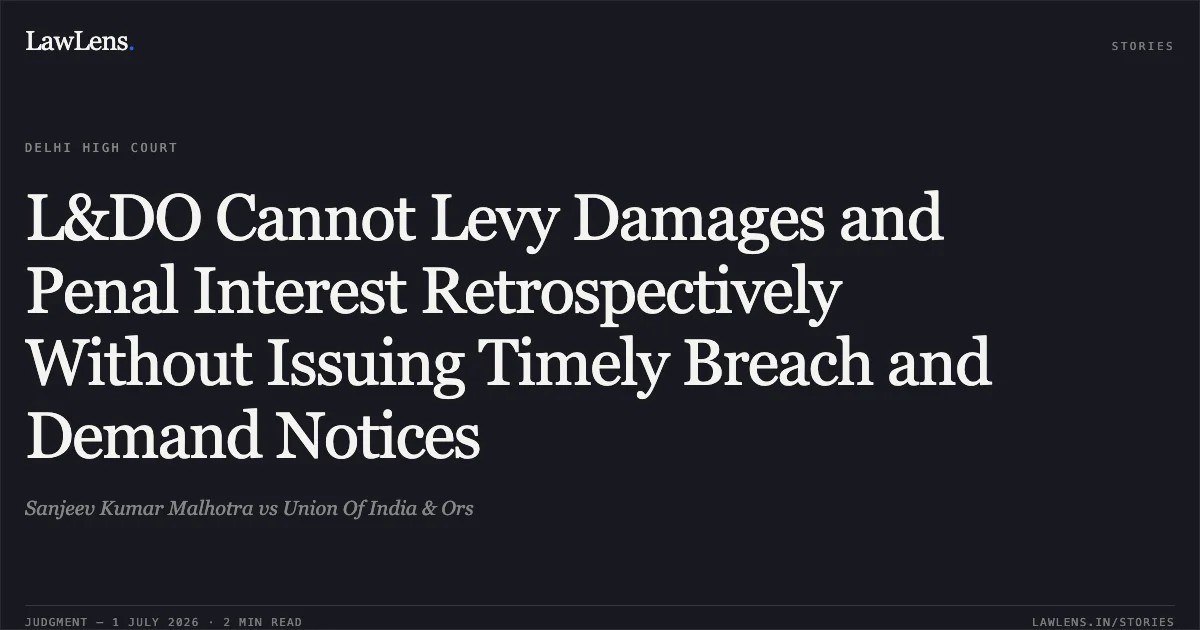
1. Whether the LDO can validly raise retrospective demand charges for unauthorized construction and misuse based on an inspection report from 1974 when no notice was served for over 30 years.
Source reference: p. 28, para. 17-182. Whether the charging of compound interest and penalties for the period of the Respondents' own inaction is legally sustainable.
Source reference: p. 29, para. 18(v)Law Applied
The Court applied Article 226 of the Constitution of India regarding the exercise of writ jurisdiction against arbitrary state action.
Source reference: p. 1, para. 1The principle established in Delhi Development Authority v. Ram Prakash, which mandates that statutory authorities must act within a reasonable time even if no limitation is prescribed; it is inequitable to allow a claim after a lapse of 25 years due to departmental inaction.
Source reference: p. 26, para. 113The precedent from Union of India v. Satish Kumar Mehta, holding that retroactive demands are procedurally and substantially unreasonable.
Source reference: p. 14, para. 8(vii)Tek Chand Narula v. Union of India, which prohibits piling up demands by delaying the crystallization of charges.
Source reference: p. 25, para. 106Reasoning
The Court observed that while an inspection occurred in 1974, the Respondents failed to issue any breach or demand notice for 32 years, until 2013.
Source reference: p. 22, para. 13The LDO did not quantify dues even when names were mutated in 2006 or when the first conversion application was filed.
Source reference: p. 23, para. 14The Court found it "unjust and unfair" to automatically presume encroachment since 1974 without giving the lessee an opportunity to rectify it at the relevant time.
Source reference: p. 23, para. 14The court noted that most of the delay in processing the conversion was attributable to the Respondents' failure to crystallize demands.
Source reference: p. 29, para. 18(v)The Court determined that the period from 1974 to 2006 must be excluded entirely, and no interest/penalties can be charged for the subsequent period of departmental delay.
Source reference: p. 29, para. 18-19Holding
The Court quashed the demand notices dated 17.05.2013, 30.08.2016, and 18.12.2024.
It held that the LDO cannot claim damages for the period 1974–2006.
Source reference: p. 29, para. 18(iv)The LDO was directed to: (i) Issue a fresh notice for damages from 14.08.2006 to 17.05.2013 without interest/penalties; (ii) Raise demands for 2013–2016 as per rules; and (iii) Request charges for 2016–2024 without interest due to the pendency of litigation.
Source reference: p. 31, para. 22The Respondents must pass a reasoned order within four weeks and decide the conversion application within another four weeks thereafter.
Source reference: p. 32, para. 22Acts & Sections Cited
2 provisions across 2 statutes referred to in this judgment. Linked provisions open on LawLens.
Code of Civil Procedure, 19081
Government Grants Act, 18951
Original Court PDF
Sanjeev Kumar MalhotravsUnion Of India & Ors
Click to open original judgment
Original judgment, available to read, download and summarize on LawLens.in