01Facts
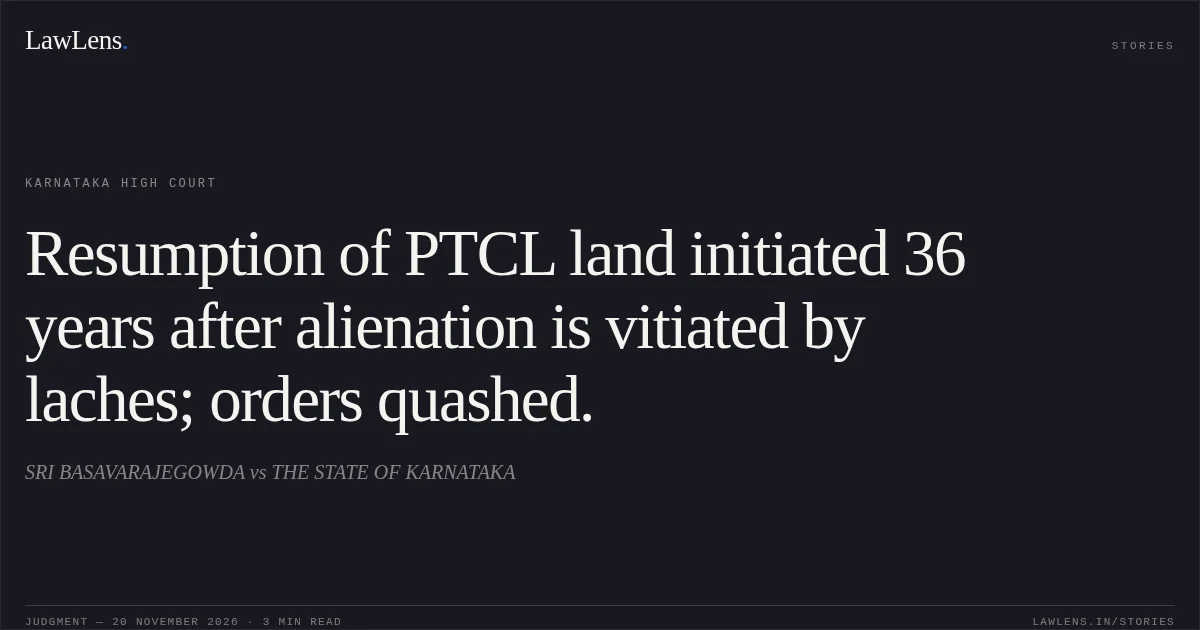
The land in question was granted in 1937-38 to the original grantee and was sold through a registered sale deed in 1958.
¶ 5 · p. 4The resumption proceedings under the Karnataka Prevention of Transfer of Certain Land Act, 1978 ("PTCL Act") were initiated before the Assistant Commissioner, Kolar Sub-Division, in 2024, about 66 years after the sale and 45 years after the PTCL Act came into force.
¶ 5 · pp. 4-5The Assistant Commissioner allowed the claim and ordered resumption (PTCL 45/2024, order dated 18.09.2025).
¶ 2(a) · p. 2 · ¶ 5 · p. 5On appeal, the Deputy Commissioner confirmed the order (PTCL 170/2025, order dated 12.01.2026).
¶ 2(b) · p. 3 · ¶ 5 · p. 5The petitioner challenged both orders under Articles 226 and 227 of the Constitution and sought restoration of his name in the revenue records for Survey No. 344 (New) of Seethi Village, Vemgal Hobli, Kolar Taluk.
¶ 2 · pp. 2-3The petitioner contended that the authorities failed to consider the delay and laches in initiating proceedings.
¶ 5 · pp. 5-6Respondent No. 4 (caveator) was absent.
pp. 1-202Issues
i.1. Whether resumption proceedings initiated after a delay of about 66 years from the registered sale deed of 1958 and about 45 years from the commencement of the PTCL Act are sustainable in law.
¶ 5 · pp. 4-6ii.2. Whether the failure of the Assistant Commissioner and the Deputy Commissioner to examine delay and laches vitiates the impugned resumption orders.
¶ 5 · pp. 5-603Law Applied
The Court's reasoning rests primarily on the doctrine of laches as applied to resumption proceedings under the PTCL Act, which the Court treated as a material and relevant consideration that the authorities were bound to examine.
¶ 5 · pp. 5-6The Court relied on a Division Bench ruling (not named in the judgment) which held that laches is the primary requirement in resuming lands and that a restoration action filed after a significant delay may be barred by laches.
¶ 5 · p. 6 · no citationThe Court also relied on the principle that rights over land crystallised under a registered sale deed, which the authorities were required to weigh against the delayed exercise of statutory power.
¶ 5 · p. 6The judgment does not specify any statutory section of the PTCL Act, and jurisdiction was exercised under Articles 226 and 227 of the Constitution.
¶ 2 · p. 2 · no citation for specific section04Reasoning
The Court found that both authorities initiated and sustained resumption proceedings roughly 66 years after the 1958 sale and 45 years after the PTCL Act came into force, yet did not examine whether such an extraordinary lapse of time was justified.
¶ 5 · pp. 5-6Applying the Division Bench principle, the Court held that the delay bore directly on whether statutory power could be exercised, particularly where title had been settled through a registered sale deed. The failure to consider laches was therefore treated as a failure to consider a material and relevant factor, which vitiated the orders directing resumption.
¶ 5 · p. 6Because the defect lay in the authorities' omission to address delay, the Court did not record a finding on the merits of the title or the original grant.
¶ 5-6 · p. 6 · no citation05Holding
The Court held that the orders of the Assistant Commissioner dated 18.09.2025 (PTCL 45/2024) and of the Deputy Commissioner dated 12.01.2026 (PTCL 170/2025) directing resumption cannot be legally sustained and are liable to be set aside.
¶ 5 · p. 6 · ¶ 6 · p. 6The writ of certiorari was issued and both orders were quashed. The Court directed the authorities to mutate or restore the petitioner's name in the revenue records for the subject land. The writ petition was allowed, interim orders were discharged, and pending interlocutory applications, if any, were disposed of.
¶ 7 · pp. 6-7 · ¶ 7 · p. 7 · ¶ 8 · p. 7Original Court PDF
SRI RAKESHvsSTATE OF KARNATAKA
Click to open original judgment
Original judgment, available to read, download and summarize on LawLens.in