01Facts
Smt. Premamma V held Form CL-9 (and RVB) excise licence for premises at AECS Layout, Marathahalli, Bengaluru, renewed for 2025-26.
¶ 2Her son predeceased her in 2022, and she died intestate-or-testate on 13.08.2025.
¶ 5Her husband had predeceased her, and she had no surviving children.
¶ 5, 27Sri Hari Prasad B.G., husband's brother's son, sought transfer under Rule 17A of the Karnataka Excise Licences (General Conditions) Rules, 1967 ("Rules, 1967"), relying on no-objection affidavits from other husband's-side relatives and on Section 15(1)(b) of the Hindu Succession Act, 1956 ("HSA") in WP 28317/2026.
¶ 2, 8, 26Sri Hari Prasad B.G. had filed a Section 372 Indian Succession Act petition for a succession certificate, which was pending.
¶ 9Sri Aswatha Narayana Reddy and Sri Karthik A, maternal relatives/brother's side, relied on three Wills in their favour, one registered on 16.12.2025, and sought transfer under Rule 17A in WP 29514/2026.
¶ 5, 16The earlier writ (WP 29599/2025) directed the Deputy Commissioner not to take coercive steps.
¶ 2A prior order requiring a succession certificate was quashed and remanded in WP 24645/2026.
¶ 4, 2On remand, the Deputy Commissioner (Respondent No. 3) again declined transfer pending a succession certificate or civil court declaration, noting two conflicting pedigree certificates.
¶ 4The impugned order is dated 03.09.2026.
preambleThe prayer in WP 28317/2026 refers to an order dated 27.08.2026, while the Court's preamble treats both petitions as challenging the 03.09.2026 order.
preamble · ¶ 102Issues
i.1. Whether the term "legal heir" in Rule 17A of the Rules, 1967 must be construed by reference to the law of succession, and whether a licence transfer under that Rule is inheritance.
¶ 25ii.2. Whether the Excise authority may require a civil court declaration of legal heirship where the heirs under intestate succession have consented to a transfer.
¶ 27, 30–31iii.3. Whether the Excise authority or the High Court in writ jurisdiction can adjudicate the genuineness of rival Wills to determine entitlement to transfer.
¶ 27, 31iv.4. Whether the State should be directed to consider amending Rule 17A to address these difficulties.
¶ 3203Law Applied
Section 71 of the Karnataka Excise Act, 1965 empowers rule-making, and Rule 17A of the Rules, 1967 permits the Deputy Commissioner, with the Excise Commissioner's previous sanction, to transfer a licence to the legal heirs of a deceased licensee. "Legal heir" is undefined and must be understood under the applicable succession law, and a licence is a statutory privilege, not inheritable property in the ordinary sense.
¶ 25Sections 15(1)(b) and 16 of the HSA, including Rule 3 of Section 16, govern intestate succession to a female Hindu's property and identify the husband's heirs as the preferred class.
¶ 26–27, 30A claimant under a Will derives rights from a testamentary disposition, and the Will's genuineness must be established in accordance with law; the mere production of a Will does not establish rights.
¶ 27Section 68(b) of the Karnataka Excise Act bars civil court jurisdiction over matters entrusted to Excise authorities but does not empower them to adjudicate genuineness of Wills or disputed civil status.
¶ 31Smt. Hamsamma v. Excise Commissioner (W.P. Nos. 56185/2015 & 56499-56502/2015, 03.02.2016) holds that unresolved inter se disputes among heirs bar a direct transfer.
¶ 21, 28Smt. Sangeetha v. State of Karnataka (W.P. No. 25774/2023, 21.08.2025) sets out requirements for mandamus.
¶ 22Smt. S. Paranjyothi v. State of Karnataka (W.P. No. 8560/2023, 19.06.2023) addresses consent-based transfer.
¶ 29Dr. P.K. Govinda v. K. Chandrashekhar (W.A. Nos. 356 & 360/2022, 02.08.2022) addresses the limits of Excise authority over contested testamentary rights.
¶ 29T.K. Kumaraswamy v. State of Karnataka (W.P. No. 2011/2023, 14.11.2024) holds that consent transfers do not extinguish other heirs' interests.
¶ 29Provisions in the judgment · 7 · Linked ones open on LawLens
Hindu Succession Act, 1956 Section 15Section 16Section 8Section 9
Indian Succession Act, 1925 Section 372Section 63
MP Land Revenue Code 1959 Section 110
04Reasoning
The husband's heirs form the preferred class under Section 15(1)(b) HSA, and the Excise licence's transfer does not depend on a separate civil declaration where the class is identified and there is no inter se dispute.
¶ 30–31The no-objection affidavits from the husband's relatives established consent without altering the statutory order of succession.
¶ 27 · order (iii)Hamsamma is distinguished because there the heirs themselves were in disagreement, whereas here the objection came from maternal relatives asserting testamentary rights, which is not a priority dispute within Section 15(1)(b).
¶ 28A Will-based objection cannot automatically be treated as a dispute among the same class of intestate heirs.
¶ 28The Wills of the maternal claimants cannot be treated as proved or invalid in writ proceedings, and the Excise authority cannot determine the genuineness of Wills; their claim therefore remains for the civil court.
¶ 27, 30–31Pendency of civil proceedings does not by itself justify forfeiture or extend the licence beyond the Rules.
¶ 31Structural gaps in Rule 17A are identified, including the absence of a definition of "legal heir," the effect of consents, treatment of disputed Wills, and the status of licences during prolonged litigation, which may render the subject matter unavailable through the auction pool.
¶ 3205Holding
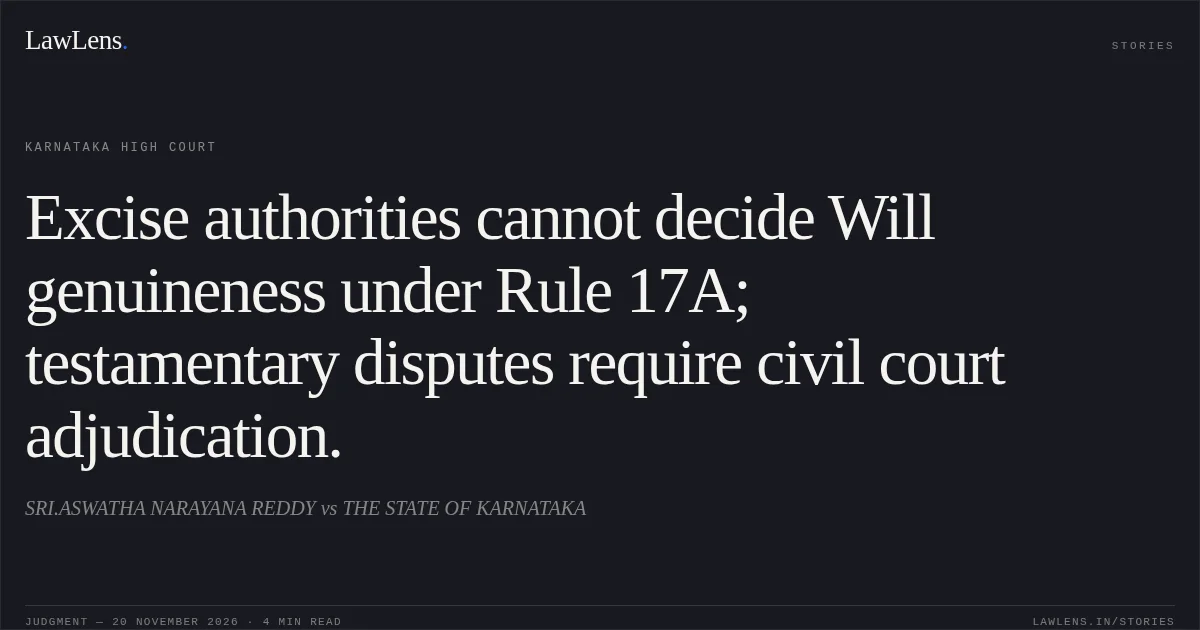
The "legal heir" under Rule 17A must be determined per the applicable succession law; the husband's heirs are the preferred class under Section 15(1)(b) HSA; the consent affidavits establish no inter se dispute; and the Excise authority cannot adjudicate Wills.
¶ 25, 27, 30–31 · orders (i)–(iii)The 03.09.2026 order is set aside insofar as it requires a civil court declaration in WP 28317/2026, and the Deputy Commissioner must consider transfer to Sri Hari Prasad B.G. if other statutory requirements are met.
order (v)–(vi)The 03.09.2026 order is affirmed in WP 29514/2026, and the Wills-based claimants must pursue the civil court.
order (iv)–(v) · ¶ 31The State is requested to examine clarification of Rule 17A, and the Registry must forward the order to the Principal Secretary, Finance (Excise).
order (vii) · order (viii)Original Court PDF
SRI.ASWATHA NARAYANA REDDYvsTHE STATE OF KARNATAKA
Click to open original judgment
Original judgment, available to read, download and summarize on LawLens.in