01Facts
The land was granted in 1961 and sold through a registered sale deed in 1993.
¶ 6 · p. 6Approximately 18 years later, in 2011, resumption proceedings were initiated before the Assistant Commissioner, who ordered resumption.
¶ 6 · p. 6The Deputy Commissioner dismissed the appeal and upheld the order.
¶ 6 · p. 6The petitioners challenged both orders under Articles 226 and 227 of the Constitution.
p. 2Respondent No. 4 contended that resumption was justified due to violation of the PTCL Act, that the petitioners were duly served but did not contest before the Assistant Commissioner, and that revenue entries had been mutated in his favour.
¶ 4 · p. 5Respondent No. 4 further argued that, although the impugned order was passed in 2023, the writ petition was filed only in February 2026, and that it suffered from gross delay and laches.
¶ 6 · p. 7The Court noted that notice was issued, and respondent No. 4 filed objections only in November.
¶ 6 · p. 8The Court's paragraph 3 records that the parties are referred to generically because of recurring discrepancies in names, dates and survey numbers in PTCL matters.
¶ 3 · p. 402Issues
i.1. Whether the resumption proceedings, initiated about 18 years after the 1993 registered sale, were barred by unreasonable delay and laches, which the Assistant and Deputy Commissioners failed to consider.
¶ 6 · pp. 6–7ii.2. Whether the respondent's preliminary objection that the writ petition, filed in February 2026 against a 2023 order, suffered from delay and laches could be sustained at the final hearing stage.
¶ 6 · p. 803Law Applied
The Court relied on the principle that laches is a primary consideration in resumption proceedings, as laid down by a Division Bench of this Court, which held that a restoration action filed after a significant delay may be barred by laches.
¶ 6 · p. 7The Court also relied on the general principle that a writ petition, once entertained and notice issued, cannot be defeated at the final hearing by a preliminary objection of delay and laches.
¶ 6 · p. 8The Court referred to the PTCL Act only as the statute invoked by respondent No. 4 to justify resumption; the judgment does not quote or analyse its specific provisions.
¶ 4 · p. 5The Division Bench decision is not named in the judgment.
¶ 6 · p. 704Reasoning
The Court found that the Assistant and Deputy Commissioners overlooked the 18-year gap between the 1993 sale and the 2011 initiation of resumption, and did not examine laches or the petitioners' plea of unreasonable delay.
¶ 6 · pp. 6–7Because the sale deed had settled rights in the land in 1993, the authorities were required to assess whether proceedings after such a lapse were still maintainable.
¶ 6 · pp. 6–7Their failure to address this crucial issue rendered the resumption orders unsustainable.
¶ 6 · p. 7As to the respondent's objection, the Court held that the delay in filing the writ petition could not be relied upon at the final hearing, since notice had already been ordered and the petition entertained, and the respondent's objections were filed late.
¶ 6 · p. 8The Court did not separately examine the PTCL Act violation alleged by respondent No. 4.
¶ 4 · p. 5 · ¶ 6 · p. 805Holding
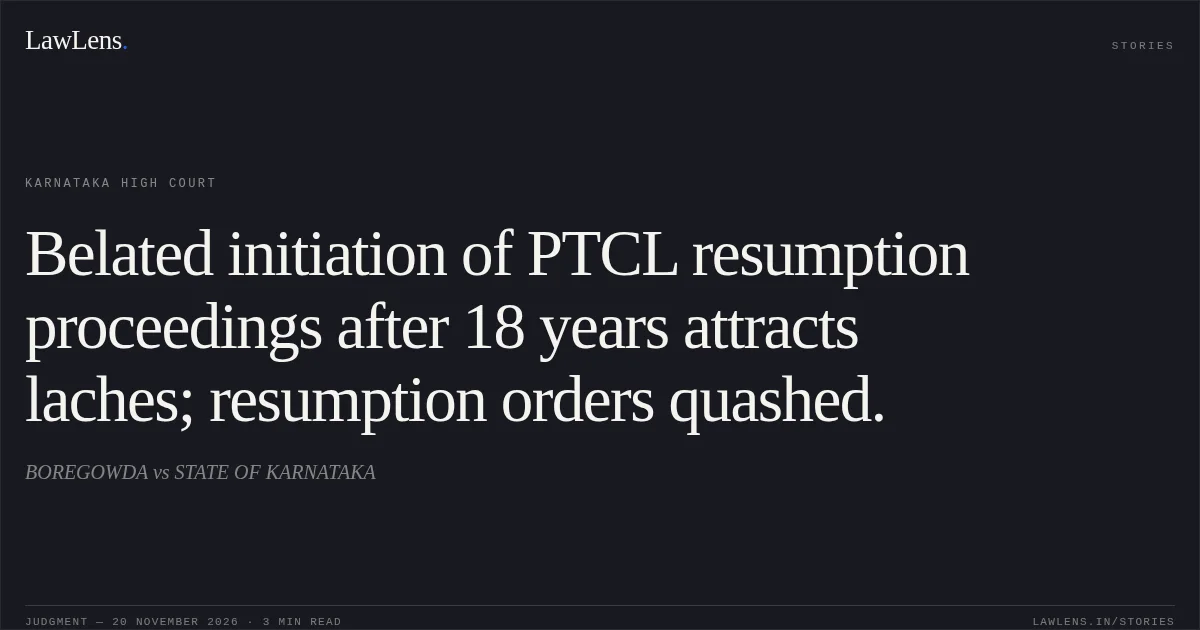
The Court held that the resumption orders of the Assistant Commissioner and the Deputy Commissioner cannot be legally sustained because the authorities failed to consider the delay and laches in initiating resumption after 18 years.
¶ 6 · p. 8The respondent's preliminary objection on delay and laches in filing the writ was rejected.
¶ 6 · p. 8The writ petition was allowed, the impugned orders were quashed by a writ of certiorari, and the revenue authority was directed to mutate or restore the petitioners' names in the revenue records.
¶ 7–9 · pp. 8–9Original Court PDF
BOREGOWDAvsSTATE OF KARNATAKA
Click to open original judgment
Original judgment, available to read, download and summarize on LawLens.in