01Facts
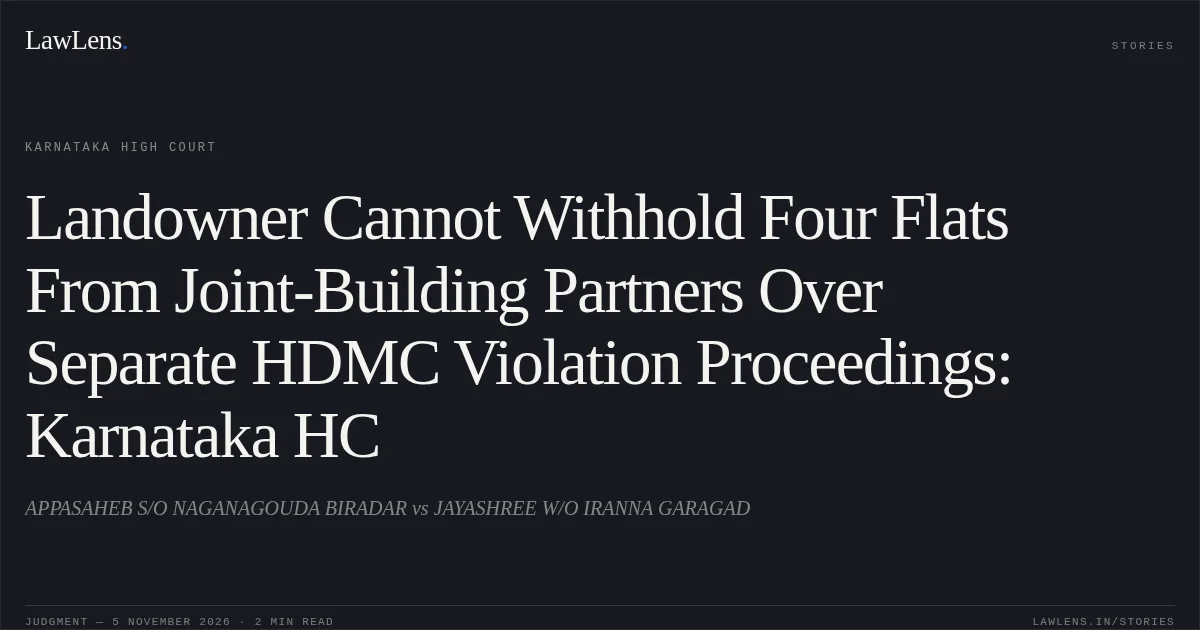
The petitioner, defendant in O.S. No. 129 of 2016 and judgment-debtor in Execution Case No. 131 of 2023, challenged an executing-court order and two Hubballi-Dharwad Municipal Corporation (HDMC) orders concerning alleged building-plan violations at the suit property.
¶ 1, 4A Division Bench had declared the respondents entitled to four residential units under the parties’ agreement, directed the petitioner to clear the bank loan and provide a no-dues certificate, and left building-plan violations to HDMC, while preserving the parties’ statutory remedies.
¶ 8The petitioner argued that the ground floor belonged exclusively to him and that the executing court lacked jurisdiction to prompt municipal action.
¶ 5The respondents and HDMC relied on the final decree and the statutory remedy available against the municipal orders.
¶ 602Issues
i.1. Whether the executing court’s direction concerning action on building-plan violations warranted interference, given the Division Bench’s reservation of HDMC’s authority to act in accordance with law.
¶ 8, 10ii.2. Whether the petitioner could challenge HDMC’s orders under Section 321 of the Karnataka Municipal Corporations Act, 1976, in the writ petition, rather than by pursuing the statutory remedy.
¶ 10–11iii.3. Whether the municipal proceedings justified withholding delivery of the four flats awarded to the respondents under the final decree.
¶ 12–1303Law Applied
The Division Bench’s final decree governed the parties’ respective entitlements and required compliance with its directions; matters concerning building-plan violations were left to HDMC for determination in accordance with law, with statutory remedies preserved for aggrieved parties.
¶ 8Orders under Section 321 of the Karnataka Municipal Corporations Act, 1976, are subject to the remedies provided under that Act, which an aggrieved party must pursue in accordance with its provisions.
¶ 11, 15Municipal proceedings concerning building violations do not, by themselves, suspend or displace separate obligations imposed by a final civil decree.
¶ 12–13Provisions in the judgment · 1 · Linked ones open on LawLens
KARNATAKA MUNICIPAL CORPORATIONS ACT, 1976. Section 321
04Reasoning
The Court treated the decree’s allocation of four flats to the respondents and the municipal determination of building-plan violations as separate matters.
¶ 8, 10Because the Division Bench had expressly left violations to HDMC and preserved statutory remedies, the executing court’s direction concerning municipal action was incidental to that decree and did not warrant interference.
¶ 8, 10The petitioner could not invalidate the HDMC orders merely because they followed the executing court’s direction; any challenge had to be brought through the applicable statutory remedy.
¶ 11Nor could the petitioner rely on those proceedings to withhold the four flats: any violation affecting a flat was for HDMC to address in accordance with law, while the petitioner remained bound to comply with the final decree.
¶ 12–1305Holding
The High Court dismissed the writ petition as devoid of merit.
¶ 14It held that the petitioner could not use the municipal proceedings to delay compliance with the final decree and reserved liberty to challenge the HDMC orders through the appropriate remedy under the Karnataka Municipal Corporations Act, 1976.
¶ 13, 15If that remedy was pursued within 15 days of receiving the certified copy of the order, the time spent prosecuting the writ petition was to be considered for condonation of delay.
¶ 15Original Court PDF
APPASAHEB S/O NAGANAGOUDA BIRADARvsJAYASHREE W/O IRANNA GARAGAD
Click to open original judgment
Original judgment, available to read, download and summarize on LawLens.in