Facts
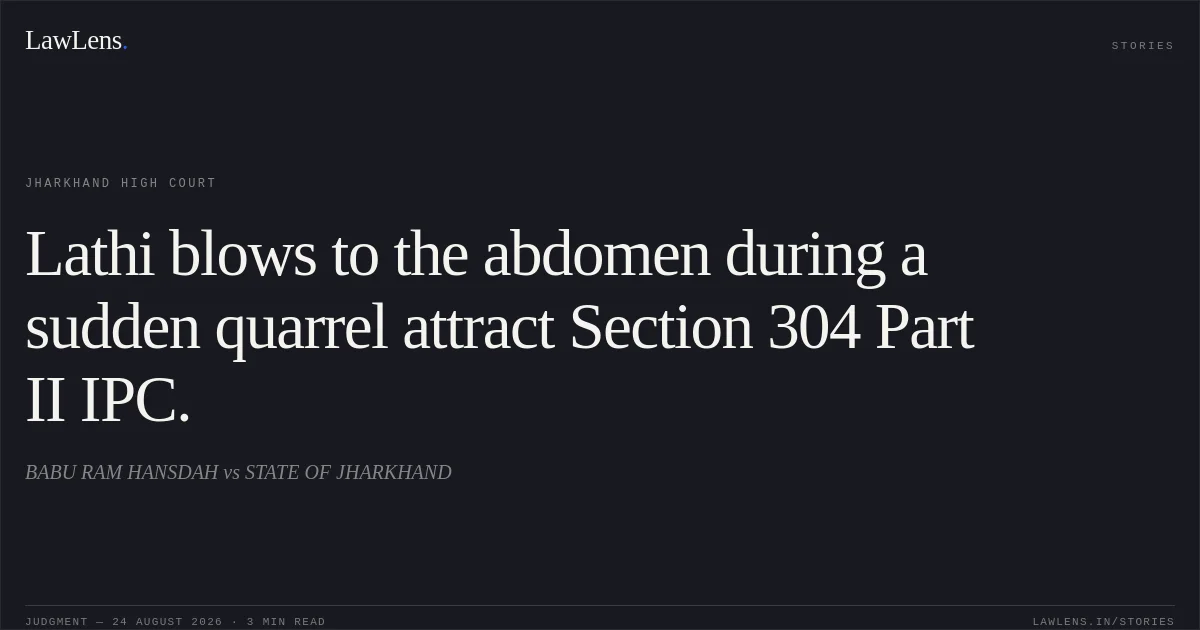
On 28 August 2003, the appellant allegedly took his bullock cart through the deceased Suniram Marandi’s maize field. When Suniram objected, a quarrel ensued, during which the appellant struck him with a lathi on the abdomen and chest. Suniram was taken for medical treatment and subsequently died during treatment. The FIR was initially registered under Sections 341 and 323 IPC, with Section 307 IPC later added; after investigation, the appellant was charge-sheeted for offences under Sections 323, 341 and 304 IPC.
Source reference: p.1–2, para.3–4At trial, the prosecution examined ten witnesses and relied on the injury report, the deceased’s fardbeyan, the inquest report, and the post-mortem report.
Source reference: p.2–3, para.5The trial court convicted the appellant under Section 304 Part II IPC and sentenced him to five years’ rigorous imprisonment. The appellant challenged that conviction and sentence in the present appeal.
Source reference: p.3–4, paras.7–8Issues
1. Whether the prosecution evidence, including the eyewitness testimony, the deceased’s statement, and the medical evidence, established beyond reasonable doubt that the appellant caused the injuries resulting in Suniram’s death?
Source reference: p.5–10, paras.11–132. Whether the appellant’s conduct attracted liability under Section 304 Part II IPC, namely, culpable homicide not amounting to murder with knowledge that the act was likely to cause death?
Source reference: p.10, paras.13–143. Whether the trial court’s judgment of conviction and sentence suffered from any serious error of law warranting appellate interference?
Source reference: p.5, para.11Law Applied
The Court applied Section 304 Part II of the Indian Penal Code, which covers culpable homicide not amounting to murder where the accused acts with knowledge that the act is likely to cause death, but without the intention to cause death or such bodily injury as is likely to cause death.
Source reference: p.9–10, para.13The Court also relied on the principles governing appreciation of ocular and medical evidence, including the use of a deceased person’s statement recorded during his lifetime as corroborative evidence, and the requirement that the prosecution evidence establish a causal connection between the accused’s act, the injury, and the death.
Source reference: p.9–10, para.13Reasoning
The Court treated P.Ws. 2 and 4 as material eyewitnesses whose evidence consistently established the quarrel over the bullock cart and the appellant’s lathi assault on the deceased’s abdomen.
Source reference: p.5–7, para.12It found their testimony corroborated by the deceased’s fardbeyan recorded by P.W.9 and by P.W.5’s evidence that he found the deceased immediately after the occurrence holding his abdomen and naming the appellant as the assailant.
Source reference: p.7–10, paras.12–13The medical evidence supported the prosecution version: P.W.1 found serious abdominal injury and intestinal perforation, while the post-mortem evidence recorded perforation of the ileum with sepsis and opined that death resulted from shock caused by the traumatic injury.
Source reference: p.8–10, paras.12–13Although the occurrence arose suddenly during a quarrel, the Court held that deliberately inflicting lathi blows on the abdomen—a vital part of the body—demonstrated knowledge that the assault was likely to cause death, thereby satisfying Section 304 Part II IPC.
Source reference: p.10, para.13The alleged inconsistencies and challenges to the witnesses’ credibility were therefore insufficient to displace the trial court’s findings.
Source reference: p.10, paras.14–15Holding
The High Court held that the prosecution had proved the appellant’s liability under Section 304 Part II IPC and that the trial court had correctly appreciated the evidence.
The conviction and sentence of five years’ rigorous imprisonment were upheld, and the appeal was dismissed.
Source reference: p.10, paras.14–16As the appellant was on bail, his bail bond was cancelled and he was directed to surrender before the concerned trial court within two months to serve the remaining sentence; failing surrender, coercive steps were directed to be taken for his arrest and detention.
Source reference: p.10–11, para.17Acts & Sections Cited
4 provisions across 1 statute referred to in this judgment. Linked provisions open on LawLens.
Indian Penal Code, 18604
Original Court PDF
BABU RAM HANSDAHvsSTATE OF JHARKHAND
Click to open original judgment
Original judgment, available to read, download and summarize on LawLens.in