Facts
The petitioner, a student of the five-year B.A. LL.B. course at Prayag Vidhi Mahavidyalaya, affiliated with Prof. Rajendra Singh (Rajju Bhaiya) University, appeared in the IX Semester Examination 2025–26, including the paper “Bio-Diversity Protection Law” (Course Code G020904T).
Source reference: para. 3The result declared on 18 March 2026 awarded him zero marks in the subject, despite his having attempted all the questions.
Source reference: paras. 3–4After obtaining a copy of his answer book under the Right to Information Act, 2005, the petitioner found that no marks had been awarded for any answer and submitted representations seeking re-evaluation.
Source reference: para. 4He therefore sought a writ of mandamus directing the University authorities to re-examine the answer book, award marks according to the answers written, and issue a revised marks statement.
Source reference: para. 2Pursuant to the Court’s direction, the University produced the original question paper and answer book for judicial examination.
Source reference: paras. 5–6Issues
Whether the Court should direct re-examination or re-evaluation of the petitioner’s answer book on the ground that zero marks were awarded despite the petitioner having attempted all questions.
Source reference: paras. 2, 4–9Whether the examiner’s award of zero marks disclosed arbitrariness, mala fides, violation of statutory provisions, or a patent error warranting interference under Article 226 of the Constitution.
Source reference: para. 9Whether the answer book raised concerns warranting examination of the petitioner’s institution and the broader standards of legal education by the Bar Council of India and the Law Commission of India.
Source reference: paras. 10–13Law Applied
The Court applied the established principle that judicial review of academic evaluation under Article 226 is extremely limited and is justified only where arbitrariness, mala fides, violation of statutory provisions, or a patent error in the evaluation process is demonstrated.
Source reference: para. 9The Court also considered the statutory role of the Bar Council of India under the Advocates Act, 1961, as the regulator responsible for maintaining standards of legal education.
Source reference: para. 12On that basis, the Court held that it could invite the Bar Council of India to examine whether an institution imparting legal education satisfies the prescribed academic and infrastructural standards, while ensuring procedural fairness to the institution.
Source reference: para. 12Reasoning
The Court examined the original answer book rather than relying solely on the petitioner’s assertion that all questions had been attempted.
Source reference: paras. 5–7In relation to Question 3(c), which required a description of Indian national laws concerning biodiversity conservation, the Court found that the answer was incoherent and disclosed no comprehensible legal reasoning, factual account, or relevant legal proposition.
Source reference: paras. 7–9The Court reached the same conclusion regarding the remaining answers and held that the award of zero marks was not arbitrary or erroneous.
Source reference: paras. 7–9Since the record disclosed no prejudice arising from the evaluation process and no ground recognised for judicial interference in academic assessment, the Court declined to order re-evaluation.
Source reference: para. 9However, the quality of the answers caused the Court concern regarding the academic standards of the institution and the broader condition of legal education.
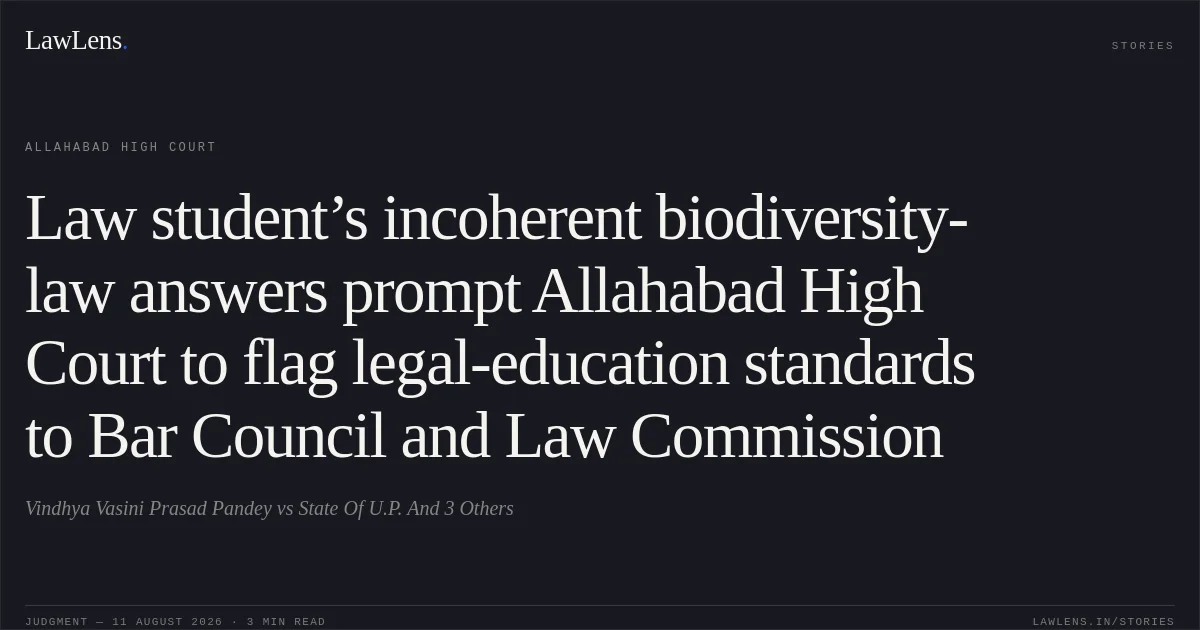
Source reference: paras. 10–13Without recording any adverse finding against the institution, its teachers, or the examiner, the Court directed that the matter be placed before the Bar Council of India and the Law Commission of India for appropriate consideration.
Source reference: paras. 10–13Holding
The Court held that no ground for interference under Article 226 was established and dismissed the writ petition; no re-examination, re-evaluation, or revision of the petitioner’s marks was ordered.
The original question paper and evaluated answer book were directed to be returned to the University for safe custody.
Source reference: para. 15The Registrar (Compliance) was directed to transmit redacted copies of the question paper and answer book to the Bar Council of India for consideration of the institution’s legal-education standards and the adequacy of existing affiliation and inspection mechanisms.
Source reference: para. 16Similar redacted copies were directed to be sent to the Member Secretary of the Law Commission of India for consideration of possible reforms in legal education.
Source reference: para. 17Original Court PDF
Vindhya Vasini Prasad PandeyvsState Of U.P. And 3 Others
Click to open original judgment
Original judgment, available to read, download and summarize on LawLens.in