01Facts
The petitioners, owners and occupiers of Plot No. O-2, C.R. Park, challenged the e-auction of the adjacent Plot No. O-4 and the modified layout plan dated December 3, 1990.
¶ 1-2The petitioners alleged that Plot No. O-4 was carved out by illegally including a "public lane" meant for air and ventilation, as depicted in their 1993 perpetual lease deed.
¶ 2, 12Respondent No. 1 (DDA) contended that both Plot O-2 and O-4 were part of the same modified layout plan approved in 1990.
¶ 15-16Respondent No. 2 (SDMC/MCD) confirmed that construction on Plot O-4 was as per sanctioned plans and no encroachment on public land was found.
¶ 17-18During the proceedings, the court had granted an ex-parte status quo order on August 23, 2021, halting construction.
¶ 33-3402Issues
i.1. Whether the modification of a layout plan requires the statutory procedure of inviting objections under Section 11A of the Delhi Development Act, 1957.
¶ 49-50ii.2. Whether the petitioners can challenge the modified layout plan while being beneficiaries of the same plan for their own allotment.
¶ 56iii.3. Whether a claim for easementary rights (light and air) against a private party and a statutory authority can be adjudicated in a writ petition under Article 226 of the Constitution.
¶ 66-6803Law Applied
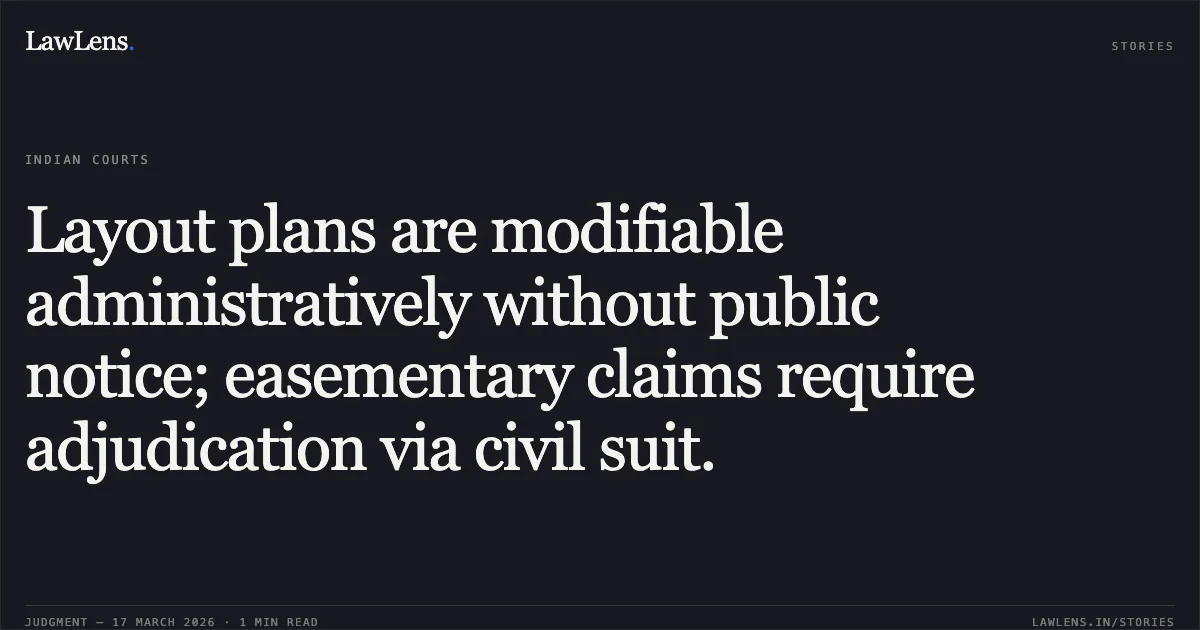
The court applied Section 11A of the Delhi Development Act, 1957, noting it governs modifications to the Master Plan or Zonal Development Plan, but not layout plans, which are administrative "working drawings".
¶ 49-50The court relied on Rohit Dhupar v. LT. Governor, establishing that layout plans can be modified administratively if they conform to the Master Plan.
¶ 50The court applied Sections 4, 15, 33, and 35 of the Indian Easements Act, 1882, which require proof of uninterrupted enjoyment for 20 years (30 years against the government) and evidence of "substantial damage".
¶ 61-63The court applied the principle from Roshina T.V. v. Abdul Azeez K.T., holding that property disputes and easement claims involving pure questions of fact must be settled in civil suits rather than writ petitions.
¶ 68Provisions in the judgment · 6 · Linked ones open on LawLens
Indian Easements Act, 1882 Section 4Section 15Section 28Section 32Section 33Section 35
04Reasoning
The court reasoned that since the petitioners did not allege any violation of the Master Plan or Zonal Development Plan, the DDA was within its administrative rights to modify the layout plan without public notice.
¶ 53-54The court found the petitioners’ reliance on their 1993 lease deed—which showed a rear lane—to be misplaced, as the 1990 modified layout plan (which omitted the lane) took precedence and was the basis for the petitioners' own plot allotment.
¶ 55-56On the issue of easementary rights, the court observed that determining whether light and air were "materially diminished" or if the statutory prescriptive period was met required evidence-based adjudication.
¶ 65-66The court held that such summary proceedings under Article 226 are inappropriate for resolving disputed questions of fact and property rights between private individuals.
¶ 68-6905Holding
The Court dismissed the writ petition, holding that the modified layout plan was valid and that claims regarding easementary rights must be pursued via a civil suit.
¶ 69The interim stay order dated August 23, 2021, was vacated.
¶ 69Applying the principle actus curiae neminem gravabit (an act of the court shall prejudice no one), the court directed the MCD to extend the validity of the respondents' building sanction plan by excluding the period during which the stay was in operation.
¶ 73-74The petitioners were granted liberty to file civil proceedings to establish their easementary claims.
¶ 69Original Court PDF
Mila Sen And AnrvsDelhi Development Authority And Ors
Click to open original judgment
Original judgment, available to read, download and summarize on LawLens.in