01Facts
The appellants, daughters of Abdul Hak Haji Abdul Kadar (died intestate, 24.04.2000), filed a partition suit (SCS No. 130 of 2008, Chandrapur) against their brother, Defendant No. 1 (Nurul Haq), who did not appear and was proceeded against ex parte.
¶ 3–4The suit was partly decreed on 19.10.2010, and a preliminary decree was drawn.
¶ 3–4Defendant No. 1 filed a first appeal in 2012 with an 18-month and 11-day delay. The delay was condoned on 02.04.2016 subject to costs of Rs. 6,000, failing which the appeal would stand rejected.
¶ 5The costs were not paid in time, and the extension application was not entertained. The appeal was held dismissed, and the Bombay High Court, in Writ Petition No. 5217 of 2016, granted liberty on 17.07.2018 to take available steps in law.
¶ 6No steps were taken. Defendant No. 1 died on 29.09.2021.
¶ 6–7Respondents 1–3 (widow and children) filed Second Appeal (ST) No. 16593 of 2022 under Section 100 CPC on 16.08.2022, with an application for condonation of a 1568-day delay.
¶ 7The explanation offered was the deceased's supervision of a community hall construction, his ill health (COVID-19 in May 2021, cardiac procedure in July 2021), the pandemic, and the family's unawareness of the litigation until his death.
¶ 7The second appeal was dismissed in default and restored on payment of Rs. 1,000.
¶ 8The High Court condoned the delay on 24.02.2025, subject to costs of Rs. 20,000.
¶ 902Issues
i.1. Whether the High Court erred in condoning the 1568-day delay in preferring the second appeal, where the explanation did not account for the entire period of default under Section 5 of the Limitation Act, 1963.
¶ 2, 10, 15–16, 20ii.2. Whether the legal representatives' lack of knowledge of the proceedings could explain the delay that accrued during the lifetime of the original defendant.
¶ 17–1803Law Applied
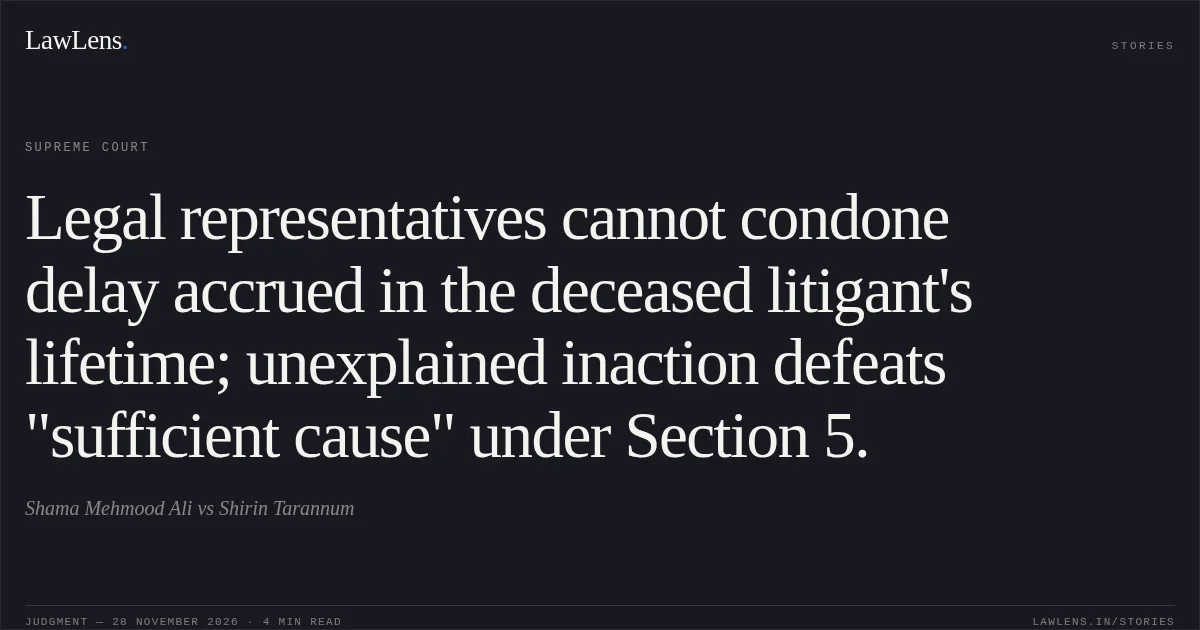
Section 5 of the Limitation Act, 1963 permits condonation of delay only upon "sufficient cause," and the discretion is judicial and reviewable where condonation falls outside Section 5.
¶ 13, 20The burden of establishing sufficient cause lies on the applicant; the length of delay is not by itself decisive; and the applicant must account for the complete period of default, though not every day with pedantic precision.
¶ 14Legal representatives take the proceedings as they find them and succeed to no higher right than their predecessor, so their ignorance cannot explain delay that accrued in the predecessor's lifetime.
¶ 18Indulgence repeatedly extended does not ripen into entitlement, and the law of limitation secures repose once a valuable right accrues to the decree-holder.
¶ 19Article 136 of the Constitution frames the Court's ordinarily restrained interference with condonation orders.
¶ 13The appellants relied on Majji Sannemma v. Reddy Sridevi, (2021) 18 SCC 384, for the proposition that unexplained delay is not condonable.
¶ 10Provisions in the judgment · 3 · Linked ones open on LawLens
Code of Civil Procedure, 1908 Section 96Section 100
Limitation Act, 1963 Section 5
04Reasoning
From the grant of liberty on 17.07.2018 to the onset of the pandemic on 15.03.2020 (about 20 months), the only explanation was the deceased's preoccupation with the community hall. This was no explanation under Section 5, since he was a lecturer discharging his duties throughout and had personally prosecuted the writ petition that gave him the liberty.
¶ 15The pandemic period was supported only by a general reference to COVID-19 and medical records from May 2021 onward, so the High Court's reliance on it did not cover the pre-pandemic inaction.
¶ 16The period from March 2022 to August 2022 was covered only by an assertion that the legal representatives learnt of the case about a month before filing.
¶ 16Because the delay was complete during the predecessor's lifetime, the legal representatives' ignorance could at most explain the roughly eleven months following his death on 29.09.2021, and could not relate back.
¶ 18The Court weighed the consistent pattern of inaction: the belated first appeal, the unused 2016 indulgence, the two-year writ, the four-year lapse after liberty, and the default dismissal of the second appeal.
¶ 19Given the unexplained segments, the Court found the High Court's exercise of discretion unsupported by sufficient cause.
¶ 16, 2005Holding
The explanation tendered did not disclose sufficient cause for the 1568-day delay, and the High Court erred in condoning it.
¶ 16, 19–20The appeal was allowed. The High Court's order dated 24.02.2025 was set aside, and Civil Application (S) No. 765 of 2023 was rejected. Consequently, Second Appeal (ST) No. 16593 of 2022 stands dismissed as barred by limitation.
¶ 21The Rs. 20,000 deposited with the Bar Association, Tirora, is to be refunded to respondents 1–3 within two weeks on application.
¶ 22The Registry was directed to transmit the judgment to the High Court and the Bar Association, and there was no order as to costs.
¶ 23–24Original Court PDF
Shama Mehmood AlivsShirin Tarannum
Click to open original judgment
Original judgment, available to read, download and summarize on LawLens.in