01Facts
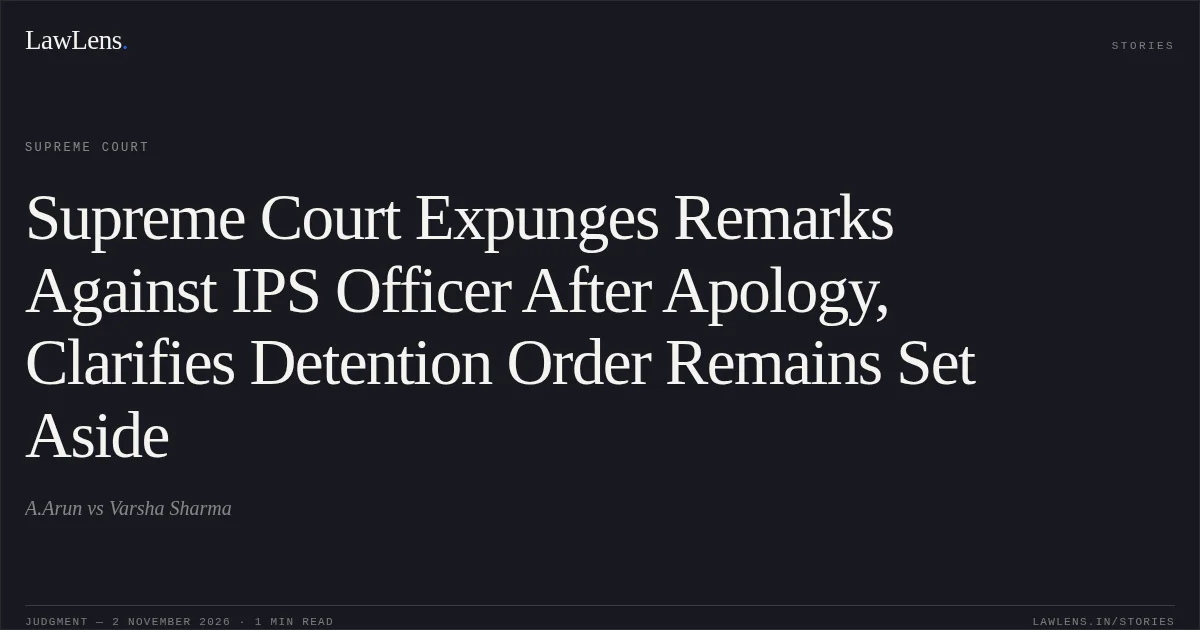
The appellant, then Commissioner of Police, Greater Chennai, issued a detention order under Section 3(1) of the Tamil Nadu Prevention of Dangerous Activities Act, 1982, classifying the first respondent’s father as a “Goonda”.
¶ 3 · ¶ 3.5The High Court set aside the detention order and made adverse remarks about the appellant. The appellant appealed to the Supreme Court seeking expunction of those remarks. He tendered an unconditional apology and undertook to exercise greater care in future.
¶ 3.6 · ¶ 4 · ¶ 6–702Issues
i.1. Whether the adverse remarks made against the appellant in the High Court’s judgment should be expunged in light of his unconditional apology and assurance.
¶ 4, 6–10ii.2. Whether expunction of those remarks should affect the High Court’s decision setting aside the detention order.
¶ 1103Law Applied
Under Section 3(1) of the Tamil Nadu Prevention of Dangerous Activities Act, 1982, detention power is a statutory power that must be exercised with utmost circumspection and in strict conformity with law, particularly because it directly affects personal liberty.
¶ 8An apology cannot substitute for due care in exercising powers affecting liberty.
¶ 9Provisions in the judgment · 5 · Linked ones open on LawLens
Indian Penal Code, 1860 Section 409Section 420Section 465Section 468Section 471
04Reasoning
The Court considered the appellant’s unconditional apology, his regret for failing to acknowledge his error before the High Court, and his assurance of greater care in future.
¶ 7–8Taking these matters and the circumstances of the case into account, it accepted the apology and directed expunction of the specified adverse remarks, while cautioning that an apology does not replace the duty to exercise statutory powers carefully. The Court separately clarified that expunction would not disturb the High Court’s decision to set aside the detention order.
¶ 9–1105Holding
The appeal was disposed of by accepting the appellant’s apology and directing that the adverse remarks in paragraphs 6, 8, 10 and 19–23 of the High Court judgment be expunged.
¶ 10The High Court’s decision setting aside the detention order remained unaffected.
¶ 11Original Court PDF
A.ArunvsVarsha Sharma
Click to open original judgment
Original judgment, available to read, download and summarize on LawLens.in