01Facts
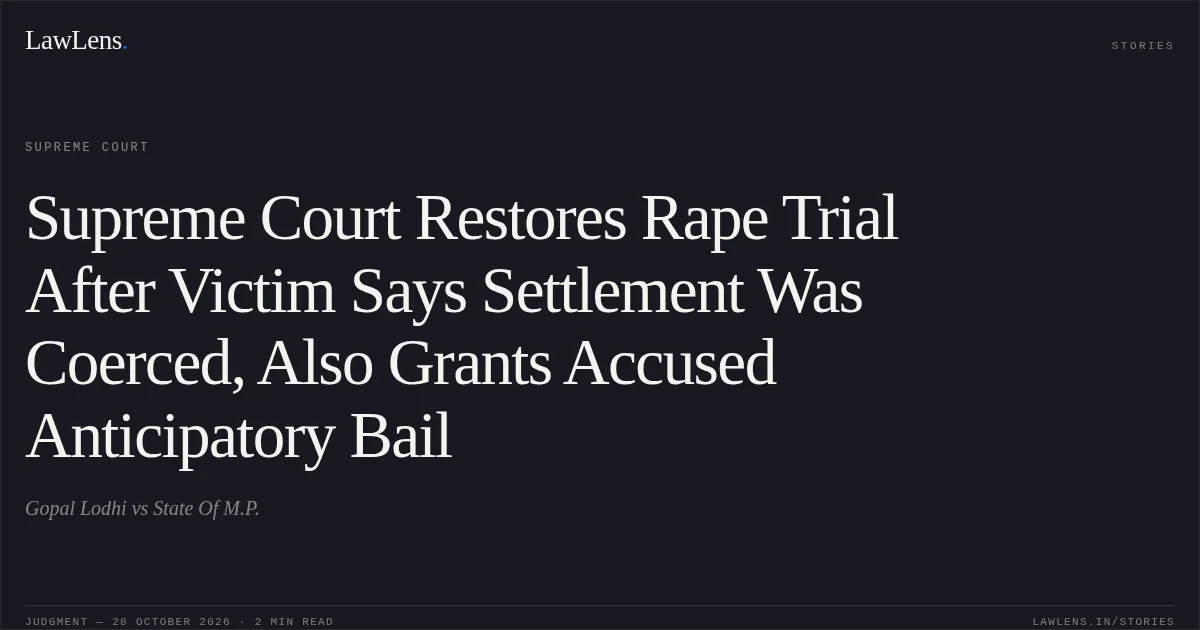
The petitioner sought anticipatory bail in a case alleging offences under Sections 64(1), 331(2) and 351(3) of the Bharatiya Nyaya Sanhita, 2023, and Sections 3(1)(w)(i), 3(1)(w)(ii) and 3(2)(v) of the Scheduled Castes and Scheduled Tribes (Prevention of Atrocities) Act, 1989.
p. 1During the proceedings, the Supreme Court was informed that the parties had settled and that the High Court had quashed the complaint under its inherent jurisdiction on that basis.
p. 1, 5The Supreme Court called for the High Court records and facilitated an interaction with the victim, who stated that she had been coerced into the settlement, was not willing to settle, and had made her complaint truthfully.
pp. 5–602Issues
i.Whether the High Court could quash a case alleging rape, solely on the basis of a compromise, without examining whether the exercise of inherent jurisdiction was justified.
pp. 1, 4–5ii.Whether the petitioner was entitled to anticipatory bail in the circumstances of the case.
pp. 1, 6–703Law Applied
The Court considered the inherent power to quash criminal proceedings under Section 482 of the Code of Criminal Procedure, 1973, and its successor, Section 528 of the Bharatiya Nagarik Suraksha Sanhita, 2023 (the judgment refers to Section 528 as “BNS” in one passage), as distinct from the statutory power to compound offences under Section 320 CrPC.
pp. 1, 3–4Under Gian Singh v. State of Punjab, Narinder Singh v. State of Punjab and the other authorities discussed, inherent power may be used to secure the ends of justice in appropriate cases, but serious and heinous offences—such as rape—cannot ordinarily be quashed merely because the parties have reached a compromise.
pp. 2–4The Court also distinguished cases turning on private disputes or allegations which, on their face, disclosed a consensual relationship, including Shambhu Kharwar v. State of U.P.
p. 2, 4Provisions in the judgment · 16 · Linked ones open on LawLens
Bharatiya Nyaya Sanhita, 2023 Section 64Section 331Section 351Section 528
Scheduled Castes and the Scheduled Tribes (Prevention of Atrocities) Act, 1989 Section 3
Indian Penal Code, 1860 9 provisions
Section 379Section 406Section 409Section 418Section 506Section 34Section 307Section 324Section 323Code of Criminal Procedure, 1973 Section 482Section 320
04Reasoning
The High Court had relied on compromise and authorities concerning private, commercial or otherwise distinct factual contexts, but the Supreme Court was not satisfied that those authorities justified quashing a rape case on settlement alone.
pp. 1–5Its interaction with the victim reinforced the need for caution: she stated that she had been coerced into settling and maintained that her complaint was truthful.
p. 6The Court therefore held that the High Court’s order could not stand; it left the truth of the allegations to be determined at trial and cautioned against both settlements motivated by coercion and false accusations allegedly made in expectation of financial settlement.
p. 6Separately, although the Court set aside the order in the petitioner’s criminal appeal, it directed that he be released on anticipatory bail subject to the Trial Court’s conditions and required his cooperation with the investigation.
pp. 6–705Holding
The Supreme Court set aside the High Court’s order quashing the complaint in Misc. Criminal Case No. 15763 of 2026 and directed that the trial proceed.
p. 6It also set aside the order in Criminal Appeal No. 2110 of 2026 and granted the petitioner anticipatory bail on the conditions imposed by the Trial Court, directing him to cooperate with the investigation and appear when summoned.
pp. 6–7The special leave petition was disposed of.
p. 7Original Court PDF
Gopal LodhivsState Of M.P.
Click to open original judgment
Original judgment, available to read, download and summarize on LawLens.in