Facts
The first respondent/plaintiff instituted O.S. No. 4403 of 2007 seeking specific performance based on an unregistered sale deed dated 25 February 1996, declarations that subsequent sale deeds in favour of the petitioner/second defendant and the third defendant were null and void, and consequential injunction.
Source reference: p.2, para.2The petitioner claimed that the first defendant had mortgaged the property in its favour in 1994 and subsequently sold the property to it by sale deed dated 31 May 2003; the petitioner later conveyed it to the third defendant.
Source reference: p.3–4, para.4The petitioner earlier sought rejection of the unregistered sale deed under Order XIII Rule 3 CPC, but the application was dismissed; in CRP No. 4477 of 2010, the High Court directed the trial court to consider Sections 17, 35 and 49 of the Registration Act and the applicable stamp-law requirements when the document was marked.
Source reference: p.2–3, para.3The document was thereafter marked as Ex.A1, and the plaintiff’s evidence was closed when she did not appear for cross-examination.
Source reference: p.8, para.11The petitioner then filed I.A. No. 1 of 2022 under Order VII Rule 11 CPC, contending that the plaint was barred by limitation and that the unregistered and allegedly insufficiently stamped sale deed could not be relied upon.
Source reference: p.4, para.4The trial court dismissed the application, holding that the admissibility, proof and relevancy of Ex.A1 could be evaluated while deciding the suit and that limitation was not conclusively established from the pleadings.
Source reference: p.5, para.6Issues
1. Whether the plaint was liable to be rejected under Order VII Rule 11(a) CPC for failure to disclose a cause of action, particularly because the plaintiff relied on an unregistered and allegedly insufficiently stamped sale deed.
Source reference: p.9–10, paras.14–152. Whether the suit was barred by limitation under Order VII Rule 11(d) CPC, having regard to the subsequent sale deed dated 31 May 2003 and the plaintiff’s pleaded date of knowledge in 2006.
Source reference: p.10–12, paras.16–183. Whether the objections relating to the admissibility of Ex.A1 under the Registration Act and the Stamp Act could be determined at the threshold in an application for rejection of plaint.
Source reference: p.5–8, paras.6–11Law Applied
Order VII Rule 11(a) CPC permits rejection of a plaint only where it does not disclose a cause of action, while Rule 11(d) applies only where the suit appears from the statements in the plaint itself to be barred by law.
Source reference: p.9–10, para.14At the Order VII Rule 11 stage, the plaint averments must be taken at face value and disputed factual matters ordinarily cannot be adjudicated.
Source reference: no citationThe Court considered Sections 17 and 49 of the Registration Act concerning compulsory registration and the effect of non-registration, and Section 35 of the Stamp Act concerning the evidentiary use of an insufficiently stamped instrument.
Source reference: p.3, para.3; p.6–7, para.7It also considered Avinash Kumar Chauhan v. Vijay Krishna Mishra, (2009) 3 MLJ 409 (SC), on the requirement to address stamp admissibility before admitting a document in evidence.
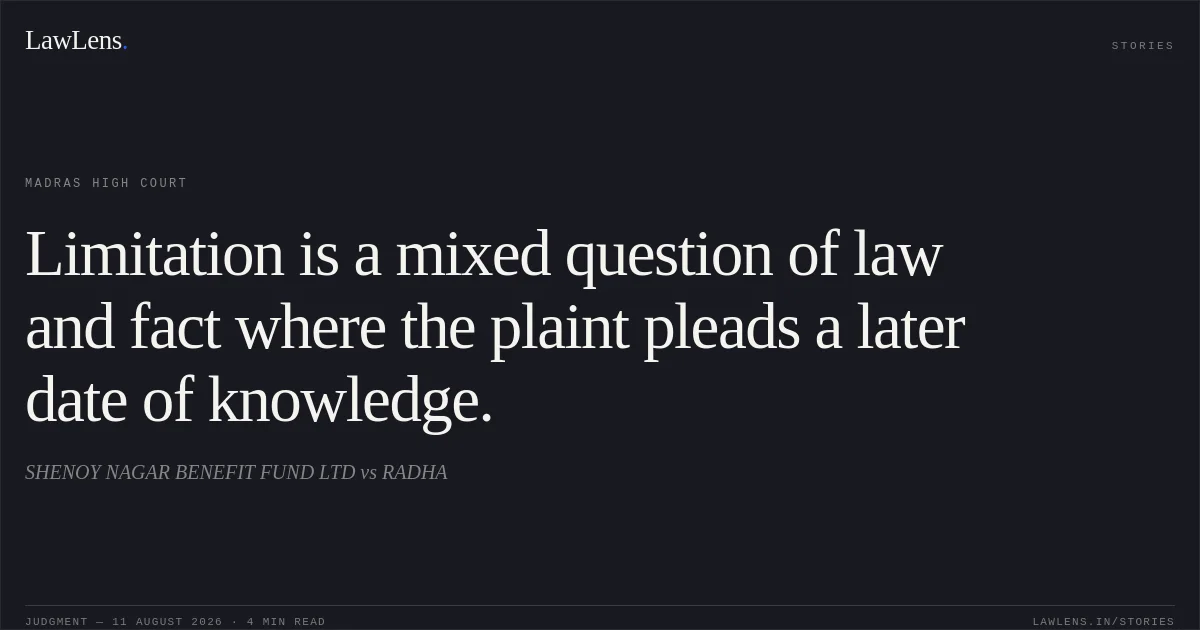
Source reference: p.3, para.3Relying particularly on P. Kumarakurubaran v. P. Narayanan, 2025 INSC 598, the Court held that where the plaintiff pleads a specific date of knowledge and the credibility of that plea requires evidence, limitation becomes a mixed question of law and fact and cannot ordinarily be decided under Order VII Rule 11 CPC.
Source reference: p.11–12, paras.17–18Reasoning
The plaint expressly pleaded the 1996 transaction, the subsequent alienations, the plaintiff’s possession, and her alleged discovery of the later transactions only in 2006, thereby disclosing a cause of action; consequently, rejection under Order VII Rule 11(a) was unavailable.
Source reference: p.10, para.15Although the petitioner argued that the declaration concerning the 2003 sale deed was filed beyond the three-year limitation period, the plaintiff’s pleaded date of knowledge and the petitioner’s own written statement acknowledging that the plaintiff allegedly became aware of the transactions only in 2006 created a factual dispute requiring evidence.
Source reference: p.10–12, paras.16–18The Court further held that the objections concerning the registration, stamping, admissibility, proof and relevancy of Ex.A1 were matters for consideration in the course of evaluating the evidence and could not, on the facts presented, justify rejection of the entire plaint at the threshold.
Source reference: p.5–8, paras.6, 8–11The earlier order in CRP No. 4477 of 2010 also contemplated that objections would be raised when the document was tendered and that the trial court would apply the relevant registration and stamp-law provisions at that stage.
Source reference: p.2–3, para.3Holding
The High Court dismissed the Civil Revision Petition, holding that the plaint disclosed a cause of action and that limitation could not be conclusively determined under Order VII Rule 11 because it depended on the disputed issue of the plaintiff’s date of knowledge.
The Court did not reject the plaint or finally determine the admissibility and evidentiary value of Ex.A1; those questions were left to the trial court while deciding the suit in accordance with the applicable provisions of the Registration Act, the Stamp Act and relevant precedents.
Source reference: p.5–8, paras.6, 11The connected miscellaneous petition was also dismissed, without costs, and the trial court was requested to dispose of the suit expeditiously, considering that it had been instituted in 2007.
Source reference: p.12, para.19Acts & Sections Cited
5 provisions across 3 statutes referred to in this judgment. Each provision opens on LawLens.
Registration Act, 19083
Indian Stamp Act, 18991
Limitation Act, 19631
Original Court PDF
SHENOY NAGAR BENEFIT FUND LTDvsRADHA
Click to open original judgment
Original judgment, available to read, download and summarize on LawLens.in