Facts
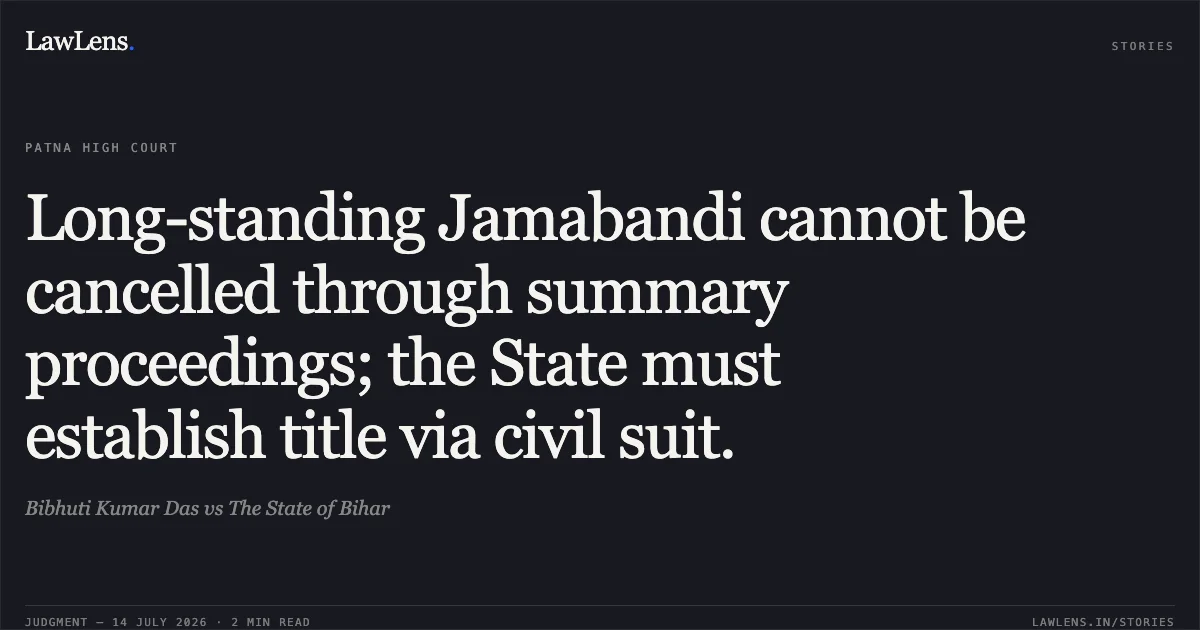
The petitioners challenged orders passed by the Additional Collector, Darbhanga, which cancelled long-standing Jamabandis (land revenue records) held by the petitioners or their predecessors.
Source reference: para. 2, 5, 13The revenue authorities initiated these proceedings based on a report from the Circle Officer suggesting the land was public land (pond/tank) and that the original records were created without competent orders.
Source reference: para. 2, 5, 13Crucially, the authorities initiated and concluded cancellation proceedings against individuals who were already deceased at the time of the inquiry.
Source reference: para. 3, 4, 12The petitioners contended that the land was recorded as cultivable (Dhanhar) in the Cadastral Survey, rather than a water body, and had been in their possession for over 90 years.
Source reference: para. 17, 21Issues
1. Whether the revenue authorities have the jurisdiction to cancel a long-standing Jamabandi through summary proceedings.
Source reference: para. 222. Whether an order for cancellation of Jamabandi passed against a deceased person is legally sustainable.
Source reference: para. 12, 183. Whether the State must seek relief in a Civil Court to dispute a settled title rather than resorting to administrative cancellation.
Source reference: para. 23, 28Law Applied
The court applied Section 9 of the Bihar Land Mutation Act, 2011, regarding the cancellation of Jamabandi.
Source reference: para. 12It heavily relied on established judicial precedents, specifically Maya Devi & Ors. v. The State of Bihar (2014) and State of Bihar v. Harendra Nath Tiwary (2015), which dictate that long-standing Jamabandis cannot be cancelled in summary proceedings.
Source reference: para. 23, 24The court applied the principle from Nathuni Singh v. The State of Bihar, holding that the State must file a Title Suit in a Civil Court if it intends to challenge a decades-old revenue entry.
Source reference: para. 25Reasoning
The court reasoned that the revenue authorities acted beyond their jurisdiction by summarily overturning land records that had stood for nearly a century (since 1927).
Source reference: para. 20, 21It observed a factual discrepancy where authorities relied on map depictions of a "pond" while ignoring the official Khatiyan entries describing the land as Dhanhar (cultivable).
Source reference: para. 20, 21The court found a procedural nullity: the proceedings were initiated against dead persons without substituting their legal heirs, which violates the fundamental principles of natural justice and renders the resulting orders void.
Source reference: para. 4, 12, 26The court emphasized that administrative summary powers are not a substitute for a full trial in a Civil Court when title is at stake.
Source reference: para. 25Holding
The cancellation of a 90-year-old Jamabandi in a summary proceeding is illegal, especially when passed against deceased persons.
The Court allowed the writ petitions and set aside the impugned orders dated 30.07.2021 and 01.08.2021. The Court granted the State liberty to institute a title suit in a competent Civil Court to adjudicate its claims over the land, provided such a suit is decided on its own merits without prejudice to this judgment.
Source reference: para. 27, 28Acts & Sections Cited
1 provisions across 1 statute referred to in this judgment. Each provision opens on LawLens.
Bihar Land Mutation ACT, 20111
Original Court PDF
Bibhuti Kumar DasvsThe State of Bihar
Click to open original judgment
Original judgment, available to read, download and summarize on LawLens.in