Facts
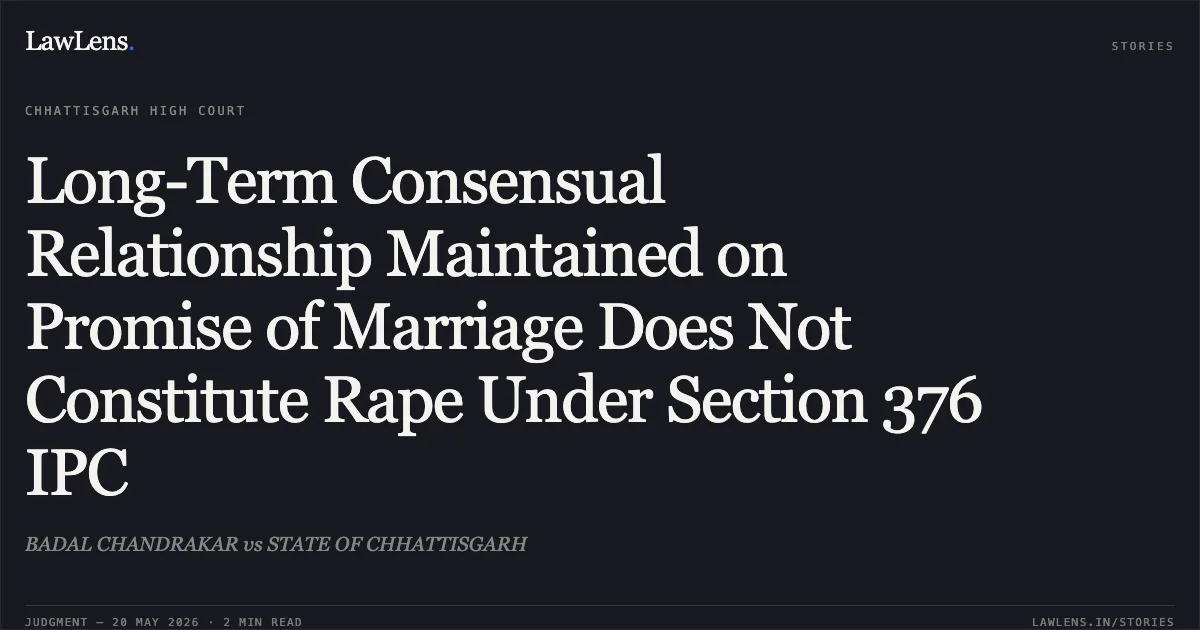
The petitioner sought to quash Session Trial No. 49/2021 and FIR No. 0132/2021 filed under Sections 376(2), 377, 313, 294, 506, and 509B of the IPC, Section 6 of the POCSO Act, and Section 67 of the IT Act.
Source reference: para. 2-3The complainant (respondent No. 3), an educated graduate, alleged that the petitioner engaged in a sexual relationship with her for 12 years (from ages 16 to 28) under a false promise of marriage, recorded obscene videos to threaten her, and forced a termination of pregnancy.
Source reference: para. 3, 6, 8The petitioner contended the relationship was consensual and fueled by mutual affection, noting the lack of medical evidence regarding pregnancy or seized digital evidence regarding IT Act charges.
Source reference: para. 4, 8Issues
1. Whether a long-term sexual relationship maintained under an alleged promise of marriage can be categorized as rape under Section 376 of the IPC when the parties are educated adults and the relationship appears consensual.
Source reference: para. 8-112. Whether the continuation of criminal proceedings constitutes an abuse of the process of law in the absence of corroborative evidence of coercion or deceit.
Source reference: para. 11-12Law Applied
Inherent powers of the High Court to quash proceedings to prevent abuse of process under Section 482 of the CrPC.
Source reference: para. 2A man cannot be held guilty of rape if an educated woman willingly engages in a long-term sexual relationship without evidence of inception-level deceit or "misconception of fact" under Section 90 of the IPC (Principle from Rajnish Singh v. State of Uttar Pradesh (2025)).
Source reference: para. 9Parameters for quashing FIRs where allegations, even if taken at face value, do not prima facie constitute an offence as per State of Haryana v. Bhajan Lal (1992).
Source reference: para. 10Reasoning
The Court observed that the complainant was well-educated and aware of the consequences of her actions throughout the 12-year relationship.
Source reference: para. 8The Court reasoned that the prolonged duration of the relationship (2009–2020) without any prior complaints to authorities or family strongly suggested the physical intimacy was consensual rather than forceful.
Source reference: para. 8The Court noted a critical lack of material evidence, such as medical records for the alleged termination of pregnancy or the obscene videos mentioned in the FIR, to support the charges under Sections 313 IPC or 67 IT Act.
Source reference: para. 8Applying the Samadhan v. State of Maharashtra precedent, the Court found that the relationship fell within the "contours of a voluntary and willing" association, and the subsequent "breach of promise" did not retroactively transform consensual sex into rape.
Source reference: para. 10-11Holding
The Court answered the issues in the affirmative, holding that the relationship was consensual and devoid of coercion or fraud.
The Court ruled that continuing the prosecution would be an abuse of the court machinery and consequently quashed the entire proceedings of Session Trial No. 49/2021, the FIR, the charge sheet, and the charge memo dated 27.06.2022.
Source reference: para. 10, 12-13Acts & Sections Cited
14 provisions across 6 statutes referred to in this judgment. Each provision opens on LawLens.
Code of Criminal Procedure, 19733
Indian Penal Code, 18607
Protection of Children from Sexual Offences Act, 20121
Information Technology Act, 20001
Bharatiya Nagarik Suraksha Sanhita, 20231
Indian Contract Act, 18721
Original Court PDF
BADAL CHANDRAKARvsSTATE OF CHHATTISGARH
Click to open original judgment
Original judgment, available to read, download and summarize on LawLens.in