01Facts
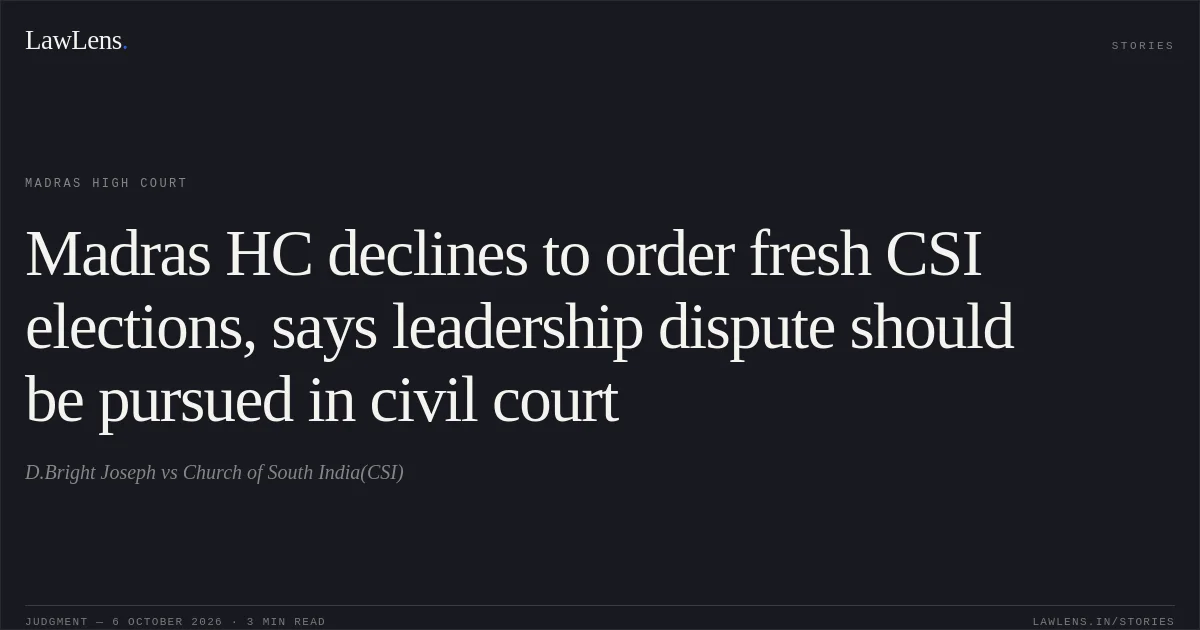
The petitioners challenged the continuation of the Church of South India (CSI) Synod’s office-bearers after the ordinary Synod meeting held on 15 January 2023.
¶ 4, 6The CSI Constitution provides for an ordinary Synod meeting once every three years and states that office-bearers hold office until the close of the next ordinary meeting.
¶ 4, 6The petitioners contended that the office-bearers’ terms had expired in January 2026 and sought, among other reliefs, their removal, appointment of administrators, and directions to convene elections.
The respondents maintained that, owing to proceedings and orders in a pending suit under Section 92 of the Code of Civil Procedure, 1908 (CPC), the relevant Synod session would close only in 2025 and the office-bearers’ terms would extend until the next ordinary meeting in 2028.
¶ 10–11The dispute arose against the background of the pending suit, C.S. No. 7 of 2023, concerning the CSI’s governance and electoral process.
¶ 7–1002Issues
i.Whether the writ petitions were maintainable under Article 226 of the Constitution in relation to the CSI’s Synod governance and the alleged continuation of its office-bearers.
¶ 20–26ii.Whether, even if maintainable, the writ petitions were an appropriate means of resolving the dispute, given the pending civil proceedings and the availability of relief in that forum.
¶ 27–2803Law Applied
Article 226 permits writs against a private body or person performing a public duty; the body’s form is not decisive, and the relevant consideration is the nature of the duty, including any positive obligation owed to the affected party (Andi Mukta Sadguru Shree Muktajee Vandas Swami Suvarna Jayanti Mahotsav Smarak Trust v. V.R. Rudani).
¶ 21The Court also referred to Ajay Hasia v. Khalid Mujib Sehravardi on the principles governing writ jurisdiction.
¶ 20Applying the Full Bench’s decision in W.P. No. 30472 of 2022, the Court recognised that CSI’s administration of educational institutions and hospitals may involve public duties, and that matters affecting the election of the Synod may be reviewable where they bear on those institutions.
¶ 22–23Where the dispute concerns the administration of an alleged public charitable trust, Section 92 CPC provides a civil procedure through which the Court may protect the trust and make appropriate arrangements for its administration.
¶ 27(d)–(e)Provisions in the judgment · 1 · Linked ones open on LawLens
Code of Civil Procedure, 1908 Section 92
04Reasoning
The Court did not determine whether CSI was itself a trust or a juristic person; for the maintainability question, it proceeded on the basis that CSI was a private body and not a juristic person.
¶ 17–19It held W.P. No. 5441 of 2026 not maintainable because the individuals whose office-holding was challenged had not been joined, and CSI itself was not a juristic person.
¶ 25As to W.P. No. 3618 of 2026, although the individuals were parties, the immediate complaint concerned their alleged failure to vacate office, rather than the performance of a public duty or a demonstrated adverse effect on the administration of educational institutions.
¶ 26The Court further held that the dispute arose directly from the pending Section 92 CPC proceedings, and that the petitioners could seek relief in that suit—or bring an appropriate civil suit—where the issues concerning the Synod’s term, office-bearers, and administration could be determined.
¶ 27–2805Holding
The Court dismissed both writ petitions, holding that W.P. No. 5441 of 2026 was not maintainable as framed and that W.P. No. 3618 of 2026 was not an appropriate proceeding for resolving the dispute in light of the pending civil proceedings and available civil remedies.
¶ 25–29It left the petitioners at liberty to pursue appropriate applications in the pending suit or institute civil proceedings, and made no order as to costs.
¶ 29Original Court PDF
D.Bright JosephvsChurch of South India(CSI)
Click to open original judgment
Original judgment, available to read, download and summarize on LawLens.in