01Facts
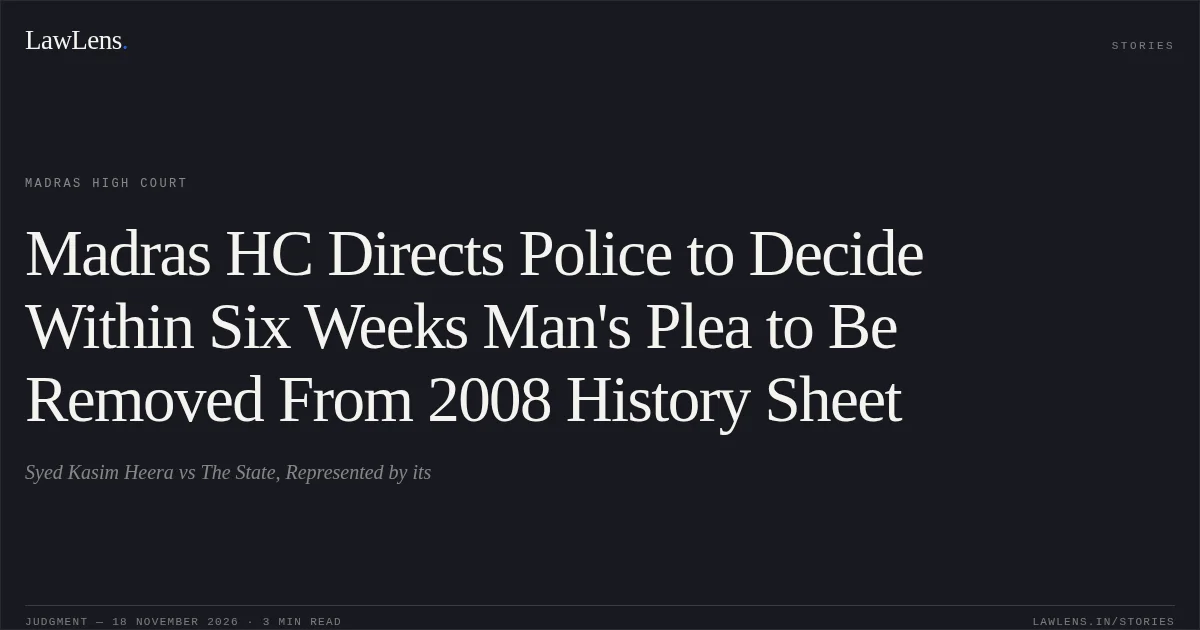
The petitioner was named in History Sheet No. 131 of 2008 maintained by the Inspector of Police, Pettai Police Station, Tirunelveli District.
p. 2 · ¶ 2On 18.09.2026 the petitioner submitted a representation seeking removal of his name from the history sheet.
p. 2 · ¶ 2Because the representation was not considered, the petitioner filed this writ petition for a mandamus.
p. 2 · ¶ 2The Court noted that the same issue had already been decided in W.P.(MD) No. 19651 of 2017 (order dated 26.09.2018).
p. 2 · ¶ 3Following that order, the Director General of Police issued Circular Rc.No. 66569/Crime 3(2)/2019 dated 24.04.2019, which sets out principles governing the opening, review, retention, and closure of history sheets under Police Standing Orders (PSO) Nos. 742, 746, 747, and 748.
p. 2 · ¶ 3 · pp. 2–5The circular stresses that retention beyond the stipulated period requires valid material and reasoned orders, and that history sheeting must be balanced against Article 21.
pp. 4–5, principles (i)–(k)02Issues
i.1. Whether the respondents are bound to consider the petitioner's representation dated 18.09.2026 for removal of his name from History Sheet No. 131 of 2008.
p. 2 · ¶ 2 · p. 6 · ¶ 5ii.2. Whether retention of the petitioner's name in the history sheet beyond the PSO-prescribed period must be supported by valid materials and reasons, in light of the DGP circular and Article 21.
p. 5 · ¶ 4 · pp. 4–5, principles (i)–(j)03Law Applied
The Court relied on the DGP Circular dated 24.04.2019, which was itself framed on the basis of W.P.(MD) No. 19651 of 2017.
p. 2 · ¶ 3Under PSO 746, a history sheet may be opened against a person addicted to crime, whether convicted or not, and that category requires periodic monitoring.
p. 3, principle (c), (e)Under PSO 747, opening is automatic on conviction for listed offences, and the entry may be retained for two years after release.
p. 3, principles (d), (f)Under PSO 748, closure may be ordered by the Superintendent of Police (or Divisional Officer after the PSO 747 period), and retention beyond two years requires orders by an officer of ASP/DSP rank, passed annually on valid materials and recorded reasons.
pp. 3–4, principles (g)–(i)Branding a person as a history sheeter affects the person's reputation and must be balanced against the fundamental right under Article 21 of the Constitution of India.
p. 5, principle (j)In Manivanan v. State (2013) 7 MLJ 501, the Court directed the DGP to issue guidelines on maintenance of history sheets and extension orders.
p. 5, principle (k)04Reasoning
The Court did not examine the merits of the petitioner's retention in History Sheet No. 131 of 2008. Instead, it held that the question had already been settled by the earlier Madurai Bench decision and the DGP circular, and that the matter should be decided under those principles.
p. 2 · ¶ 3 · p. 5 · ¶ 4Because the petitioner's representation had not been considered, the Court found it appropriate to direct a decision on it rather than to decide removal itself.
p. 6 · ¶ 5The direction reflects the requirement in principles (i) and (j) that any continued retention be justified by objective and subjective material and reasons, and not on the "whims and fancies" of the police.
pp. 4–5The Court expressly stated that it would apply these principles to determine whether the police had followed the PSOs and the judgments of the Court in retaining the petitioner's name.
p. 5 · ¶ 4The prayer is addressed to the second respondent, but the operative direction is addressed to the first respondent, the Commissioner of Police.
p. 1 · p. 6 · ¶ 505Holding
The Court directed the first respondent (Commissioner of Police, Tirunelveli District) to consider the petitioner's representation dated 18.09.2026 on merits and in accordance with law, following the principles in the DGP Circular dated 24.04.2019.
p. 6 · ¶ 5The writ petition was disposed of on these terms, with the first respondent directed to pass orders within six weeks from receipt of a copy of the order. No finding was recorded on whether the petitioner should be removed from the history sheet, and the order does not specify the consequences of non-compliance or expressly address the second respondent's role in any further decision.
p. 6 · ¶ 5–6Original Court PDF
Syed Kasim HeeravsThe State, Represented by its
Click to open original judgment
Original judgment, available to read, download and summarize on LawLens.in