01Facts
The petitioner, a practising advocate enrolled on 06.10.2010 with about 15 years' practice, has 60% permanent impairment of the right lower limb and is a "person with benchmark disability" under Section 2(r) of the RPwD Act, 2016
¶ 2 · pp. 1–2He applied for appointment as a Central Government Notary, was interviewed in 2018 without selection, reapplied in 2021, and was interviewed by video conference on 03.02.2026
¶ 2 · p. 2On 20.03.2026 he was informed that he was not recommended for appointment
¶ 2 · p. 2He then made a representation dated 23.03.2026 under Rule 8(3) of the Notaries Rules, 1956, relying on his benchmark disability
¶ 2 · pp. 2–3No response was received, so he filed W.P. No. 23046 of 2026. On 19.06.2026 the Court directed the second respondent to dispose of the representation
¶ 2 · p. 3The first respondent then passed the impugned order dated 17.09.2026, received by the petitioner on 28.09.2026
¶ 2 · p. 3The petitioner challenged it under Article 226 as illegal, arbitrary, non-speaking and violative of natural justice
Prayer · ¶ 202Issues
i.1. Whether the impugned order dated 17.09.2026, which rejects the petitioner's application for appointment as a Notary without clearly setting out reasons, is a valid speaking order and can be sustained
¶ 4, 5, 7 · pp. 3–4ii.2. Whether the appropriate relief is quashing and remand for a fresh, reasoned decision after a personal hearing, rather than a determination of the merits of the petitioner's claim
¶ 7, 8 · pp. 4–503Law Applied
The principle that judicial and quasi-judicial orders must contain reasons, and that an authority must record reasons when a decision adversely affects an individual's rights
¶ 5 · p. 4Kranti Associates Pvt. Ltd. v. Masood Ahmed Khan, (2010) 9 SCC 496, which holds that an order of a quasi-judicial or administrative authority affecting a party's rights must be a speaking order reflecting the reasons for the decision, and which summarises the governing principles at para. 47
¶ 6 · p. 4Rule 3 of the Notaries Rules, 1956, under which benchmark-disabled persons are eligible if they have practised for at least seven years as on the date of application; that eligibility does not confer an automatic right to appointment
¶ 4 · pp. 3–4The statutory definition of "person with benchmark disability" under Section 2(r) of the RPwD Act, 2016
¶ 2 · p. 1Rule 8(3) of the Notaries Rules, 1956, under which the representation was made
¶ 2 · p. 2Provisions in the judgment · 1 · Linked ones open on LawLens
Rights of Persons with Disabilities Act, 2016. Section 2
04Reasoning
The Court examined the impugned order and found that it did not give the reasons for rejecting the application
¶ 4 · p. 3Its only substantive statements were that the petitioner's disability was not a ground of rejection, that Rule 3 makes benchmark-disabled persons eligible subject to seven years' practice, and that eligibility does not create an automatic right to appointment
¶ 4 · pp. 3–4Those observations did not explain why the petitioner, who met the Rule 3 threshold, was not recommended. Applying Kranti Associates, the Court held that a refusal that adversely affects a candidate's rights must show the reasons for it
¶ 5–6 · p. 4Because the order was unclear and non-speaking, it could not be sustained
¶ 7 · p. 4The Court did not decide whether the petitioner should have been selected. It limited its scrutiny to the absence of reasons and therefore left the substantive merits to the authority
¶ 7–8 · pp. 4–5The remedy of remand with a personal hearing was chosen so that the respondent could give the petitioner an opportunity to present his case and then state reasons in any rejection
¶ 8 · p. 505Holding
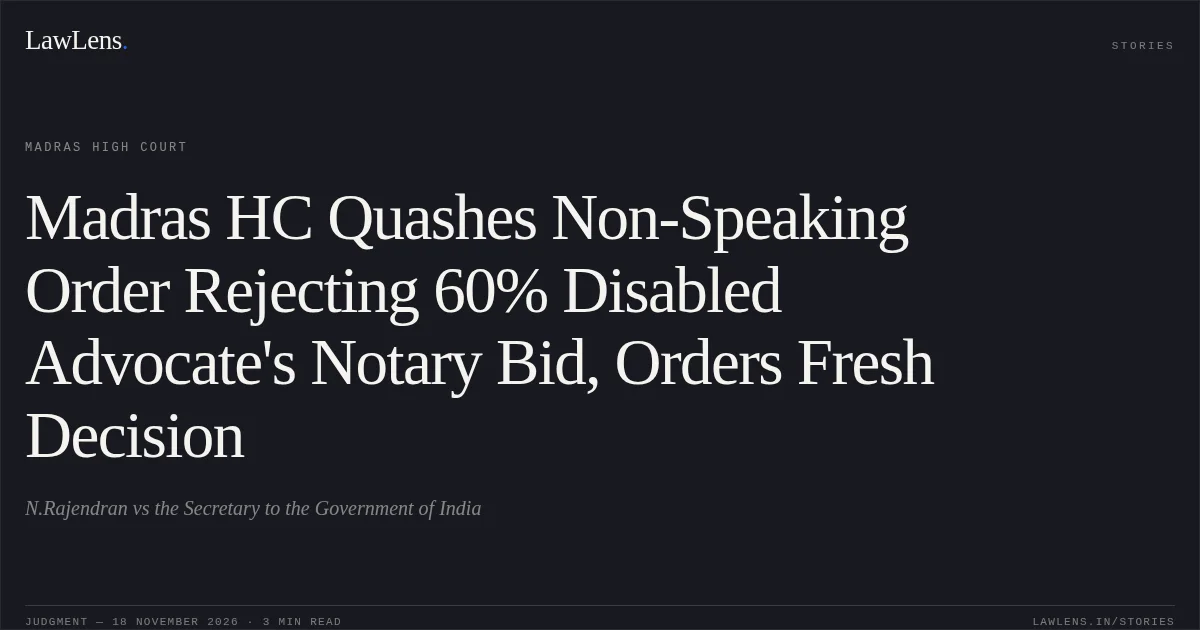
The impugned order dated 17.09.2026 is non-speaking and does not record reasons for rejecting the petitioner's application, and is therefore liable to be quashed
¶ 7 · p. 4The order is quashed and the matter is remitted to the first respondent for fresh consideration. The first respondent must afford the petitioner a personal hearing and then pass a reasoned, speaking order. If the application is rejected, the order must clearly assign reasons, and the exercise must be completed within one month from receipt of the order. No costs were awarded
¶ 8 · p. 5Original Court PDF
N.Rajendranvsthe Secretary to the Government of India
Click to open original judgment
Original judgment, available to read, download and summarize on LawLens.in