01Facts
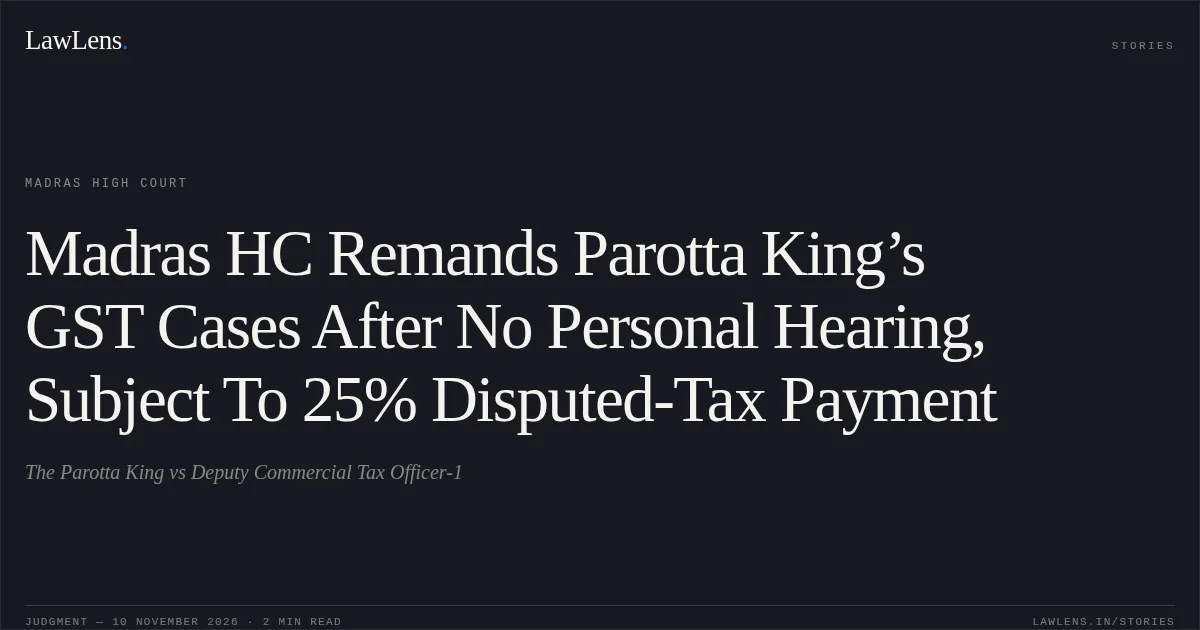
The Parotta King challenged two assessment orders under Section 73 of the Tamil Nadu Goods and Services Tax Act, 2017, dated 13 February 2025 and 15 December 2025.
p. 1 · p. 3 · ¶ 1The petitioner said the notices and communications had been uploaded under “View Additional Notices and Orders” on the GST portal, and that it had not become aware of them in time to respond.
p. 3 · ¶ 3It alleged that the orders were made without a personal hearing and offered to pay 25% of the disputed tax for each assessment.
pp. 3–4 · ¶ 3–4The respondent stated that notices had also been sent by RPAD, but acknowledged that no personal hearing had been provided before the orders were passed.
p. 4 · ¶ 502Issues
i.Whether the assessment orders should be set aside and the matters remanded where the petitioner claimed it had not become aware of portal notices and no personal hearing was provided
pp. 4–5 · ¶ 7–9ii.Whether remand should be conditional on payment of 25% of the disputed tax for each assessment
pp. 5–6 · ¶ 1003Law Applied
Section 169 of the GST Act recognises prescribed modes of service, including service through the GST portal and other modes such as RPAD; the Court held that where a taxpayer does not respond to portal notices, the officer should consider other available modes, preferably RPAD, to make service effective.
pp. 4–5 · ¶ 8–9Section 73 provides for determination of tax not paid or short-paid, while the Court’s exercise of jurisdiction under Article 226 enabled it to set aside the orders and remit the matters for reconsideration.
Provisions in the judgment · 1 · Linked ones open on LawLens
Central Goods and Services Tax Act, 2017 Section 169
04Reasoning
Although portal service was legally sufficient, the Court considered that the petitioner claimed not to have known of the notices and that the respondent had admittedly provided no personal hearing before making the orders.
pp. 4–5 · ¶ 5, 7–8It emphasised that, where portal notices receive no response, the officer should explore other statutory modes of service rather than rely on formal compliance alone.
p. 5 · ¶ 8–9In light of the resulting procedural concern and the petitioner’s offer to pay 25% of the disputed tax, the Court found remand appropriate on that condition.
pp. 5–6 · ¶ 1005Holding
The Court set aside both assessment orders and remanded the matters for fresh consideration, conditional on the petitioner paying 25% of the disputed tax for each order within four weeks of receiving the judgment; any amount already recovered or deposited could be adjusted.
p. 6 · ¶ 10(i)The petitioner was directed to file its reply and supporting documents within three weeks of payment. The respondent must then provide 14 days’ clear notice of a personal hearing and pass fresh orders on the merits and in accordance with law.
p. 6 · ¶ 10(ii)–(iii)The writ petitions were disposed of without costs.
p. 7 · ¶ 11Original Court PDF
The Parotta KingvsDeputy Commercial Tax Officer-1
Click to open original judgment
Original judgment, available to read, download and summarize on LawLens.in