Facts
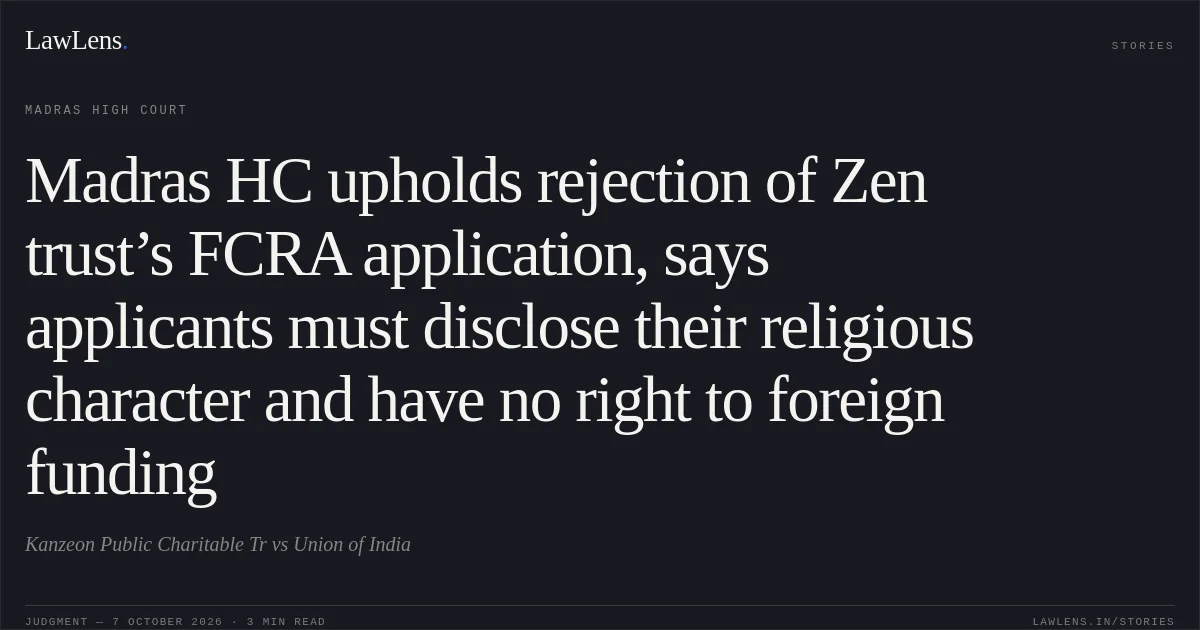
The appellant trust, founded in 2021 and registered under Sections 12AB and 80G of the Income Tax Act, applied for FCRA registration.
Source reference: p.1The judgment records that the application was dated 18 June 2025 and rejected on 19 November 2025, while the appeal’s prayer identifies an impugned order dated 19 January 2025; the judgment does not reconcile these dates.
Source reference: p.1; para. 2, p.2The trust described its activities as Zen meditation and contended that it was not a religious organisation. The Union of India maintained that the trust conducted religious programmes.
Source reference: para. 4, p.4; para. 5, p.5The trust appealed under Section 31(2) of the Foreign Contribution (Regulation) Act, 2010 (“FCRA”).
Source reference: p.1Issues
Whether an applicant has a right to obtain FCRA registration and, if not, what principles govern the authority’s decision on an application.
Source reference: para. 1, p.2; paras. 12, 14, pp.10–11Whether the appellant’s description of itself as non-religious, despite its Zen Buddhist activities, justified rejection of its application.
Source reference: paras. 7–8, pp.6–7; para. 13, p.11Whether an appeal under Section 31(2) of the FCRA should be heard by a Division Bench.
Source reference: para. 3, pp.2–4Law Applied
Section 31(3) of the FCRA treats an appeal under that section as an appeal from an original decree and applies Order XLI of the Code of Civil Procedure, 1908, so far as applicable; the Court accordingly held that this FCRA appeal should be heard by a Division Bench under Rule 2(5) of the Madras High Court Appellate Side Rules, 1965.
Source reference: para. 3, pp.2–4The Court read Rule 9 of the Foreign Contribution (Regulation) Rules, 2011 and Form FC-3A as requiring an applicant to disclose its organisational nature and, where relevant, its religious classification.
Source reference: para. 7, p.6It held that the FCRA confers no right to receive foreign contribution and that the registering authority has considerable discretion, subject to judicial review where its decision is perverse, ignores relevant material, or reflects non-application of mind.
Source reference: paras. 10, 12, pp.9–10; para. 14, p.11Relying on Commissioner, HR&CE v. Shirur Mutt, (1954) 1 SCC 412, the Court reasoned that a religious school or sect falls within the broader religious tradition; it also relied on Noel Harper v. Union of India, (2023) 3 SCC 544, concerning the absence of a vested or absolute right to accept foreign donations, and State represented by CBI v. M. Kurian, (2001) 4 SCC 290, on construing the FCRA in light of its statutory purpose.
Source reference: paras. 7, 10, 13, pp.6, 9, 11The Court further referred to Section 12(4)(a)(ii) concerning conversion from one religious faith to another.
Source reference: para. 10, p.9Reasoning
The Court found that the appellant’s own materials showed an association with Zen Buddhist philosophy and treated Zen as a variant of Mahayana Buddhism. It therefore considered the trust religious, notwithstanding its position that its meditation activities were non-religious.
Source reference: paras. 6–7, pp.5–6Because the Court found that the application had not correctly disclosed the trust’s religious nature, it concluded that the authority was justified in rejecting it.
Source reference: paras. 7–8, pp.6–7; para. 13, p.11The Court also stated that applicants should be classified according to their actual activities, distinguishing educational or cultural dissemination of Indian Knowledge Systems from programmes involving worship and rituals.
Source reference: para. 14, p.11It found no basis to interfere with the rejection under its stated standard of review.
Source reference: paras. 12, 15, pp.10–11Holding
The Court held that applicants must accurately disclose the nature of their organisation, that FCRA registration is not an enforceable right, and that the authority may refuse an application subject to limited judicial review.
It sustained the rejection order and dismissed the appeal without costs.
Source reference: para. 15, p.11Acts & Sections Cited
4 provisions across 2 statutes referred to in this judgment. Each provision opens on LawLens.
Foreign Contribution (Regulation) Act, 20103
Code of Civil Procedure, 19081
Original Court PDF
Kanzeon Public Charitable TrvsUnion of India
Click to open original judgment
Original judgment, available to read, download and summarize on LawLens.in