Facts
The prosecution alleged that the applicant and others misused the educational certificates of one Anamika Shukla to obtain an appointment at Kasturba Gandhi Balika Vidyalaya, leading to an FIR under Sections 419, 420, 467, 468, 471, and 474 of the IPC
Source reference: p.1The applicant moved a discharge application under Section 239 of the CrPC on May 30, 2023
Source reference: p.2The trial court rejected this application on September 26, 2024, stating that the truthfulness of the facts could only be considered after evidence was furnished during the trial
Source reference: p.2The applicant challenged this rejection before the High Court, contending that the trial court failed to apply its judicial mind and rendered the stage of discharge redundant
Source reference: p.2Issues
1. Whether the trial court's order rejecting the discharge application was passed without the application of judicial mind and in violation of the procedure prescribed under Section 239 of the CrPC
Source reference: p.32. Whether the stage of discharge requires a prima facie evaluation of the police report and documents rather than deferring the assessment of facts until the conclusion of trial evidence
Source reference: p.4-5Law Applied
The court primarily applied Section 239 of the CrPC (and its equivalent Section 227 for Sessions cases), which mandates that a Magistrate must consider the police report and documents to determine if a charge is "groundless"
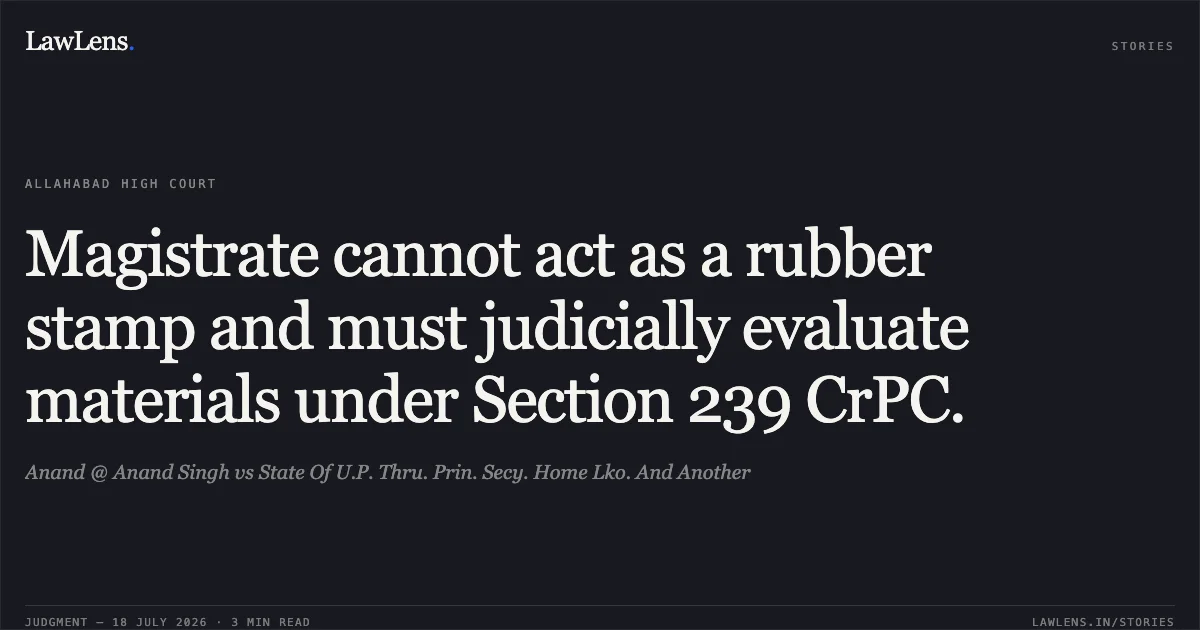
Source reference: p.3The court relied on Union of India v. Prafulla Kumar Samal, establishing that a Judge is not a "mere post office" or "rubber stamp" but must sift evidence to find a prima facie case
Source reference: p.5The court further cited State of Bihar v. Ramesh Singh, holding that while strong suspicion is sufficient for framing charges, the absence of a prima facie case necessitates discharge
Source reference: p.4The court cited Dr. Anand Rai v. State of Madhya Pradesh, emphasizing that discharge is an essential safeguard to prevent the process itself from becoming a punishment
Source reference: p.7Reasoning
The High Court observed that the trial court’s finding—that the truthfulness of facts can only be considered after evidence is furnished—was legally flawed and rendered the discharge stage "redundant"
Source reference: p.2, 8The Court reasoned that Section 239 of the CrPC imposes a duty on the Magistrate to examine the material available in the police report and Section 173 documents specifically to decide whether to proceed with the trial
Source reference: p.3By deferring this evaluation to the end of the trial, the Magistrate failed to distinguish between "suspicion" and "grave suspicion" or "groundlessness" and "material warrants"
Source reference: p.8The High Court found that the impugned order was a non-speaking one that did not evaluate whether the ingredients of the alleged IPC offences were prima facie present in the material provided by the prosecution
Source reference: p.3, 8Holding
The High Court held that the trial court’s order was unsustainable due to non-application of mind and failure to follow the statutory mandate of Section 239 CrPC
The application under Section 482 was allowed at the admission stage. The Court set aside the order dated September 26, 2024, and remitted the matter back to the trial court with directions to pass a fresh order on the discharge application within eight weeks, considering the materials available on record
Source reference: p.8Acts & Sections Cited
10 provisions across 2 statutes referred to in this judgment. Each provision opens on LawLens.
Indian Penal Code, 18606
Code of Criminal Procedure, 19734
Original Court PDF
Anand @ Anand SinghvsState Of U.P. Thru. Prin. Secy. Home Lko. And Another
Click to open original judgment
Original judgment, available to read, download and summarize on LawLens.in