Facts
The petitioner, a Head Constable in the Madhya Pradesh Police, was subjected to a departmental inquiry following a charge-sheet issued on September 9, 2008.
Source reference: p. 2During the inquiry, no Presenting Officer was appointed; instead, the Inquiry Officer (IO) conducted the proceedings and cross-examined both the petitioner and the prosecution witnesses.
Source reference: p. 2, 11Following the inquiry report, the Disciplinary Authority initially imposed a minor penalty—withholding one annual increment with cumulative effect for one year.
Source reference: p. 2The petitioner appealed to the DIG, Gwalior. The DIG issued a show-cause notice for enhancement of punishment but did not provide the petitioner with a personal hearing.
Source reference: p. 2-3On July 30, 2009, the DIG exercised suo motu revision powers to cancel the original order and imposed the major penalty of compulsory retirement.
Source reference: p. 3The petitioner challenged these orders under Article 226 of the Constitution of India.
Source reference: no citationIssues
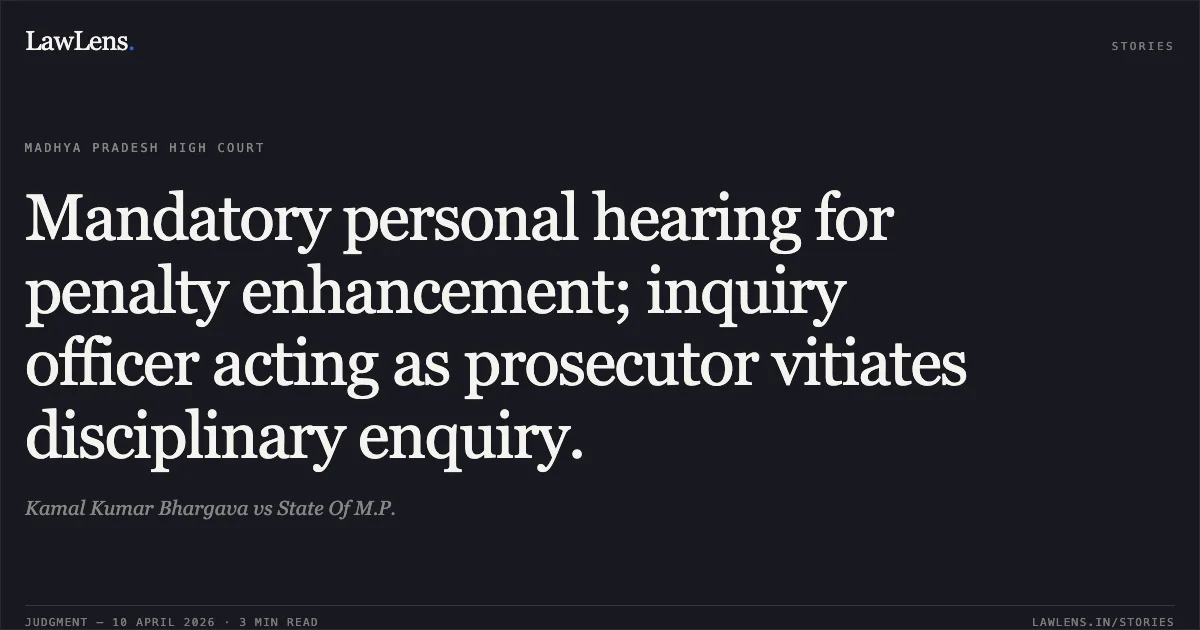
Whether the reviewing or appellate authority is mandatory required to afford a personal hearing to the delinquent employee before enhancing a punishment under Regulation 270 of the M.P. Police Regulations.
Source reference: p. 7, 9Whether a departmental inquiry is vitiated if the Inquiry Officer assumes the role of a prosecutor by cross-examining witnesses and the delinquent employee in the absence of a Presenting Officer.
Source reference: p. 11, 15Law Applied
Regulation 270 of the M.P. Police Regulations, specifically the proviso to Clause 4, which mandates that a revising authority shall not vary or reverse any order unless the interested parties are served notice and given an opportunity to be heard.
Source reference: p. 4, 9The court relied on the Division Bench ruling in Sant Lal v. State of MP (W.A. No. 404/2017), which held that personal hearing is mandatory for enhancing punishment under Regulation 270.
Source reference: p. 4-5the principle from Fazal Bhai Dhala v. The Custodian-General (AIR 1961 SC 1397), establishing that "reasonable opportunity" in revision includes a hearing where the party can appear personally or through counsel.
Source reference: p. 7, 9the doctrine from Union of India v. Ram Lakhan Sharma (2018) 7 SCC 670, which states that an inquiry is vitiated by bias if the Inquiry Officer acts as a prosecutor/Presenting Officer.
Source reference: p. 11-15Reasoning
while a show-cause notice was issued, the DIG failed to provide a personal hearing before converting a minor penalty into the major penalty of compulsory retirement.
Source reference: p. 9, 11This violated the procedural safeguards under Regulation 270(4) and the principles of natural justice as interpreted in Sant Lal.
Source reference: p. 4, 7the Inquiry Officer overstepped his adjudicatory role by cross-examining the petitioner with approximately 22 questions and cross-examining prosecution witnesses in the absence of a Presenting Officer.
Source reference: p. 2, 11when an IO acts as a prosecutor, the independent capacity of the adjudicator is lost, and bias is presumed, thereby vitiating the entire disciplinary proceeding.
Source reference: p. 12-15Holding
The Court answered both issues in the affirmative, holding that the lack of personal hearing and the biased conduct of the Inquiry Officer rendered the proceedings void.
The Court quashed the order of compulsory retirement dated July 30, 2009, and the original punishment order dated April 22, 2009.
Source reference: p. 18The respondents were directed to extend all consequential benefits to the petitioner, including the issuance of a revised PPO (Pension Payment Order) and GPO (Gratuity Payment Order) within three months.
Source reference: p. 18-19As the petitioner had already retired on May 31, 2014, the Court declined to grant the State liberty to initiate fresh proceedings.
Source reference: p. 19Original Court PDF
Kamal Kumar BhargavavsState Of M.P.
Click to open original judgment
Original judgment, available to read, download and summarize on LawLens.in