Facts
The matter originated from a 2017 challenge to a judgment of conviction and death sentence passed by the High Court of Judicature at Patna.
Source reference: para 1During the proceedings, the Supreme Court took suo motu notice of the "inordinate delay" affecting cases involving legal aid.
Source reference: para 1An amicus curiae was appointed to consult with the Supreme Court Legal Services Committee (SCLSC) and the National Legal Services Authority (NALSA) to identify causes of delay.
Source reference: para 1-2The SCLSC reported that delays primarily stemmed from the submission of incomplete documents by applicants, vernacular translation hurdles, and a lack of timely communication between jail authorities, High Court Legal Services Committees (HCLSCs), and panel lawyers.
Source reference: para 3Issues
Whether systemic delays in the translation and transmission of records for legal aid beneficiaries violate the constitutional mandate of access to justice and the right to a speedy trial.
Source reference: para 2, 6Whether a standardized, time-bound protocol is necessary to coordinate stakeholders (Jails, HCLSCs, SCLSC) and digitize the filing process for Special Leave Petitions (SLPs) and appeals.
Source reference: para 8, 10Law Applied
Article 39A of the Constitution, which mandates the State to provide free legal aid to ensure justice is not denied due to economic or other disabilities.
Source reference: para 6Article 21, as established in Hussainara Khatoon v. State of Bihar, which recognizes free legal aid as an essential component of a fair, just, and reasonable procedure.
Source reference: para 7The Court relied on M.H. Hoskot v. State of Maharashtra to affirm that the right to counsel is a fundamental right.
Source reference: para 7The Court referenced Suhas Chakma v. Union of India regarding the systemic necessity of "Prison Legal Aid Clinics" and Standard Operating Procedures (SOPs) for prisoners.
Source reference: para 7Reasoning
The Court observed that despite the availability of information and communication technology, a lack of "even-handedness" persisted in legal aid filings.
Source reference: para 2It analyzed the SCLSC’s "Mission Mode" data and identified that the absence of a structured framework for vernacular translation and record transmission was a primary bottleneck.
Source reference: para 3The Court reasoned that since the proposed 2025 SOP was a product of in-depth deliberations among all "major players," it served as a viable solution to address structural gaps.
Source reference: para 10The Court emphasized that categorizing cases (e.g., Category A1 for death sentences/life imprisonment) is vital for prioritizing severe liberty deprivations.
Source reference: para 8It further noted that poor translation quality necessitated a structural change in how High Courts manage translator cadres and supervisors.
Source reference: para 12-13By mandating a "Delay Explanation" format, the Court aimed to ensure accountability for each day lost in the process from the date of judgment to the date of filing.
Source reference: para 14Holding
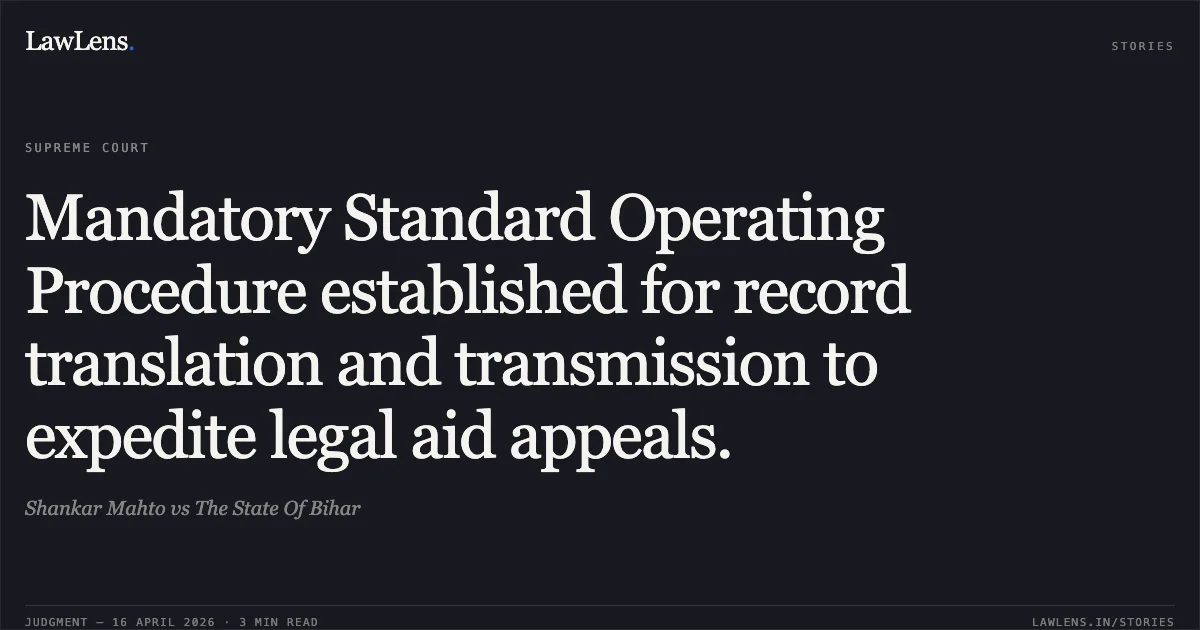
The Court approved and adopted the "Standard Operating Procedure (SOP) for Translation and Transmission of Records for Filing Legal Aid Appeals and SLPs, 2025".
It held that the timelines specified in Heading 5 of the SOP are binding on all Legal Services Committees.
Source reference: para 11High Courts to create/upgrade cadres of Translators and Supervisors within 90 days.
Source reference: para 8 (Clause 6), 12The National Informatics Centre (NIC) to create a unified digital platform for SCLSC, HCLSCs, and Jail Authorities within two months.
Source reference: para 9, 15The Member Secretary, NALSA, to act as the Nodal Officer for periodic reviews.
Source reference: para 9, 15A mandatory "Delay Explanation" format to be incorporated into all legal aid filings within two weeks.
Source reference: para 14The matter is listed for a status report on May 4, 2026.
Source reference: para 16Acts & Sections Cited
1 provisions across 1 statute referred to in this judgment. Each provision opens on LawLens.
Legal Services Authorities Act, 19871
Original Court PDF
Shankar MahtovsThe State Of Bihar
Click to open original judgment
Original judgment, available to read, download and summarize on LawLens.in