Facts
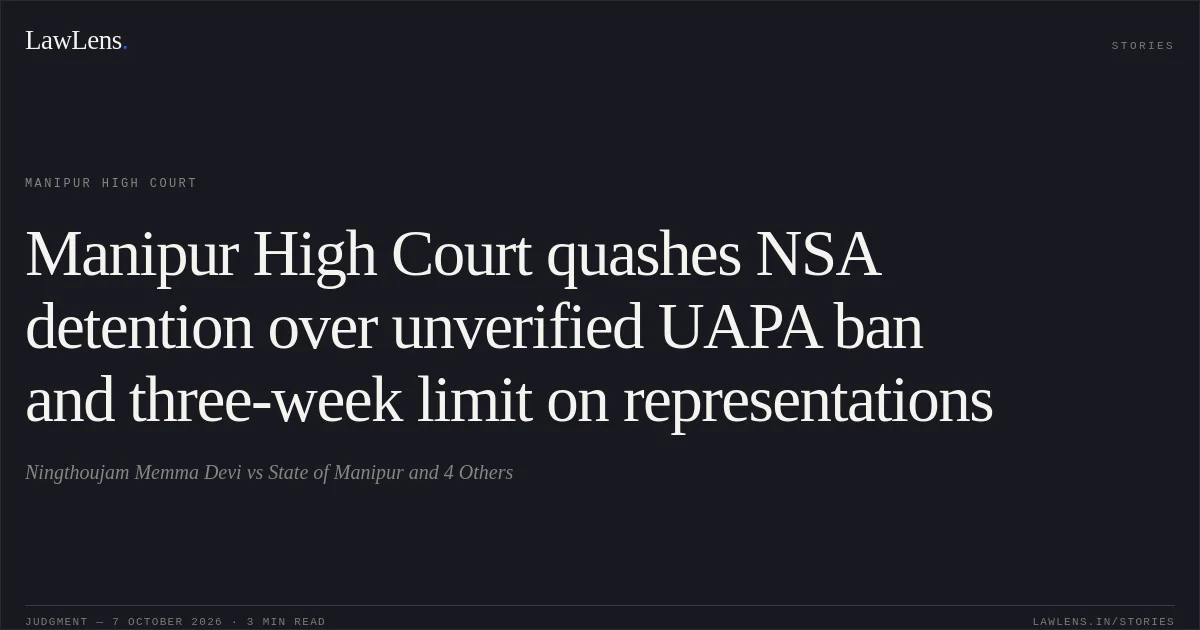
The petitioner challenged the preventive detention of her son under the National Security Act, 1980 (NSA).
Source reference: p. 3–6The detenu had been arrested in February 2026 in connection with criminal proceedings and was served with the detention order and grounds of detention on 6 April 2026.
Source reference: p. 3–6The District Magistrate’s grounds described him as a member of Kangleipak Communist Party (Apunba) (KCP-Apunba), an association declared unlawful by a Central Government notification dated 13 November 2023, and stated that he had joined the association in July 2023.
Source reference: p. 3–6The detenu made representations to the relevant authorities within three weeks, but the detention order prescribed that period as the time for submitting representations.
Source reference: p. 3–6After the criminal court granted him default bail on 28 July 2026, he remained in custody solely under the preventive detention order.
Source reference: p. 3–6The High Court allowed his application to raise additional grounds and considered the detention challenge on the completed pleadings and record.
Source reference: p. 11–13Issues
1. Whether the detaining authority’s failure to verify whether the UAPA Tribunal had confirmed the notification declaring KCP-Apunba unlawful, together with the absence of material that the detenu remained a member after the notification, vitiated the detention order for non-application of mind.
Source reference: p. 7–102. Whether limiting the period for making representations to three weeks from detention infringed the detenu’s right to make an effective representation under Article 22(5) of the Constitution.
Source reference: p. 11–13Law Applied
Article 22(5) of the Constitution protects a detenu’s right to make an effective representation, and that right continues while the preventive detention order remains in force; it is not exhausted by an initial representation or subject to a fixed time limit imposed by the detaining authority.
Source reference: p. 11–13The Court relied on Premlata Sharma v. District Magistrate, Mathura, (1998) 4 SCC 260, and followed its decisions in Mutum Ranjan Meitei @ Lamjingba, Laishram Nilajit Shija and Yambem Manichandra Singh on the impermissibility of such a time cap.
Source reference: p. 11–13Under Sections 3 and 4 of the Unlawful Activities (Prevention) Act, 1967 (UAPA), a declaration that an association is unlawful is subject to Tribunal confirmation; the Tribunal must decide within six months, and its order is to be published in the Official Gazette.
Source reference: p. 7–10Applying Ameena Begum v. State of Telangana, (2023) 9 SCC 587, the Court held that subjective satisfaction in preventive detention is reviewable where, among other grounds, the authority has not applied its mind, applies a wrong legal test, or reaches satisfaction without rationally probative material.
Source reference: p. 8–10Reasoning
The detaining authority relied on the 2023 notification declaring KCP-Apunba unlawful but did not verify whether the UAPA Tribunal had confirmed it, despite the notification being expressly subject to Section 4 and having been issued more than two years before the detention order.
Source reference: p. 7–10The record contained no Tribunal confirmation order.
Source reference: p. 7–10Further, the grounds stated that the detenu joined the association in July 2023, before the notification, and contained no material or assertion that he remained a member after the declaration.
Source reference: p. 7–10The Court therefore found the authority’s satisfaction legally misconceived and unsupported by rationally probative material.
Source reference: p. 7–10The Court also held that the three-week limit impermissibly curtailed the continuing right to make representations.
Source reference: p. 11–13Although the detenu had made initial representations within that period, his additional grounds stated that he wanted to make a further representation but refrained because of the time cap; the Court considered that later developments, including the grant of default bail, could have been raised.
Source reference: p. 11–13Holding
The High Court allowed the writ petition and set aside the detention order dated 6 April 2026, the approval order dated 13 April 2026, and the confirmation order dated 27 April 2026.
It directed that the detenu be released forthwith, unless required in another case, and made no order as to costs.
Source reference: p. 19Acts & Sections Cited
15 provisions across 7 statutes referred to in this judgment. Each provision opens on LawLens.
Explosive Substances Act, 19081
Unlawful Activities (Prevention) Act, 19675
Arms Act, 19591
National Security Act, 19802
Bharatiya Nyaya Sanhita, 20233
Bharatiya Nagarik Suraksha Sanhita, 20232
Code of Criminal Procedure, 19731
Original Court PDF
Ningthoujam Memma DevivsState of Manipur and 4 Others
Click to open original judgment
Original judgment, available to read, download and summarize on LawLens.in