Facts
The testator, Girindra Kishore Pal Choudhury, died on April 29, 2015, leaving a Will dated November 30, 2006
Source reference: para. 5One executor predeceased him, and the sole surviving executor failed to apply for probate. Consequently, the plaintiff (a beneficiary) applied for the grant of Letters of Administration
Source reference: para. 5The caveator (daughter-in-law) challenged the Will, alleging it was a product of fraud and that the testator never intended to execute it
Source reference: para. 6Historically, the Trial Court dismissed the application on April 3, 2025, in TS/26/2018, leading to this appeal
Source reference: para. 1-2Issues
1. Whether the Will was properly executed in terms of law, specifically regarding the requirements of attestation
Source reference: para. 7 (Issue 3)2. Whether the execution of the Will was tainted with suspicious circumstances or fraud
Source reference: para. 7 (Issues 4 & 5)3. Whether Section 71 of the Indian Evidence Act can be invoked to prove a Will when an attesting witness testifies that the testator was not present during signing
Source reference: para. 12-14Law Applied
Section 63 of the Indian Succession Act, 1925, which mandates that a Will must be signed by the testator in the presence of at least two witnesses who must also sign in the testator's presence
Source reference: para. 8Section 68 of the Indian Evidence Act, 1872 requires at least one attesting witness to prove execution
Source reference: para. 9Section 71 allows proof by "other evidence" only if the attesting witness denies or does not recollect execution; however, this does not dispense with the necessity of actual attestation as defined in law
Source reference: para. 11, 14Reasoning
The High Court examined the evidence of the attesting witness, Mr. Rathin, who stated that while he signed the document, he did not see the testator sign it, nor was the testator present when the witness and the advocate signed
Source reference: para. 13The Court determined that this was not a case of "denial" or "lack of recollection" under Section 71, but rather a failure to meet the mandatory attestation requirements of Section 63 of the Succession Act
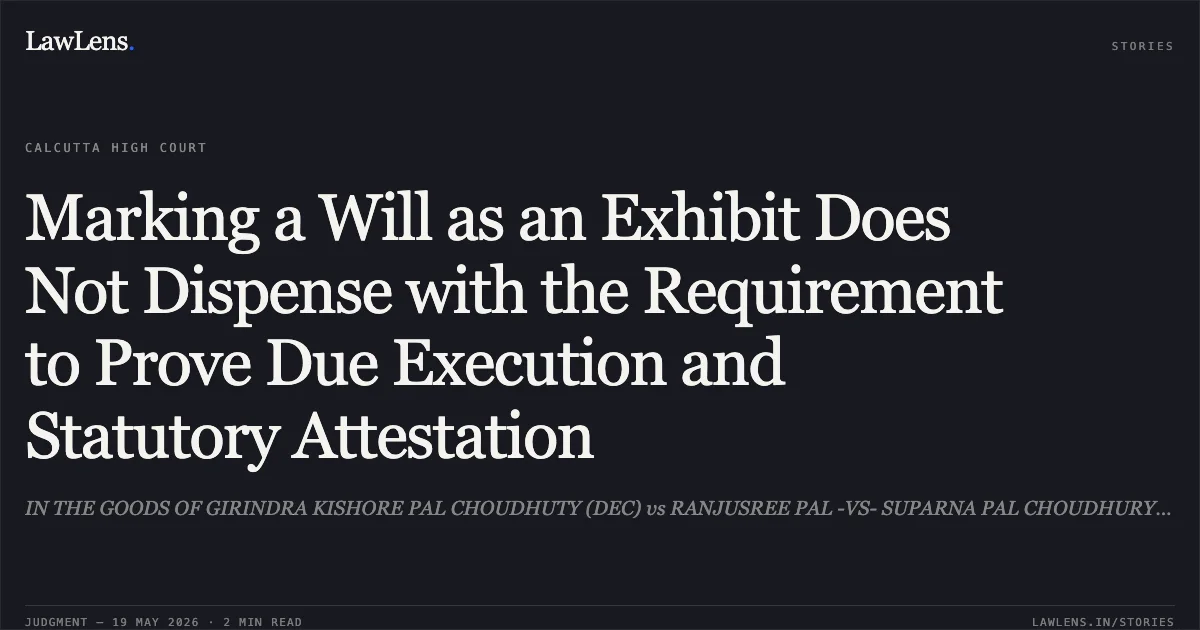
Source reference: para. 14Relying on the distinction between admissibility and proof of due execution, the Court held that marking a Will as an exhibit does not automatically prove it was legally executed
Source reference: para. 17Since the witnesses’ testimony affirmatively showed that the statutory ritual of attestation (signing in each other’s presence) was bypassed, the Will remained unproved
Source reference: para. 14, 18Holding
The Court answered the issues in the negative, holding that the petitioners failed to prove that the Will was duly executed by the testator according to law
The Court affirmed that Section 71 of the Evidence Act cannot validate a Will where the evidence shows the attestation process itself was fundamentally flawed. The appeal (APD/8/2025) was dismissed, and the Trial Court’s judgment refusing the Letters of Administration was upheld
Source reference: para. 14, 19-20Acts & Sections Cited
1 provisions across 1 statute referred to in this judgment. Each provision opens on LawLens.
Indian Succession Act, 19251
Original Court PDF
IN THE GOODS OF GIRINDRA KISHORE PAL CHOUDHUTY (DEC)vsRANJUSREE PAL -VS- SUPARNA PAL CHOUDHURY AND ANR
Click to open original judgment
Original judgment, available to read, download and summarize on LawLens.in