Facts
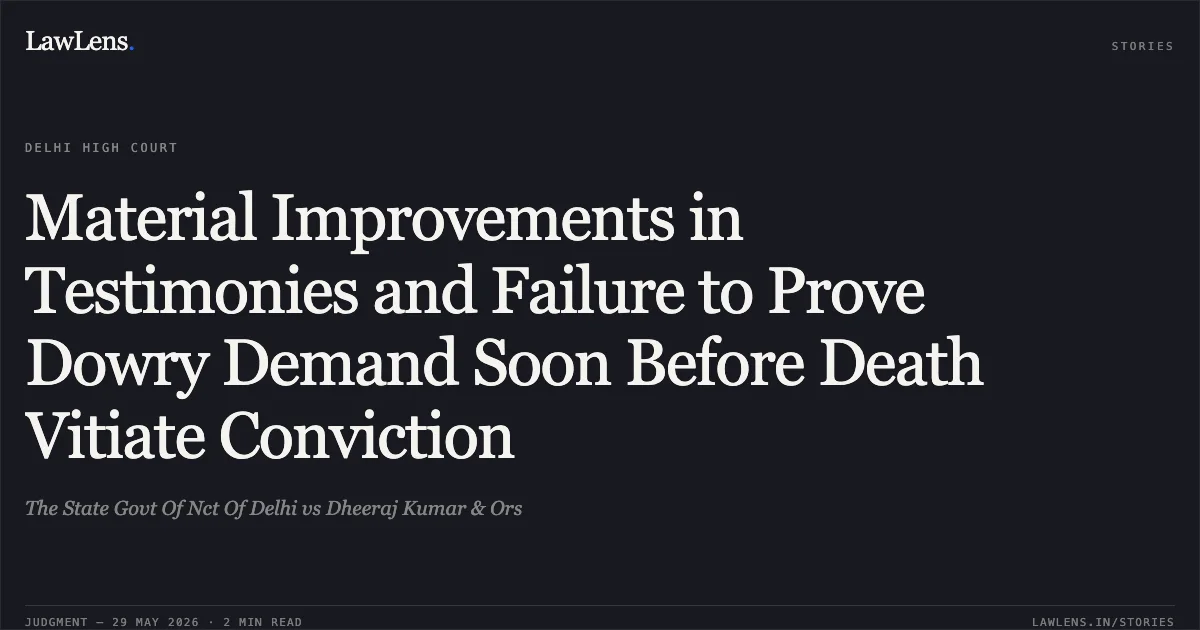
The State appealed the acquittal of the Respondents (husband and in-laws of the deceased, Rajni) for offences under Sections 498A and 304B of the IPC.
Source reference: p. 2Rajni married Respondent-1 on April 29, 2013, and died by hanging on March 23, 2014, within a year of marriage.
Source reference: p. 2The father of the deceased (PW-1) initially stated to the SDM that the deceased was troubled by her in-laws but did not mention specific dowry demands or the alleged payment of ₹25,000 made a day before the death.
Source reference: p. 20During the trial, PW-1, the mother (PW-11), and the brother (PW-6) introduced new allegations regarding a demand for a car and death threats.
Source reference: p. 3, 21-29The defense contended the deceased was distressed because the family refused her wish to give her child in adoption to her maternal uncle.
Source reference: p. 10Issues
1. Whether the prosecution established beyond reasonable doubt that the deceased was subjected to cruelty or harassment in connection with a demand for dowry "soon before her death" to attract Sections 304B and 498A IPC
Source reference: para. 262. Whether the material omissions in earlier statements and subsequent improvements made by witnesses during trial vitiated the prosecution's case
Source reference: para. 39-40Law Applied
The court applied Section 304B IPC (Dowry Death) and Section 498A IPC (Cruelty), alongside the presumption under Section 113B of the Indian Evidence Act.
Source reference: para. 41-42It relied on the precedent State of Uttarakhand v. Sanjay Ram Tamta (2025), which holds that material omissions in Section 161 CrPC statements that emerge as improvements during trial cannot be safely relied upon.
Source reference: para. 40It further applied Shoor Singh v. State of Uttarakhand (2025), emphasizing that the "foundational facts" of dowry-related harassment must be proved by the prosecution before the statutory presumption can be invoked.
Source reference: para. 47Reasoning
The Court observed that while the death occurred within seven years of marriage under unnatural circumstances, the prosecution failed to prove the nexus with dowry.
Source reference: para. 43-46The Court noted significant discrepancies between the initial statement to the SDM (Ex.PW1/A) and court testimonies. PW-1 failed to mention the alleged ₹25,000 payment or specific car demands in his earliest version, which the Court deemed "highly improbable" given the proximity of those events to the death.
Source reference: para. 32-33The Court characterized the witnesses’ allegations as vague and general improvements.
Source reference: para. 48Furthermore, the medical evidence confirmed death by suicide (hanging) with no external injuries, and the customary 40-day post-natal isolation was misconstrued by the prosecution as cruelty.
Source reference: para. 27, 35Applying the law, the Court found that the prosecution did not satisfy the "soon before death" requirement for dowry harassment, thereby rendering the Section 113B presumption inapplicable.
Source reference: para. 48Holding
The Court answered both issues in the negative, holding that the prosecution failed to establish the essential ingredients of Section 304B IPC beyond reasonable doubt.
The High Court affirmed the Trial Court's judgment of acquittal, finding no perversity or misappreciation of evidence. The appeal was dismissed, and the respondents' bail bonds were discharged.
Source reference: para. 49-51Acts & Sections Cited
3 provisions across 3 statutes referred to in this judgment. Linked provisions open on LawLens.
Code of Criminal Procedure, 19731
Indian Penal Code, 18601
Indian Evidence Act, 18721
Original Court PDF
The State Govt Of Nct Of DelhivsDheeraj Kumar & Ors
Click to open original judgment
Original judgment, available to read, download and summarize on LawLens.in