Facts
The petitioners filed a writ petition under Article 226 of the Constitution of India seeking to quash FIR No. 479/2025 and the subsequent charge sheet filed under Sections 281, 296, 115(2), 351(2), 3(5), and 109 of the Bharatiya Nyaya Sanhita (BNS), 2023
Source reference: para. 1, 10.2The complainant (Respondent No. 5) alleged that on 04.10.2025, the petitioners hit his vehicle and assaulted him and his friend near Ambedkar Square
Source reference: para. 2The court noted that the dispute was a consequence of matrimonial discord between Petitioner No. 1 and Respondent No. 5, who were living separately
Source reference: para. 3On 30.01.2026, the High Court referred the matter to a Mediation Centre, where the parties reached an amicable settlement on 06.04.2026
Source reference: para. 4The settlement included the return of Stridhan, a monetary payment of ₹5,52,016 to Petitioner No. 1, and an agreement to withdraw all mutual criminal cases
Source reference: para. 4Issues
1. Whether the High Court can exercise its power to quash criminal proceedings involving non-compoundable offences when the dispute is predominantly matrimonial and private in nature
Source reference: para. 7, 92. Whether the continuation of criminal proceedings, following a voluntary and amicable settlement between the parties, would amount to an abuse of the process of law
Source reference: para. 10, 12Law Applied
The Court relied on the inherent powers of the High Court to quash proceedings to secure the ends of justice and prevent the abuse of the process of any Court
Source reference: para. 10It applied the principle from Gian Singh v. State of Punjab, which held that while heinous crimes cannot be quashed, cases involving matrimonial or civil disputes where the wrong is private in nature may be quashed if a settlement renders the possibility of conviction remote
Source reference: para. 10The Court further cited Jitendra Raghuvanshi v. Babita Raghuwanshi, establishing that Section 320 of the Code is not a bar to quashing non-compoundable matrimonial offences if the court is satisfied that the parties have settled voluntarily
Source reference: para. 9It also applied the guidelines from Narinder Singh v. State of Punjab, which allow quashing when the offence has no serious impact on society
Source reference: para. 8Reasoning
The Court observed that the dispute was rooted in matrimonial strain and that the alleged injuries were simple in nature, lacking any element of a heinous crime or grave societal impact
Source reference: para. 4, 12By reviewing the mediation report dated 06.04.2026, the Court verified that the compromise was entered into voluntarily and without coercion
Source reference: para. 5The Court reasoned that since the parties had resolved their property and financial issues and agreed to live peacefully, the objective of the law—to maintain harmony—would be better served by ending the litigation
Source reference: para. 11It determined that because the parties had settled, the prospect of a successful prosecution was "remote and bleak," and forcing the continuation of Sessions Case No. 425/2025 would cause extreme injustice and result in an abuse of the judicial process
Source reference: para. 10, 12Holding
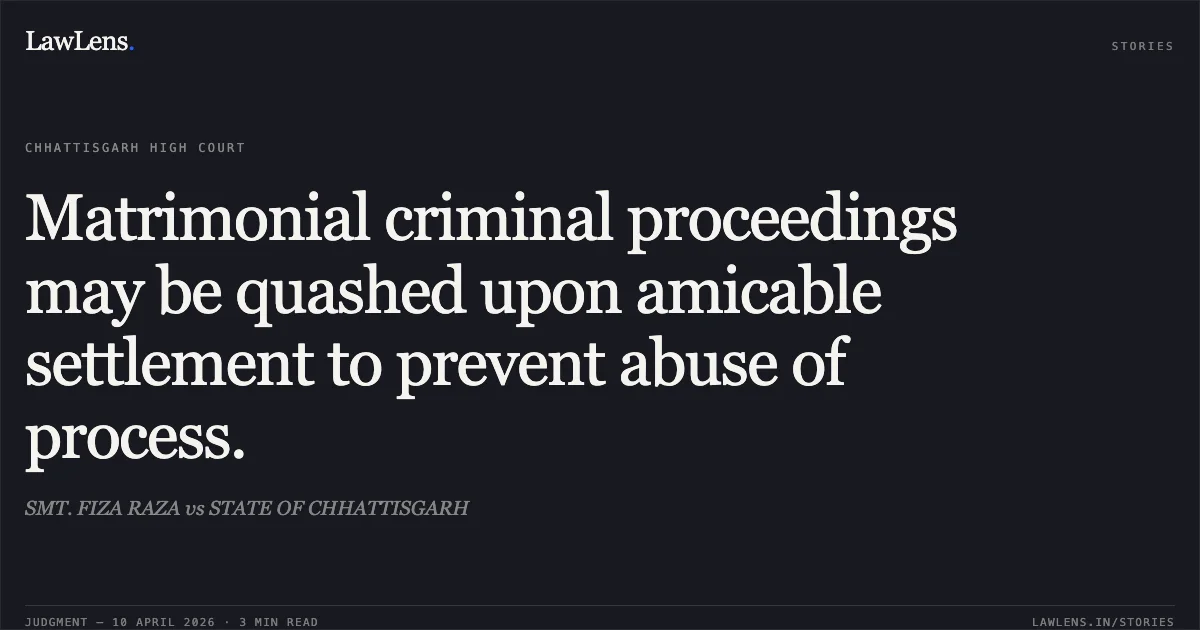
The Court allowed the writ petition and quashed FIR No. 479/2025, Charge Sheet No. 468/2025, and all consequential proceedings, including the cognizance order dated 10.12.2025
The Court held that in matrimonial disputes, the duty of the court is to encourage genuine settlements to secure the ends of justice
Source reference: para. 9, 11The parties were ordered to remain bound by the terms of the mediation settlement
Source reference: para. 15Acts & Sections Cited
11 provisions across 3 statutes referred to in this judgment. Each provision opens on LawLens.
Bharatiya Nyaya Sanhita, 20237
Code of Criminal Procedure, 19733
Indian Penal Code, 18601
Original Court PDF
SMT. FIZA RAZAvsSTATE OF CHHATTISGARH
Click to open original judgment
Original judgment, available to read, download and summarize on LawLens.in