Facts
On 26 August 2017, Vimal Chandrakant Patel, a Sales Manager with M/s. M.M. Vohra Automobiles Pvt. Ltd., was travelling in a Mahindra & Mahindra XUV demo car while returning after showing the vehicle to a customer. The vehicle, driven by another employee, was allegedly driven rashly and negligently, lost control, and collided with a tanker parked on the roadside without warning signals. Patel sustained serious injuries in the accident
Source reference: p.2, para. 2Patel filed a motor accident claim petition. The Motor Accident Claims Tribunal (Auxiliary), Kheda at Nadiad, partly allowed the claim in MACP No. 491 of 2018 and awarded ₹39,68,916 with interest at 7.5% per annum from the date of filing until realization. United India Insurance Co. Ltd. challenged the award, principally disputing the assessment of income and the award of medical expenses
Source reference: p.1, para. 1; p.2, paras. 4–5Issues
Whether the Tribunal erred in assessing the claimant’s monthly income at ₹40,000 without deducting income tax from his salary and incentive income?
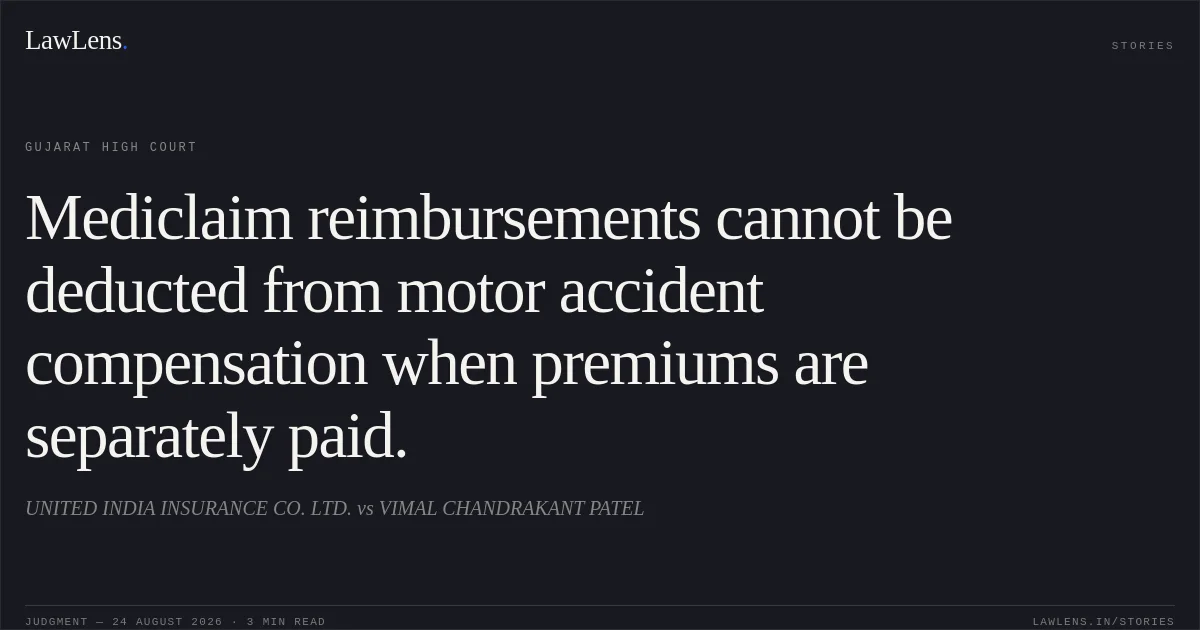
Source reference: p.3, para. 7; p.5, para. 12Whether the amount of ₹10,44,000 reimbursed to the claimant under a separately purchased mediclaim policy was required to be deducted from the medical expenses awarded as compensation?
Source reference: p.3, para. 8; p.6, para. 13Law Applied
For computation of loss of income, the claimant’s established income must be assessed on the basis of the evidence on record; however, where income-tax deduction is alleged, the party asserting non-deduction must produce supporting material. The Court noted that, under the Income Tax Act, the employer is ordinarily responsible for deducting tax at source, and no adverse presumption could be drawn against the claimant in the absence of evidence that tax had not been deducted
Source reference: p.5, para. 12Regarding medical expenses, the Court applied the principle that benefits received under an independent contractual insurance arrangement, for which the claimant has paid a separate premium, are not pecuniary advantages arising from the accident and cannot be deducted from statutory compensation. Relying on Managing Director, KSRTC v. P. Chandramouli, 2026 (0) AIJEL-SC 76709, and the principles in Helen C. Rebello, United India Insurance Co. Ltd. and Sebastiani Lakra, the Court held that independent contractual or social-security benefits lack the requisite nexus with compensation under the Motor Vehicles Act, 1988
Source reference: p.6, para. 13Reasoning
The Tribunal had assessed the claimant’s monthly income at ₹40,000 after considering his basic salary and incentive payments, including incentives of ₹84,400 in 2014–15, ₹1,93,700 in 2015–16, ₹2,33,500 in 2016–17 and ₹1,52,571 for the period from 1 April 2017 to 26 August 2017. The insurer’s cross-examination did not establish that income tax had not been deducted from those payments. Since the insurer neither put the necessary question to the witness nor produced contrary evidence, the Court rejected the proposed deduction and upheld the income assessment
Source reference: p.5, para. 12As to medical expenses, the claimant proved medical bills amounting to ₹13,26,000, and the Tribunal awarded ₹10,48,116 under that head. Although ₹10,44,000 had been reimbursed under a mediclaim policy, the claimant had paid a separate premium for that policy. Applying P. Chandramouli, the Court held that the reimbursement arose from an independent contractual relationship and that the tortfeasors could not claim the benefit of insurance protection independently purchased by the claimant
Source reference: p.6, paras. 13–14Holding
The High Court held that the Tribunal had committed no error either in assessing the claimant’s monthly income at ₹40,000 without the proposed income-tax deduction or in refusing to deduct the mediclaim reimbursement from the medical expenses
The appeal was dismissed as devoid of merit. United India Insurance Co. Ltd. was directed to satisfy the award of ₹39,68,916 with interest at 7.5% per annum from the date of filing of the claim petition until realization, within six weeks of receiving the order. Upon deposit, the Tribunal was directed to disburse the compensation and interest to the claimant after due verification and deduction of any deficit court fee
Source reference: p.7, paras. 15–16Original Court PDF
UNITED INDIA INSURANCE CO. LTD.vsVIMAL CHANDRAKANT PATEL
Click to open original judgment
Original judgment, available to read, download and summarize on LawLens.in