01Facts
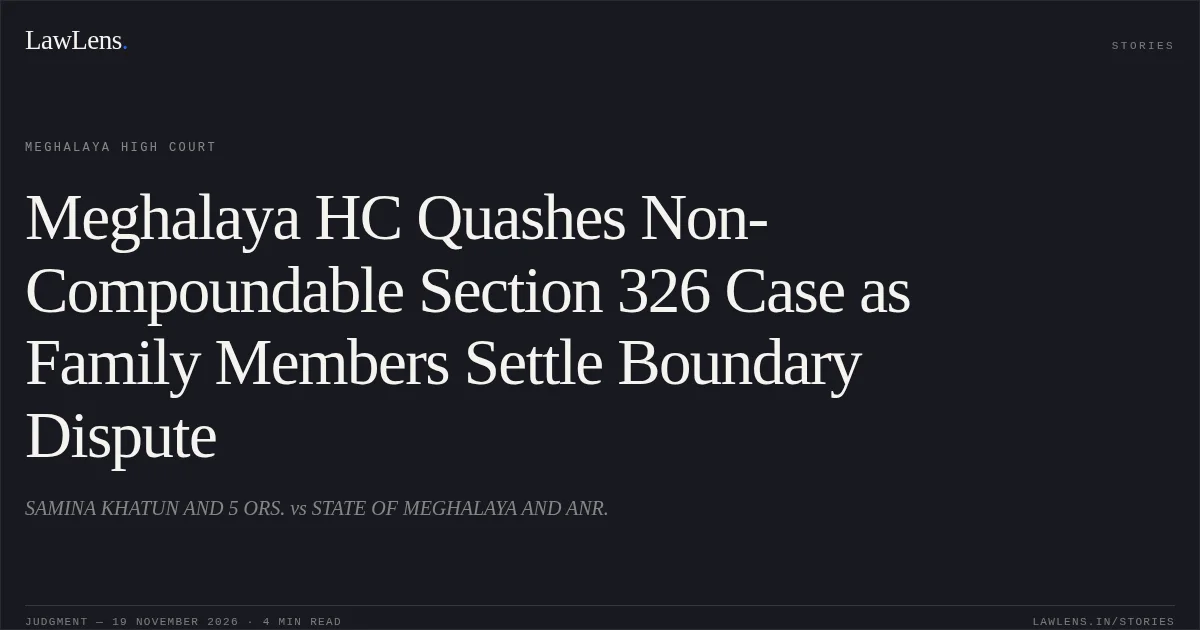
The petitioners (six members of one family) sought quashing of Phulbari P.S. Case No. 11(04)16, registered on the complaint of Respondent No. 2 under Sections 447, 326 and 506 read with Section 34 of the IPC.
p. 2 · ¶ 3The petition was based on an amicable settlement between the petitioners and Respondent Nos. 2 to 4, who are family members.
p. 3 · ¶ 4Two FIRs arose from the same incident. The police filed a closure report in the counter-FIR lodged from the petitioners' side, and a chargesheet was filed only in the FIR lodged at Respondent No. 2's instance, against all six petitioners.
p. 3 · ¶ 5 · p. 5 · ¶ 11The incident of 6 April 2016 arose from a boundary and village property dispute.
p. 5 · ¶ 11After chargesheeting, village elders and the Gaonbura mediated, and the parties executed a Deed of Compromise dated 29 April 2025, expressing regret, undertaking to maintain peace, and agreeing not to provoke or threaten each other.
p. 5 · ¶ 11The learned AAG did not dispute the family relationship.
p. 4 · ¶ 7Respondent Nos. 2 to 4, appearing through VC, confirmed on record that they had no objection to quashing.
p. 4 · ¶ 8–9 · p. 5 · ¶ 11The injury certificates showed that none of the injured was hospitalised; all were discharged the same day, with a forearm injury, a shoulder injury and a sutured head injury.
p. 8 · ¶ 1502Issues
i.1. Whether the High Court, in exercise of its inherent power under Section 482 CrPC, can quash criminal proceedings for offences under Sections 326 and 447/506 IPC, which are not compoundable under Section 320 CrPC, on the basis of a settlement between the parties who are family members and where the victims do not object.
p. 6 · ¶ 12 · p. 8 · ¶ 16ii.2. Whether the nature of the injuries, the personal character of the dispute and the genuineness of the compromise justify quashing the FIR and the pending chargesheet proceedings in the interest of justice.
pp. 8–9 · ¶ 1603Law Applied
The court relied on Sections 447, 326 and 506 read with Section 34 IPC as the charged offences.
p. 2 · ¶ 3The court applied the principle that compoundable offences are governed by Section 320 CrPC, which must be strictly followed, but that the High Court may nonetheless quash non-compoundable offences under Section 482 CrPC where the parties have amicably settled, the victim has no objection, and the offences are personal and do not affect public peace or tranquillity, as laid down in Yogendra Yadav & Ors. v. State of Jharkhand & Anr., (2014) 9 SCC 653.
p. 6 · ¶ 12The court relied on Gian Singh v. State of Punjab, (2012) 10 SCC 303, para. 58, as applied in Yogendra Yadav.
pp. 6–7 · ¶ 13The court followed H.N. Pandakumar v. State of Karnataka (Misc. Application No. 2667 of 2024 in SLP (Crl.) No. 895 of 2024), which permitted compounding of a Section 326 IPC offence on the basis of a voluntary settlement, the complainant's consent and the need to preserve social harmony, as exceptional circumstances warranting inherent powers.
pp. 7–8 · ¶ 14Counsel cited Naushey Ali & Ors. v. State of Uttar Pradesh (2025) 4 SCC 78, but the court did not discuss it.
pp. 3–4 · ¶ 6Provisions in the judgment · 7 · Linked ones open on LawLens
Indian Penal Code, 1860 Section 447Section 326Section 506Section 34Section 307
Code of Criminal Procedure, 1973 Section 320Section 482
04Reasoning
The court found that the offences were essentially personal, arising from a boundary and property dispute between closely related family members (brothers, sisters, nephews and nieces) and affecting no wider public interest.
p. 5 · ¶ 11Applying Yogendra Yadav, the court held that continuing the prosecution would be a "lame prosecution" whose pursuit would waste time and resources and could unsettle the compromise and hinder restoration of peace.
p. 6 · ¶ 12The settlement was genuine: it was reached with the intervention of village elders and the Gaonbura, recorded in a Deed of Compromise, accompanied by an expression of regret and undertakings of future peace, and reiterated by the injured complainants in court through VC.
p. 5 · ¶ 11 · p. 4 · ¶ 9The court relied on H.N. Pandakumar for the proposition that a voluntary compromise between closely related parties justifies the exercise of inherent powers even for a non-compoundable offence.
pp. 7–8 · ¶ 14The medical evidence supported the same conclusion. None of the injuries required hospitalisation, and all injured persons were discharged the same day, with injuries to the forearm, shoulder and head.
p. 8 · ¶ 15Weighing the family relationship, the nature of the injuries, the bona fides of the settlement and the consent of the victims, the court found no legal impediment to quashing.
pp. 8–9 · ¶ 1605Holding
The High Court held that it may exercise its Section 482 CrPC power to quash proceedings for a non-compoundable offence (Section 326 IPC) where the dispute is personal, the parties are family members, the injuries are non-grievous, and the victims consent to a bona fide settlement.
p. 6 · ¶ 12 · pp. 8–9 · ¶ 16The petition was allowed and Rule made absolute. FIR No. 11(04)16 registered at Phulbari P.S., and all consequent proceedings pending before the Judicial Magistrate First Class, Circuit Court, Phulbari, West Garo Hills District, were quashed and set aside.
p. 9 · ¶ 17–18The petition was disposed of accordingly, and all parties were directed to act on the authenticated copy of the order.
p. 9 · ¶ 19–20Original Court PDF
SAMINA KHATUN AND 5 ORS.vsSTATE OF MEGHALAYA AND ANR.
Click to open original judgment
Original judgment, available to read, download and summarize on LawLens.in