01Facts
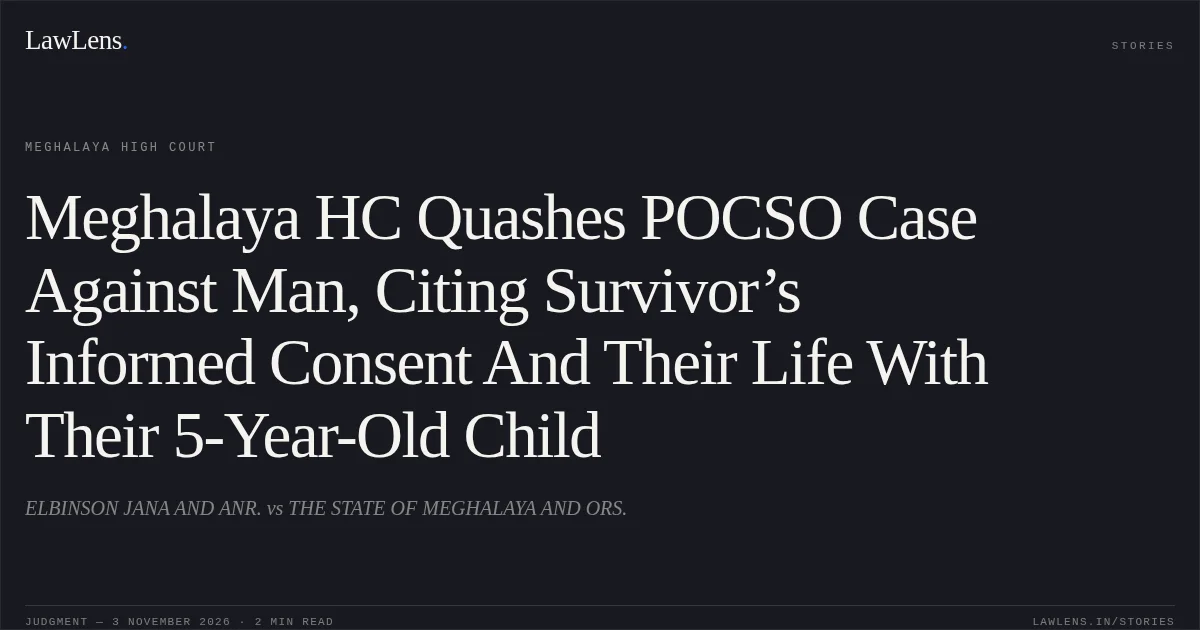
The petitioners, Sayedullah Hoque (Petitioner No. 1, original accused, aged 26) and "Miss X" (Petitioner No. 2, survivor, aged 19), sought quashing of Tura Women P.S. Case No. 62(11) of 2020 under Section 5(j)(ii) read with Section 6 of the POCSO Act, and of the consequent Special (POCSO) Case No. 19 of 2021 pending before the Special Judge (POCSO), Tura.
¶ 2 · ¶ 3The FIR was lodged at the instance of the Child Welfare Committee, Tura.
¶ 3The parties had been in a relationship since 2019, later lived together, and married on 15 November 2025, after Petitioner No. 2 attained majority. They have a girl child born on 24 June 2026.
¶ 4 · ¶ 8The Court directed the parties to appear before the Secretary, High Court Legal Services Committee, and directed the Tura Women Police to verify the claims.
¶ 5 · ¶ 6The Secretary's sealed report, taken on record, stated that Petitioner No. 2 gave consent to quashing, that Petitioner No. 1 cares for her and the child, and that she has received no State or Central scheme benefits.
¶ 8The police report confirmed cohabitation, a marriage solemnised in the presence of both families, a happy marital life, and a five-month-old child.
¶ 902Issues
i.1. Whether the POCSO proceedings and FIR may be quashed under Section 528 BNSS on the basis of the victim's consent, where the victim has attained majority, the parties have married and have a child, and the consent is informed and uncoerced.
¶ 4 · ¶ 10 · ¶ 11ii.2. Whether the victim and her child should be extended the benefit of government and statutory schemes as a condition of, or in conjunction with, quashing.
¶ 10 (citing para. 34 of Shalenbor Wahlang) · ¶ 15–1603Law Applied
The Court applied Section 528 BNSS (formerly Section 482 Cr.P.C.) as the source of inherent power to quash, and the POCSO Act, Sections 5(j)(ii) and 6, as the offence provisions under challenge.
¶ 3The Court relied on its own decision in Shalenbor Wahlang & Anr. v. State of Meghalaya & Anr. (Crl.Pet. No. 92 of 2023, decided 10 April 2026), which holds that quashing a POCSO case by consent is permissible, though exercised sparingly, and that no rigid formula exists.
¶ 10 (citing paras 31, 34)The Shalenbor Wahlang framework requires: (a) verification of the marriage or cohabitation and child through a police or authority report; (b) a victim affidavit of "No Objection"; (c) confirmation that consent is informed and uncoerced, through the MLSA/DLSA Secretary, with time to reflect; and (d) due weight to the victim's and child's entitlement to government schemes.
¶ 10 (citing para. 34)Where the parties are married or cohabiting with a child, sending the accused to jail may cause greater injustice, and the Court may quash pending trial.
¶ 10 (citing para. 35)The Court relied on Re: Right to Privacy of Adolescents (Supreme Court) on the requirement to weigh government schemes.
¶ 10 (citing para. 34)The Court recognised the matrilineal and customary context of Meghalaya as relevant to the assessment.
¶ 10 (citing para. 33)Provisions in the judgment · 5 · Linked ones open on LawLens
Protection of Children from Sexual Offences Act, 2012 Section 4Section 5Section 6
Bharatiya Nagarik Suraksha Sanhita, 2023 Section 528
Code of Criminal Procedure, 1973 Section 482
04Reasoning
The Court applied the Shalenbor Wahlang framework step by step. The age of majority, marriage on 15 November 2025, and a five-month-old child were established by the Secretary's report and the police verification.
¶ 8 · ¶ 9 · ¶ 11The MLSA Secretary's report indicated that Petitioner No. 2's consent was given because she is married to Petitioner No. 1 and is well cared for, supporting a finding of informed consent.
¶ 8 · ¶ 11The police report corroborated that the parties live together happily in a marriage solemnised before both families.
¶ 9Weighing these facts, the Court held that sending Petitioner No. 1 to jail would work greater injustice on the victim and the child than the public interest in prosecution, which was the balancing exercise required by Shalenbor.
¶ 11 (citing para. 35)The Court's reasoning does not expressly record a sworn victim affidavit of no objection, although the consent is recorded through the MLSA report. Because the Court's directions for welfare benefits are substantial, this omission is in effect addressed through the post-quashing supervision mechanism.
¶ 8 · ¶ 15–1805Holding
The Court held that quashing a POCSO case by consent under Section 528 BNSS is permissible in exceptional cases where the victim's consent is informed, the parties are married or cohabiting with a child, and prosecution would cause greater injustice.
¶ 10–11The petition was allowed and Rule made absolute. The FIR in Tura Women P.S. Case No. 62(11) of 2020 and Special (POCSO) Case No. 19 of 2021 were quashed and set aside.
¶ 12–13The Court directed that Petitioner No. 2 and her child be extended all applicable State and Central schemes, listing fifteen, including the Nirbhaya Fund scheme, Mission Vatsalya, BBBP, Meghalaya Victim Compensation Scheme 2022, and NALSA schemes.
¶ 15The DCPO and Secretary, DLSA, Tura, were directed to appoint a support person and ensure delivery of benefits within eight weeks.
¶ 16Any victim compensation is to be held in a fixed deposit until Petitioner No. 2 attains 25 years, with quarterly interest payable to her. The Registry was directed to forward the order to the Member Secretary, MLSA; the Commissioner and Secretary, Social Welfare; the DCPO; and the Secretary, DLSA, Tura. The matter is listed on 3 February 2027 for compliance reporting.
¶ 17 · ¶ 18 · ¶ 19 · ¶ 20Original Court PDF
SAYEDULLAH HOQUE AND ANR.vsSTATE OF MEGHALAYA AND ANR.
Click to open original judgment
Original judgment, available to read, download and summarize on LawLens.in