01Facts
The suit properties originally belonged to Ponnusamy Udayar, who orally partitioned family property with his brother Nataraja Udayar in 1955.
¶ 3Ponnusamy had no sons and two daughters, the first defendant (Sellammal) and Muthulakshmi (deceased).
¶ 3The plaintiff, Ponnusamy's nephew, claimed the properties under a Will dated 02.04.1982 said to have been executed in his favour, and asserted possession for over 60 years.
¶ 3The defendants denied the Will, contended that Ponnusamy died intestate about 17 years before the suit, and claimed that Muthulakshmi orally relinquished her share to the first defendant.
¶ 4Patta was initially issued jointly to the plaintiff and the daughters, but was later re-issued in the first defendant's name after the Tahsildar's intervention.
¶ 3, 4The plaintiff sued in OS No. 211/1999 for declaration, permanent injunction, and, in the alternative, recovery of possession and mesne profits.
¶ 2The trial court framed issues on the plaintiff's entitlement to relief and the genuineness of the Will.
¶ 5Relying on PW1–PW3 and Exs. A1–A7, B1–B19, X1 and X2, the trial court dismissed the suit on 29.11.2004.
¶ 6, 7The first appellate court dismissed AS No. 61/2005 on 17.01.2006.
¶ 9The plaintiff then filed this second appeal.
¶ 902Issues
i.1. Whether the Will dated 02.04.1982 (Ex.A1) was duly proved in accordance with law, including its execution, attestation and the testator's sound disposing mind, and whether suspicious circumstances were dispelled.
¶ 10 · ¶ 15–17ii.2. Whether the Courts below erred in rejecting Ex.A1 despite its alleged proof under the statutory provision relating to proof of Wills.
¶ 10iii.3. Whether the Courts below erred in appreciating the evidence of the attesting witness (PW2).
¶ 15–17iv.4. Whether the concurrent findings of the Courts below call for interference in second appeal under Section 100 CPC.
¶ 17v.5. Whether the plaintiff's combined prayers for declaration/injunction and recovery of possession are sustainable.
¶ 1703Law Applied
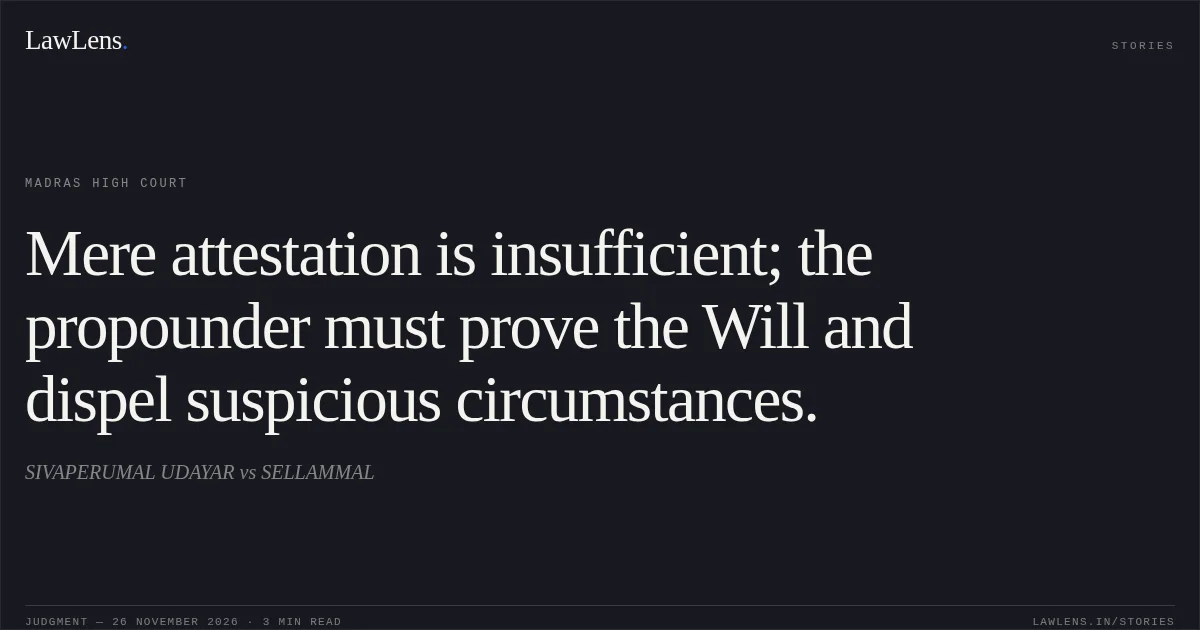
The propounder of a Will must prove its execution, attestation and the testator's sound disposing mind, and must dispel suspicious circumstances.
¶ 16Section 68 of the Indian Evidence Act requires examination of an attesting witness, and mere attestation is insufficient to prove a Will.
¶ 17The propounder must dispel suspicious circumstances, such as the omission of a natural heir.
¶ 16–17Under Section 100 CPC, a second appeal lies only on a substantial question of law, and concurrent findings of fact are not disturbed absent perversity or illegality.
¶ 17A plaintiff who pleads possession cannot simultaneously seek recovery of possession and a permanent injunction, as these reliefs are mutually inconsistent.
¶ 17The judgment cites Section 63 of the Evidence Act in the substantial question of law.
¶ 10Provisions in the judgment · 1 · Linked ones open on LawLens
Code of Civil Procedure, 1908 Section 100
04Reasoning
The plaintiff admitted that the first defendant is Ponnusamy's daughter and natural heir, so the burden lay on him to prove the 1982 Will.
¶ 15The attesting witness, PW2, deposed to execution in examination, but in cross-examination he could not speak to the testator's family background or the hospital where Ponnusamy was treated, and he admitted courtroom experience, which the Court found undermined his testimony.
¶ 15The Court held that PW2's evidence was not cogent or natural, and was insufficient to establish execution and attestation.
¶ 16–17Several suspicious circumstances were identified: the Will made no reference to the first defendant, a natural heir; it was allegedly executed one week before Ponnusamy's death; and the plaintiff took no steps after patta was transferred to the first defendant. The Court found that these circumstances were not dispelled by the propounder.
¶ 16The commissioner's report was held to be of no assistance, since the plaintiff had to prove title through documents.
¶ 16The defendants' evidence showed patta in the first defendant's name and her status as Class I heir, which supported the trial court's findings.
¶ 17The Court found that the Courts below had appreciated the evidence on both sides and that their concurrent findings were free from perversity.
¶ 17Because the plaintiff pleaded possession, the alternative prayer for recovery was inconsistent with the prayer for injunction and declaration.
¶ 1705Holding
The substantial question of law is answered against the appellant: the Courts below were correct in holding that the Will (Ex.A1) was not proved in accordance with law, and their concurrent findings do not warrant interference.
¶ 17The second appeal is dismissed without costs, and the connected Miscellaneous Petition is closed. The judgment and decree dated 17.01.2006 in AS No. 61/2005 and the decree dated 29.11.2004 in OS No. 211/1999 are upheld.
¶ 18(i) · ¶ 18(ii)Original Court PDF
SIVAPERUMAL UDAYARvsSELLAMMAL
Click to open original judgment
Original judgment, available to read, download and summarize on LawLens.in