01Facts
The first respondent filed O.P. No. 838 of 2000 for Letters of Administration with a Will dated 22.11.1985 executed by his mother, N. Panchali Ammal.
¶ 2.aThe original petition gave the address of the appellants (his sisters) as No. 6, T.K. Mudali Street, Choolai, Chennai, which was also the marital address of the first appellant. Notices to that address were recorded as "no such person," and substituted service was ordered through the vernacular daily Makkal Kural.
¶ 5.c, 7, 8The appellants were set ex parte. Ex parte evidence was recorded on 21.09.2000, the first respondent was examined as PW-1, and Exs. P1–P5 were marked.
¶ 8Letters of Administration were granted on 26.09.2001. The grant rested on an affidavit of one attesting witness, and no attesting witness was examined.
¶ 2.a, 8, 11, 12, 16The appellants filed A.No. 4524 of 2011 to revoke the grant, contending that they were not served and that the address was wrong. They relied on Exs. A1, P2–P9 and A10 series to show their residences at Aminjikarai, Arumbakkam and Bengaluru at the material time.
¶ 2.b, 9The respondents contended that the revocation application was filed in 2010, after the appellants' knowledge through the 2008 reply notice and the partition suit O.S. No. 3258 of 2010.
¶ 5.d · p. 6The learned Single Judge dismissed the application by order dated 28.06.2024, holding that the appellants' shifting of addresses did not show the respondent had been at fault. The appellants appealed.
¶ 2.b02Issues
i.1. Whether the non-service of notice on the appellants and the furnishing of a wrong address constitute "just cause" under Section 263 of the Indian Succession Act, 1925 for revoking the grant.
¶ 6, 7, 9ii.2. Whether the grant of Letters of Administration is vitiated because the Will was not proved by examining at least one attesting witness, and whether this amounts to "just cause" for revocation.
¶ 11–1603Law Applied
Section 263 of the Indian Succession Act, 1925 permits revocation of a grant for "just cause," and its explanations are illustrative and not exhaustive.
¶ 16Order XXV Rules 4, 5 and 51 of the Madras High Court Original Side Rules, which govern non-contentious and contentious testamentary applications, do not dispense with the statutory requirement of proving execution.
¶ 13, 14Section 68 of the Indian Evidence Act, 1872 (now Section 67 of the Bharatiya Sakshya Adhiniyam, 2023) and Section 63 of the Indian Succession Act make examination of at least one attesting witness mandatory where a Will is to be used as evidence, even if uncontested.
¶ 14, 15Ramesh Verma v. Lajesh Saxena (2017) 1 SCC 257, Janki Narayan Bhoir v. Narayan Namdeo Kadam (2003) 2 SCC 91, Jagdish Chand Sharma v. Narain Singh Saini (2015) 8 SCC 615, and Ramesh Chand (D) through LRs v. Suresh Chand 2025 INSC 1059 were followed on the proof of Wills and the requirement of examining attesting witnesses.
¶ 14, 15Manibhai Amaidas Patel v. Dayabhai Amaidas Patel (2005) 12 SCC 154 and Anil Behari Ghosh v. Latika Bala Dassi AIR 1955 SC 566 were applied on defective grants and the right to be heard.
¶ 9, 16Basanti Devi v. Raviprakash Ram Prasad Jaiswal (2008) 1 SCC 267 holds that a person unaware of proceedings for want of proper citation may seek revocation.
¶ 16Provisions in the judgment · 7 · Linked ones open on LawLens
Indian Succession Act, 1925 Section 263Section 281Section 284Section 295Section 63
Bharatiya Sakshya Adhiniyam, 2023 Section 67
Limitation Act, 1963 Section 137
04Reasoning
The endorsements on the original petition showed that notices were returned as "no such person," and substituted service followed without any finding that the appellants were actually served. The Single Judge erred by treating the appellants' changes of address as dispositive, without examining Exs. A1, P2–P9 and A10 series, which showed the appellants were residing elsewhere when notices issued. Because a Will ordinarily displaces the statutory line of succession, the Class I heirs were entitled to notice and an opportunity to be heard, and non-service on them was a ground for revocation.
¶ 8, 9, 16The affidavit of an attesting witness filed under Order XXV Rules 4 and 5 does not satisfy Section 68 of the Evidence Act or Section 63 of the Succession Act. The respondents' position that examination of attesting witnesses arises only in contentious proceedings was rejected, relying on Ramesh Chand. Since no attesting witness was examined, the grant was "defective in substance," which constituted just cause.
¶ 14, 15, 16The appellants could seek revocation under Basanti Devi despite the delay alleged by the respondents. The reasoning on the delay and limitation objections is not expressly set out, and the respondents' further objections, that the non-examination plea was raised for the first time on appeal and that the Will was registered and unchallenged, were not expressly answered in the reasoning.
¶ 5.b, 5.c, 5.d, 5.e05Holding
Non-service of notice on the Class I legal heirs, established by the endorsements and documentary evidence, is just cause under Section 263 of the Indian Succession Act, 1925.
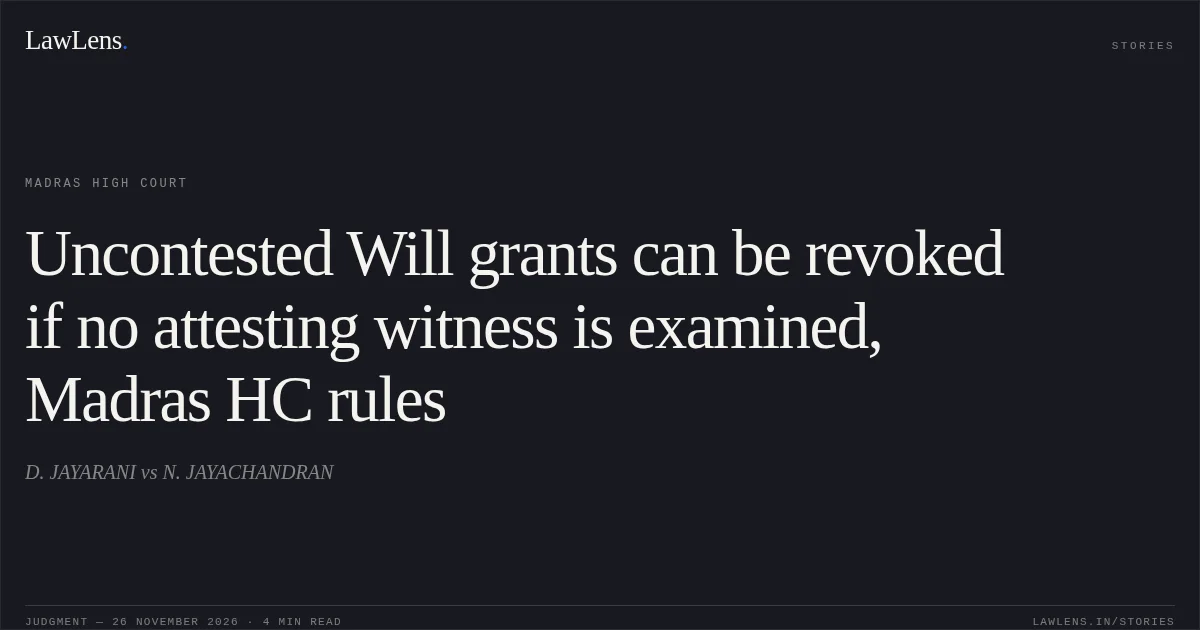
¶ 9, 16Failure to examine at least one attesting witness, as mandated by Section 68 of the Evidence Act and Section 63 of the Succession Act, renders the grant defective in substance and is independently just cause for revocation.
¶ 15, 16The Court set aside the Single Judge's order dated 28.06.2024 and allowed the appeal without costs. The appellants are directed to enter a caveat and file an affidavit, which shall be converted into a Testamentary Original Suit to be disposed of expeditiously. Connected C.M.P. No. 12607 of 2025 stands closed.
¶ 17Original Court PDF
D. JAYARANIvsN. JAYACHANDRAN
Click to open original judgment
Original judgment, available to read, download and summarize on LawLens.in