Facts
The petitioners, the husband and mother-in-law of the respondent, were respondents in M.C. No. 32 of 2025 pending before the Judicial First Class Magistrate Court-III, Thrissur.
Source reference: para. 2The respondent had filed the proceedings under Section 12 of the Protection of Women from Domestic Violence Act, 2005 (“PWDV Act”), seeking reliefs under the Act.
Source reference: para. 2The petitioners alleged that the proceedings were based on false and vague allegations, were instituted after an unexplained delay of approximately six years, and constituted a retaliatory pressure tactic arising from disputes pending before the Family Court and other forums.
Source reference: paras. 2–4They also relied on a POCSO case involving the parties’ child, in which the police had submitted refer reports concluding that the allegations were false.
Source reference: para. 4The respondent contended that the allegations disclosed continuing domestic violence, including an incident in May 2025, and that the PWDV Act prescribed no limitation period for filing an application under Section 12.
Source reference: para. 5She further submitted that the police refer report was under challenge and that the alleged delay, the timing of the proceedings, and the previous complaints were matters for evidence before the Magistrate, not grounds for quashing at the threshold.
Source reference: para. 5The petitioners invoked the High Court’s inherent jurisdiction under Section 528 of the Bharatiya Nagarik Suraksha Sanhita, 2023 (“BNSS”) and sought quashing of the proceedings.
Source reference: paras. 1–2Issues
1. Whether the High Court could exercise its inherent jurisdiction under Section 528 of the BNSS to quash proceedings under Section 12 of the PWDV Act where the petitioners alleged falsity, delay, retaliatory motive, and abuse of process.
Source reference: paras. 6–82. Whether the alleged delay in filing the Section 12 application, the respondent’s earlier approach to other authorities, the POCSO refer reports, and the timing of the domestic-violence proceedings demonstrated that continuation of the proceedings would amount to an abuse of process.
Source reference: paras. 8–123. Whether determination of the truth of the allegations and the existence of domestic violence could be undertaken by the High Court at the quashing stage without a full evidentiary adjudication.
Source reference: para. 13Law Applied
The Court applied Section 528 of the BNSS, corresponding to Section 482 of the Code of Criminal Procedure, 1973, which preserves the High Court’s inherent power to prevent abuse of process and secure the ends of justice; the power is extraordinary and must be exercised sparingly, cautiously, and only in exceptional cases.
Source reference: para. 6Section 12 of the PWDV Act provides the statutory mechanism for an aggrieved person to seek reliefs under the Act.
Source reference: no citationRelying on Vijayalekshmi Amma K. v. Bindu V., 2010 (1) KLT 79, the Court noted that proceedings under Section 12 are predominantly civil in nature and should ordinarily not be quashed under the inherent jurisdiction when an adequate remedy exists before the Magistrate.
Source reference: para. 6Relying on Shaurabh Kumar Tripathi v. Vidhi Rawal, 2025 KHC Online 6517, the Court held that proceedings arising from a Section 12(1) application can, in an appropriate case, be quashed under Section 482 CrPC, but ordinarily only where there is gross illegality or continuation would result in manifest injustice.
Source reference: paras. 6–7The Court further held that the PWDV Act prescribes no specific limitation period for approaching the Magistrate under Section 12 and that delay, by itself, is not a ground for quashing.
Source reference: para. 9Reasoning
The Court held that the petitioners’ objections principally raised disputed questions of fact concerning the genuineness of the allegations, the explanation for delay, the significance of prior complaints, the POCSO refer reports, and the alleged retaliatory motive.
Source reference: paras. 8–12Since the respondent specifically alleged acts of domestic violence, including an incident in May 2025, the Court found that the assertion of a six-year delay could not conclusively establish abuse of process, particularly because the PWDV Act contains no prescribed limitation period.
Source reference: paras. 8–10The police refer reports in the POCSO case were not treated as conclusive because the respondent had challenged their acceptance; their evidentiary relevance could be considered by the Magistrate.
Source reference: para. 10Similarly, the fact that the Section 12 proceedings followed the husband’s Family Court compensation proceedings did not, by itself, establish retaliation or mala fides.
Source reference: para. 11The Court emphasised that it could not conduct a mini-trial or determine the truth of the allegations while exercising Section 528 jurisdiction; those questions had to be adjudicated by the jurisdictional Magistrate on the basis of evidence.
Source reference: para. 13Holding
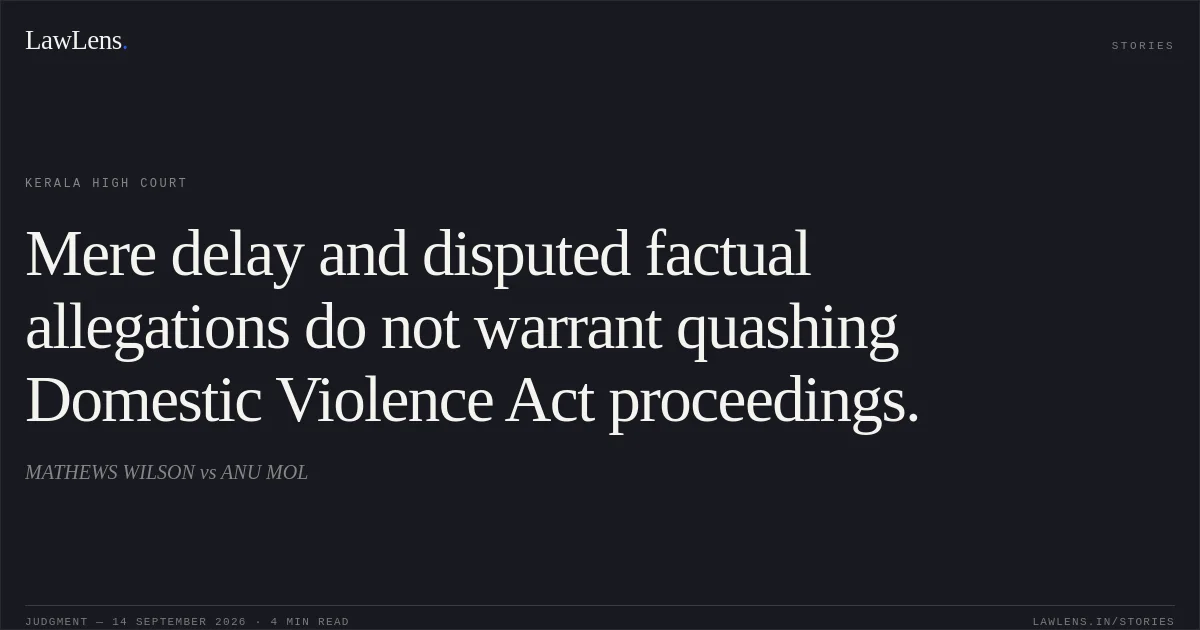
The High Court answered the issues against the petitioners.
It held that the alleged delay, prior proceedings, POCSO refer reports, and purported retaliatory timing did not, by themselves, demonstrate gross illegality or abuse of process warranting interference under Section 528 of the BNSS.
Source reference: paras. 9–12As the petition disclosed specific allegations of domestic violence requiring evidentiary adjudication, the Court declined to undertake a mini-trial or quash the proceedings.
Source reference: para. 13The Criminal Miscellaneous Case was accordingly dismissed, and the proceedings in M.C. No. 32 of 2025 were permitted to continue before the Judicial First Class Magistrate Court-III, Thrissur.
Source reference: para. 14Acts & Sections Cited
3 provisions across 3 statutes referred to in this judgment. Each provision opens on LawLens.
Bharatiya Nagarik Suraksha Sanhita, 20231
Protection of Women from Domestic Violence Act, 20051
Code of Criminal Procedure, 19731
Original Court PDF
MATHEWS WILSONvsANU MOL
Click to open original judgment
Original judgment, available to read, download and summarize on LawLens.in