Facts
P.B. Agro LLP, stated to be the master licensee for manufacture and sale of VIMAL Elaichi and pan masala not containing tobacco, challenged a show-cause notice dated 11 August 2026 issued by the Assistant Commissioner (Food), Food and Drug Administration, Greater Mumbai Division, to three brand ambassadors associated with the VIMAL Elaichi advertising campaign.
Source reference: paras. 1–5; pp. 2–4The notice referred to restrictions on advertisements under Section 24 and the prohibition of pan masala in Maharashtra under Section 30(2)(a) of the Food Safety and Standards Act, 2006.
Source reference: para. 19; p. 11The petitioner contended that the notice effectively affected its advertising campaign and business in Delhi, although it had not itself been issued any notice or given an opportunity of hearing.
Source reference: paras. 5, 8–11; pp. 3–7The respondents objected that the impugned notice was independently issued by the Maharashtra FDA, to Mumbai-based noticees, in relation to alleged activities in Maharashtra.
Source reference: paras. 12–14; pp. 7–9Issues
Whether the Delhi High Court could exercise jurisdiction under Article 226(1) or Article 226(2) of the Constitution in respect of a show-cause notice issued by the Maharashtra FDA merely because the petitioner and certain statutory authorities were located in Delhi?
Source reference: para. 16; p. 9Whether the petitioner’s Delhi-based business operations, management and payment of the advertising campaign, and alleged commercial injury in Delhi constituted a material or substantial part of the cause of action?
Source reference: paras. 21–23, 27; pp. 12–16Whether the mere location of FSSAI, the Ministry, or the CCPA in Delhi, or the pendency of separate CCPA proceedings, conferred territorial jurisdiction on the Delhi High Court?
Source reference: paras. 32–36; pp. 19–22Whether, even assuming that some part of the cause of action arose in Delhi, the Delhi High Court should decline jurisdiction on the ground of forum conveniens?
Source reference: paras. 39–41; pp. 23–25Law Applied
The Court applied Articles 226(1) and 226(2) of the Constitution, under which a High Court may exercise writ jurisdiction where the respondent authority is within its territory or where a part of the cause of action arises within that territory.
Source reference: paras. 8, 16; pp. 4, 9Under the cause-of-action principle, only material, essential or integral facts having a direct nexus with the impugned action confer territorial jurisdiction; incidental or remote facts do not, as held in Alchemist Ltd. v. State Bank of Sikkim, ONGC v. Utpal Kumar Basu, Aligarh Muslim University v. Vinay Engineering Enterprises, State of Rajasthan v. Swaika Properties, and Union of India v. Adani Exports Ltd.
Source reference: paras. 22–26, 31; pp. 13–19The Court also relied on Kusum Ingots & Alloys Ltd. v. Union of India and State of Goa v. Summit Online Trade Solutions (P) Ltd. for the doctrine of forum conveniens, under which a High Court may decline to entertain a petition even where a minor part of the cause of action arises within its territory if another court is the natural and more convenient forum.
Source reference: paras. 40–41; pp. 24–25The Court considered the FSS Act, including Sections 4 and 16(5 concerning FSSAI’s statutory role, Section 24 concerning restrictions on advertisements and unfair trade practices, and Section 30(2)(a) concerning State-level food-safety action and prohibition of pan masala in Maharashtra.
Source reference: paras. 18–19; pp. 10–11Reasoning
The Court found that the impugned notice emanated independently from the FDA, Mumbai, under the Government of Maharashtra, and that there was no material showing that FSSAI or any Delhi-based authority had directed its issuance.
Source reference: para. 18; p. 10The notice was addressed to three brand ambassadors residing in Mumbai and concerned alleged prohibited activity, regulatory action and statutory violations connected with Maharashtra.
Source reference: paras. 17–19; pp. 9–11Since the petitioner itself had not been served with the notice, had not been directed to remove advertisements or produce documents, and had not been called upon to appear before the Maharashtra authorities, its Delhi office, advertising arrangements, payments and apprehended commercial injury were held to be incidental rather than integral facts forming the cause of action.
Source reference: paras. 20–27; pp. 11–16The impleadment of FSSAI, the Ministry and the CCPA could not create jurisdiction because no specific order or decision of those authorities was challenged and no substantive relief was sought against them.
Source reference: paras. 20, 32–36; pp. 11, 19–22The Court distinguished Bakshish Ahmad v. Union of India, noting that that case involved a specific statutory and administrative relationship making Delhi-based Union authorities necessary parties, which was absent here.
Source reference: para. 37; pp. 22–23It further held that Maharashtra was the natural and convenient forum because the issuing authority, noticees, alleged conduct and central factual controversy were all located there.
Source reference: paras. 39–41; pp. 23–25Holding
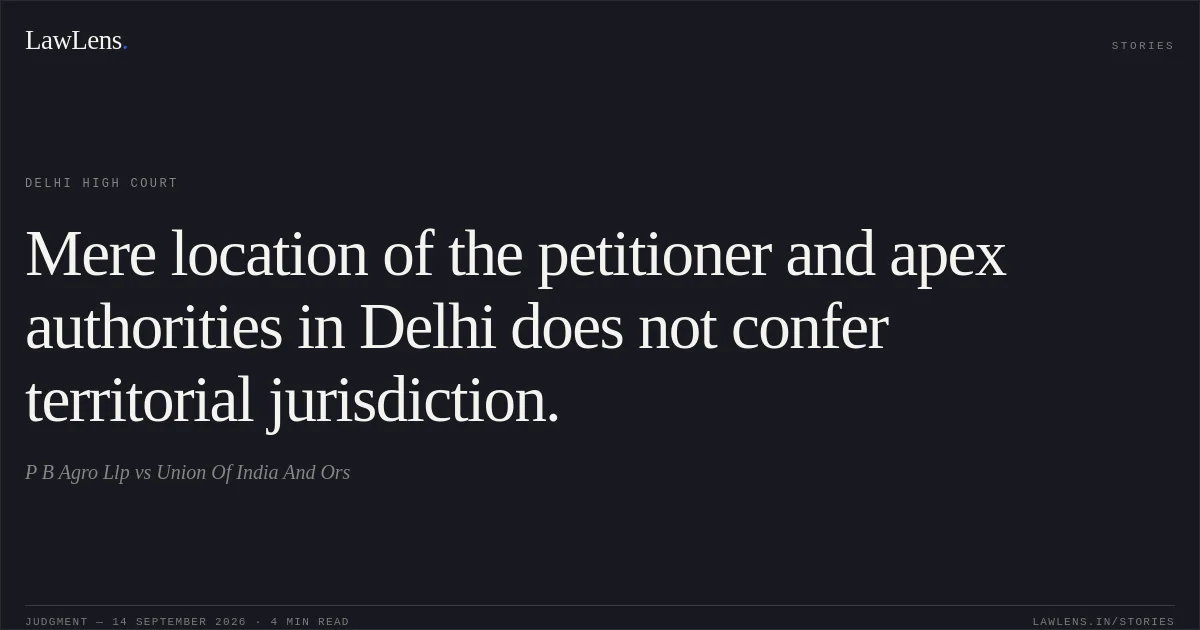
The Court held that the petitioner failed to establish that any substantial or material part of the cause of action arose within Delhi.
The location of the petitioner’s business, FSSAI, the Ministry or the CCPA in Delhi did not confer territorial jurisdiction over an independent show-cause notice issued by the Maharashtra FDA to Mumbai-based noticees in relation to alleged activities in Maharashtra.
Source reference: para. 42; p. 25The petition was therefore held non-maintainable for want of territorial jurisdiction and was also rejected on the ground that Maharashtra was the more appropriate forum under the doctrine of forum conveniens.
Source reference: paras. 43–44; p. 26The petition and pending application were dismissed without any adjudication on the merits of the challenge to the show-cause notice.
Source reference: para. 44; p. 26Acts & Sections Cited
7 provisions across 3 statutes referred to in this judgment. Each provision opens on LawLens.
Food Safety and Standards Act, 20064
Consumer Protection Act, 20191
Original Court PDF
P B Agro LlpvsUnion Of India And Ors
Click to open original judgment
Original judgment, available to read, download and summarize on LawLens.in