Facts
The Appellant (WBSETCL) issued Recruitment Notification No. REC/2023/01 for the post of Junior Engineer (Civil) Grade II, which included 30 vacancies.
Source reference: p. 3-4, para 5The notification provided for vertical (social) and horizontal (special) reservations, specifically earmarking one post for Unreserved Persons with Disabilities – Low Vision [UR (PWD-LV)] and five posts for Other Backward Classes-A [OBC-A].
Source reference: p. 3-4, para 5A note in the notification stated that if a qualified UR (PWD-LV) candidate was unavailable, the vacancy would be filled by PWD candidates of other categories as per merit.
Source reference: p. 4, para 5Respondent No. 1, a qualified UR (PWD-LV) candidate, scored 55.667 marks. Respondent No. 3, an OBC-A candidate who also belonged to the PWD-LV category, scored 66.667 marks.
Source reference: p. 7-8, para 10The Appellant appointed Respondent No. 3 to the UR (PWD-LV) post based on higher merit.
Source reference: p. 7-8, para 10The Division Bench of the Calcutta High Court set aside this appointment, holding that as long as a qualified Unreserved PWD-LV candidate (Respondent No. 1) was available, the post could not be filled by a candidate from a reserved social category.
Source reference: p. 10, para 14The Appellant challenged this before the Supreme Court.
Source reference: no citationIssues
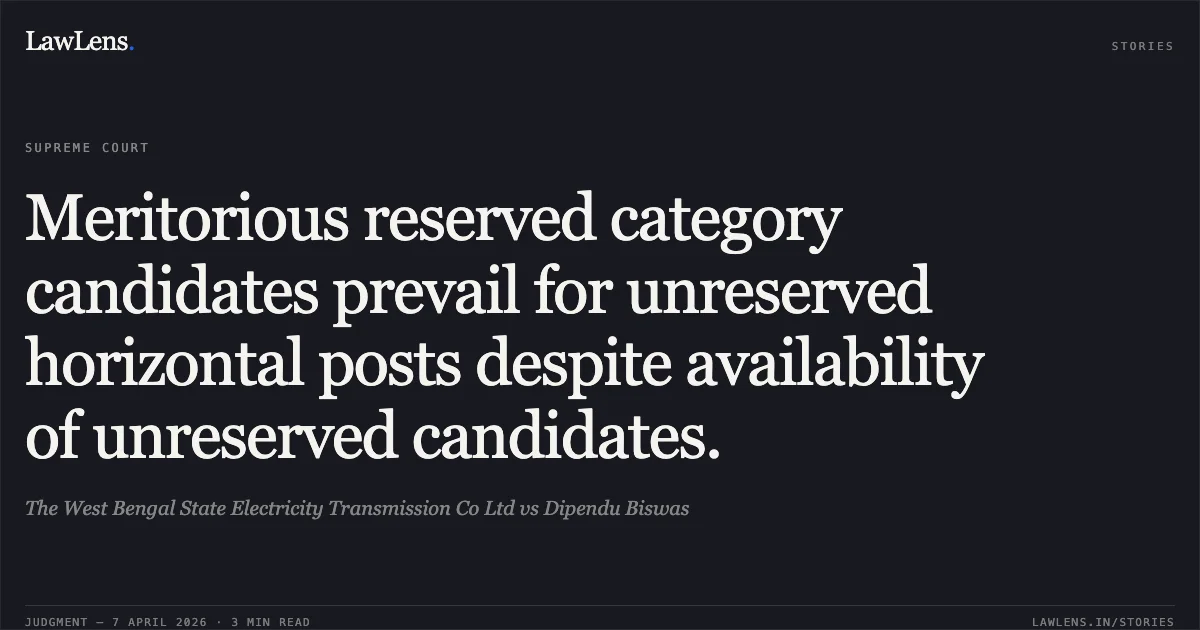
Whether a meritorious PWD-LV candidate belonging to a reserved social category (OBC-A) can be appointed against a horizontal reservation vacancy in the Unreserved category [UR (PWD-LV)] even if a qualified unreserved candidate is available.
Source reference: p. 2, para 2; p. 18, para 25Law Applied
The court relied on the landmark principles of reservation established in Indra Sawhney v. Union of India, which distinguished between vertical and horizontal reservations and affirmed that reserved category candidates selected on their own merit are not counted against the reserved quota.
Source reference: p. 13-15, para 20-21It further applied Saurav Yadav v. State of UP, which held that the "Open/Unreserved" category is not a social category but a merit pool where horizontal reservation quotas must first be filled by adjusting the most meritorious candidates, regardless of their social category.
Source reference: p. 15-16, para 22; p. 34, para 45Additionally, the court cited Deepa E.V. v. Union of India to clarify that such migration is permissible only if the reserved candidate has not availed of any relaxation (age/marks) meant specifically for their reserved category.
Source reference: p. 37, para 47Reasoning
The Court reasoned that the "Unreserved" category is not a "communal or social" category but a pool open to all candidates based on merit.
Source reference: p. 28-29, para 41When a horizontal reservation (like PWD-LV) is applied to the Unreserved category, it remains "Open" to all persons with that specific disability, whether they belong to SC, ST, OBC, or no reserved category.
Source reference: p. 20-21, para 28-30The Court held that the principle of "mobility" allows a more meritorious reserved category candidate (Respondent No. 3) to migrate to the Unreserved pool.
Source reference: p. 22, para 31The Division Bench's interpretation—that an unreserved candidate must be preferred simply for being "unreserved"—was deemed fallacious as it treated "Unreserved" as a protected social class rather than a merit-based pool.
Source reference: p. 28-29, para 41The Court clarified that the notification's "non-availability" clause was merely a restatement of the law and could not be used to bypass the merit of Respondent No. 3, who had scored higher than Respondent No. 1 and had not used any eligibility relaxations.
Source reference: p. 31-33, para 43-44; p. 37, para 48Holding
The Supreme Court allowed the appeal and set aside the Division Bench's judgment.
The Court held that for a vacancy under the Unreserved horizontal category, all candidates belonging to that special category (PWD-LV) are equal, and the most meritorious candidate must be preferred, regardless of their social reserved status.
Source reference: p. 33-34, para 44Consequently, the appointment of the more meritorious Respondent No. 3 was upheld, and the Single Bench decision was restored.
Source reference: p. 38, para 50Original Court PDF
The West Bengal State Electricity Transmission Co LtdvsDipendu Biswas
Click to open original judgment
Original judgment, available to read, download and summarize on LawLens.in