Facts
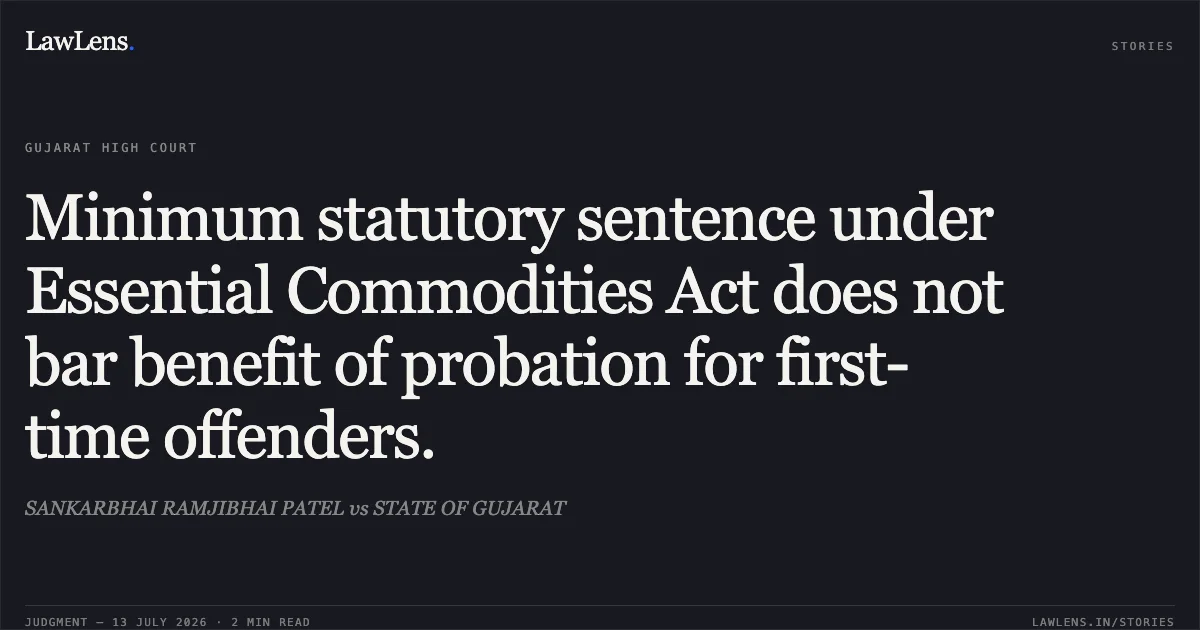
The applicant was convicted by the Addl. Judicial Magistrate First Class, Visnagar (Criminal Case No. 940/2010), for an offense under Section 7 of the Essential Commodities Act, 1955, and sentenced to 6 months rigorous imprisonment.
Source reference: p. 2The conviction was later confirmed by the 5th Addl. Sessions Judge, Mehsana, in Criminal Appeal No. 7/2018.
Source reference: p. 2The initial complaint involved storage of kerosene beyond limits (for which he was acquitted) and the discovery of four gas cylinders at his premises.
Source reference: p. 3, 7The applicant, aged 71 and suffering from age-related ailments, challenged the conviction and sought the benefit of probation.
Source reference: p. 3Issues
1. Whether the Court can exercise discretion under Section 360 of the CrPC or Section 4 of the Probation of Offenders Act for a conviction under the Essential Commodities Act, especially where a minimum sentence is prescribed.
Source reference: p. 5-6, para. 5.42. Whether the applicant's age, lack of criminal antecedents, and the lapse of 18 years since the incident warrant the grant of probation.
Source reference: p. 7, para. 8–10Law Applied
The court primarily applied Section 397 read with Section 401 of the Code of Criminal Procedure (CrPC), 1973, regarding revision jurisdiction.
Source reference: p. 2It relied on Section 360 of the CrPC and Section 4 of the Probation of Offenders Act, 1958, which permit the release of offenders on probation for good conduct.
Source reference: p. 4For substantive law, it applied Section 7 of the Essential Commodities Act, 1955.
Source reference: p. 2Tarak Nath Keshari v. State of West Bengal (2024), which held that a statutory minimum sentence is not a hurdle for invoking probation laws.
Source reference: p. 5Harivallabha v. State of MP and Dhurukumar v. State of Maharashtra, where probation was granted for Section 7 offenses to first-time offenders.
Source reference: p. 4-5Reasoning
The court evaluated the applicant's request for probation by balancing the statutory requirements of the Essential Commodities Act against the reformative principles of the CrPC.
Source reference: no citationThe court noted that although Section 7 of the Act prescribes a minimum sentence of three months, recent Supreme Court jurisprudence in Tarak Nath Keshari clarifies that Section 4 of the Probation of Offenders Act remains applicable in special circumstances.
Source reference: p. 5-6, 7-8In applying this to the facts, the court found that the applicant is 71 years old, has no prior criminal antecedents as verified by the State's report, and has maintained peace during the 18-year pendency of the case.
Source reference: p. 6-8The court reasoned that given these factors, a custodial sentence was unnecessary, and the objectives of justice would be met by releasing him on a bond of good behavior.
Source reference: p. 8Holding
The court allowed the revision application in part. While not interfering with the conviction, it modified the sentence by granting the benefit of probation.
The Court directed the applicant to be released on probation under Section 360 of the CrPC upon entering into bonds and furnishing sureties before the trial court to ensure peace and good behavior for the remainder of the period. The sentence of imprisonment was thus suspended in favor of probation.
Source reference: p. 9Acts & Sections Cited
6 provisions across 3 statutes referred to in this judgment. Each provision opens on LawLens.
Code of Criminal Procedure, 19734
Essential Commodities Act, 19551
Probation of Offenders Act, 19581
Original Court PDF
SANKARBHAI RAMJIBHAI PATELvsSTATE OF GUJARAT
Click to open original judgment
Original judgment, available to read, download and summarize on LawLens.in