01Facts
The petitioner, a former government employee, filed a writ petition under Article 226 of the Constitution seeking payment of retiral dues with interest, extension of the Sixth Pay Commission benefits from 1.1.2006, first and second Kramonnati (time-bound progression) benefits, time-scale and promotion benefits, annual increments, and quashing of a charge-sheet.
¶ 2The respondents' return stated that the petitioner's PPO had been processed, that he had been receiving pension since 2021, and that gratuity had been paid.
¶ 3The return did not address his entitlement to the Sixth Pay Commission, Kramonnati or other consequential benefits.
¶ 3The petitioner then filed an additional rejoinder annexing a Collector, Shivpuri letter dated 20.11.2023 detailing amounts paid.
¶ 3By an amendment application, allowed by the Court, the petitioner added claims for unpaid salary for specified periods, arrears of pension, Sixth and Seventh Pay Commission arrears, encashment of surrender leave, time-bound pay-scale arrears, and interest on gratuity, with interest at 18% per annum.
¶ 2–302Issues
i.1. Whether the Court should adjudicate the entitlement of the petitioner to the newly added monetary claims in the amendment application in writ jurisdiction, when those reliefs were not part of the original petition.
¶ 4ii.2. Whether the respondents are required to consider the petitioner's claims, disburse admissible amounts, and, where any claim is denied, assign cogent reasons within a fixed time.
¶ 5, 7, 8, 10iii.3. Whether the petitioner is entitled to interest on delayed payment of any amount found due, and at what rate.
¶ 603Law Applied
The petition was invoked under Article 226 of the Constitution of India.
¶ 2The Court did not decide any statutory or service-law question, and no statute, rule or precedent is cited in the order.
Where new reliefs not pleaded in the original petition are introduced, the claims should first be placed before the executive authority through a detailed representation with supporting documents, so that the State can examine them in the first instance.
¶ 4The authority must act on admissible claims that are undisputed and must assign cogent reasons for any denial, communicated within the stipulated period.
¶ 7–8Interest on delayed payment is granted at 8% per annum.
¶ 6The petitioner retains the right to challenge any adverse decision by a fresh petition.
¶ 904Reasoning
The Court refrained from examining the merits of the amended claims, noting that they did not form part of the original reliefs and that the respondents had not adjudicated them.
¶ 3–4Instead, it granted the petitioner liberty to file a detailed representation with documents substantiating each claim, directing the executive to decide the claims in the first instance and avoiding a merits determination on an incomplete record.
¶ 4To ensure timely action, the Court directed the respondents to consider all prayers and disburse admissible amounts, and to release undisputed admissible claims within the stipulated period.
¶ 5, 8Where any legal impediment is found, the respondents must give reasons and communicate them within 45 days.
¶ 7The Court fixed interest at 8% on delayed payments, which is lower than the 18% sought in the amendment application, indicating that the Court did not accept the higher rate at this stage.
¶ 6The reservation of liberty to challenge any adverse decision preserves the petitioner's remedy without deciding the entitlement question.
¶ 905Holding
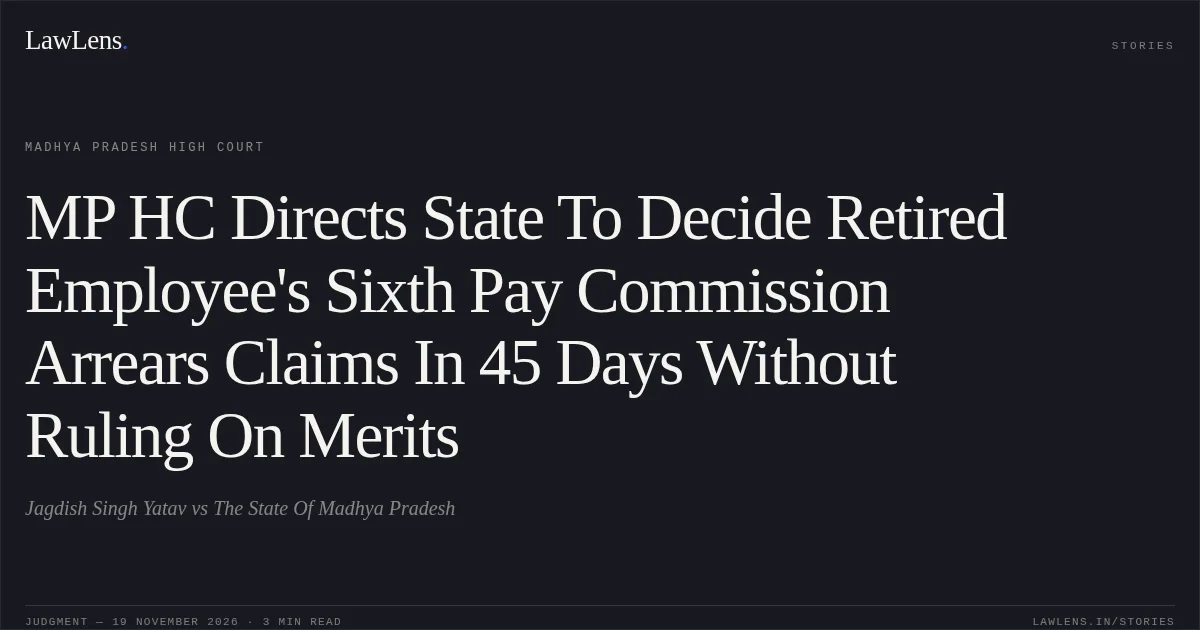
The Court held that it would not adjudicate the entitlement to the amended monetary claims at this stage, and disposed of the writ petition with liberty to the petitioner to file a detailed representation with supporting documents.
¶ 4, 11The respondents are directed to consider all prayers in the amendment application and disburse admissible amounts if the petitioner is found entitled. Interest at 8% applies to any delayed payment found due. Any legal impediment must be addressed by a reasoned order communicated within 45 days, and undisputed admissible claims must be released within the same period. If dissatisfied, the petitioner may file a fresh petition. The petition stands disposed of.
¶ 5, 6, 7, 8, 9, 10, 11Original Court PDF
Jagdish Singh YatavvsThe State Of Madhya Pradesh
Click to open original judgment
Original judgment, available to read, download and summarize on LawLens.in