01Facts
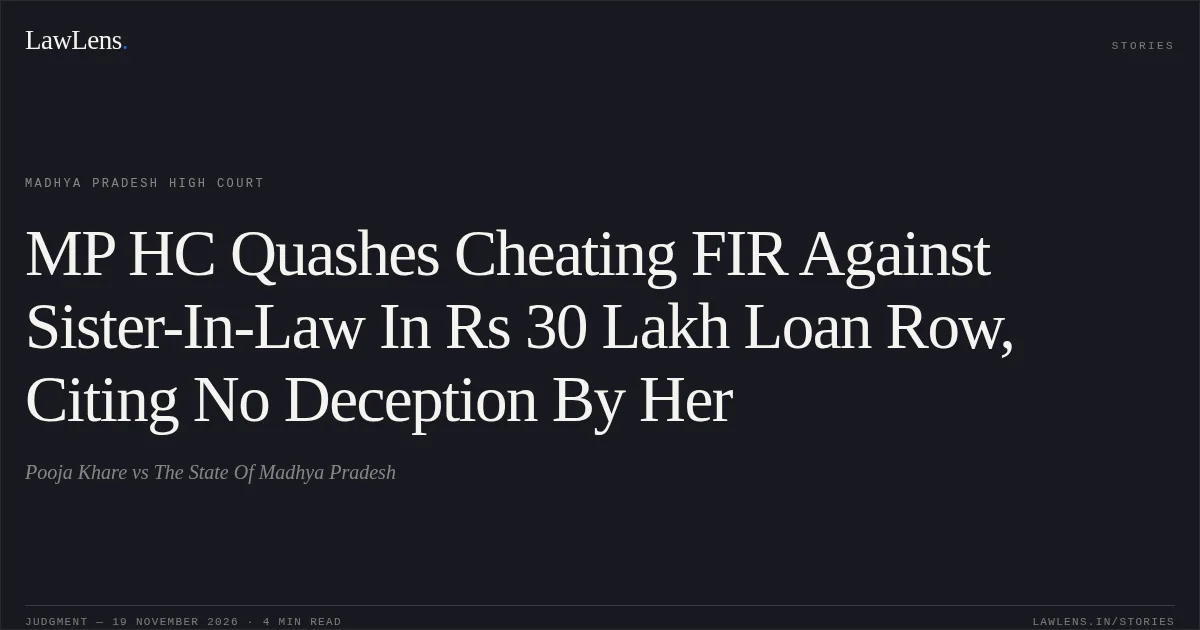
The applicant, Pooja Khare, sought quashing under Section 482 CrPC of FIR No. 432/2018 (P.S. Bagsewaniya, Bhopal) for offences under Sections 420 and 34 IPC, and of Case No. 13989/2018 pending before the JMFC, Bhopal.
¶ 1The complainant, Govind Prasad Gupta, alleged that he wanted a loan of Rs. 3 lakhs against his house but a loan of Rs. 30 lakhs was obtained from Punjab National Bank, Sadhna Branch, using his house as security.
¶ 2On receiving the bank's notice, he approached co-accused Sandeep Khare, who assured repayment and release of the registry, and executed a written agreement dated 30.09.2017 with him.
¶ 2The FIR attributes the inducing acts (approaching, persuading, assuring, and agreeing) solely to Sandeep Khare; the applicant's name appears only in the general narration.
¶ 2In his examination-in-chief, the complainant stated that Sandeep Khare took him to the bank, that the bank sanctioned Rs. 30 lakhs, and that Sandeep Khare took his registry. As against the applicant, he stated only that she refused his request and said no loan had been taken.
¶ 3He admitted he can read and write Hindi and English, and the agreement (Ex. P-4) is between himself and Sandeep Khare, with the applicant not a party.
¶ 3The Branch Manager's statement records that the Rs. 30 lakh cash credit was sanctioned to the applicant's firm, that the complainant, as guarantor, was told the house was being mortgaged for Rs. 30 lakhs, consented, signed, and got the mortgage registered on 02.12.2015.
¶ 4The loan amount was credited to the applicant's account as borrower, and the applicant and Sandeep Khare are bhabhi and brother-in-law.
¶ 4The complainant has also filed S.A. No. 273/2025 before the Debts Recovery Tribunal, which is pending.
¶ 402Issues
i.1. Whether the allegations and investigation material disclose the essential ingredients of cheating (deception and dishonest inducement) under Section 420 IPC against the applicant.
¶ 8 · ¶ 9ii.2. Whether the applicant can be roped in under Section 34 IPC merely on the basis of her familial relationship with the co-accused and the credit of loan proceeds to her firm, in the absence of any pre-arranged plan.
¶ 9iii.3. Whether continuation of the criminal proceedings against the applicant, in substance a civil dispute, amounts to an abuse of the process of the Court warranting interference under Section 482 CrPC.
¶ 1003Law Applied
The Court applied Section 482 CrPC, which preserves the High Court's inherent powers to prevent abuse of process and secure the ends of justice.
¶ 6The Court relied on Section 415 IPC, which defines cheating as deception that fraudulently or dishonestly induces delivery of property or consent to retention of property, or intentional inducement to act or omit to act, causing or likely causing harm.
¶ 7Section 420 IPC punishes cheating that dishonestly induces delivery of property or alteration or destruction of a valuable security.
¶ 7Section 34 IPC makes each person liable for a criminal act done by several persons in furtherance of a common intention.
¶ 7The Court followed the Supreme Court in Sudha Rakesh v. State of Karnataka & Anr., 2026 INSC 1086, which holds that cheating requires a deceptive act leading to inducement for delivery of property, and that the absence of this foundational ingredient, where the dispute is essentially civil, warrants quashing of the FIR.
¶ 8Provisions in the judgment · 5 · Linked ones open on LawLens
Code of Criminal Procedure, 1973 Section 482
Indian Penal Code, 1860 Section 420Section 34Section 415Section 423
04Reasoning
The Court first found that, on the complainant's own account, Sandeep Khare alone took him to the bank, took his registry, and gave the assurances, while the applicant only refused his request and said no loan had been taken.
¶ 3 · ¶ 9The FIR does not attribute any deceptive act or dishonest inducement to the applicant.
¶ 2 · ¶ 9The Court held that the sanction of the Rs. 30 lakh loan to the applicant's firm and its credit to her account were the natural consequences of a loan transaction and did not, by themselves, amount to deception of the complainant.
¶ 9The Branch Manager's statement showed that the complainant was told of the Rs. 30 lakh terms, consented, signed, and registered the mortgage. The complainant was also literate in English and Hindi.
¶ 4 · ¶ 9Applying Sudha Rakesh, the Court reasoned that the grievance (non-repayment and continued mortgage of the house) is a liability under the loan, mortgage, and agreement documents, for which civil remedies exist and are already being pursued before the DRT.
¶ 9On Section 34, the Court held that the bhabhi-brother-in-law relationship, absent any allegation of a pre-arranged plan, could not attract common intention.
¶ 9Accordingly, the Court found that the matter casts the shadow of criminality on a civil dispute, and that continuing the prosecution against the applicant would abuse the process of Court.
¶ 1005Holding
The Court answered all three issues in the applicant's favour. The foundational ingredient of cheating is absent as against the applicant, Section 34 IPC cannot be invoked on the mere relationship, and continuation of proceedings would be an abuse of process.
¶ 9 · ¶ 10The application is allowed. The FIR in Crime No. 432/2018 (P.S. Bagsewaniya, Bhopal) under Sections 420 and 34 IPC, and all consequential proceedings in Case No. 13989/2018 before the JMFC, Bhopal, are quashed qua the applicant, Pooja Khare.
¶ 11The observations are confined to the applicant and do not affect the trial of co-accused Sandeep Khare, the DRT proceedings, or any civil remedy of the complainant or the bank. A copy is to be sent to the trial Court.
¶ 11 · ¶ 12Original Court PDF
Pooja KharevsThe State Of Madhya Pradesh
Click to open original judgment
Original judgment, available to read, download and summarize on LawLens.in