01Facts
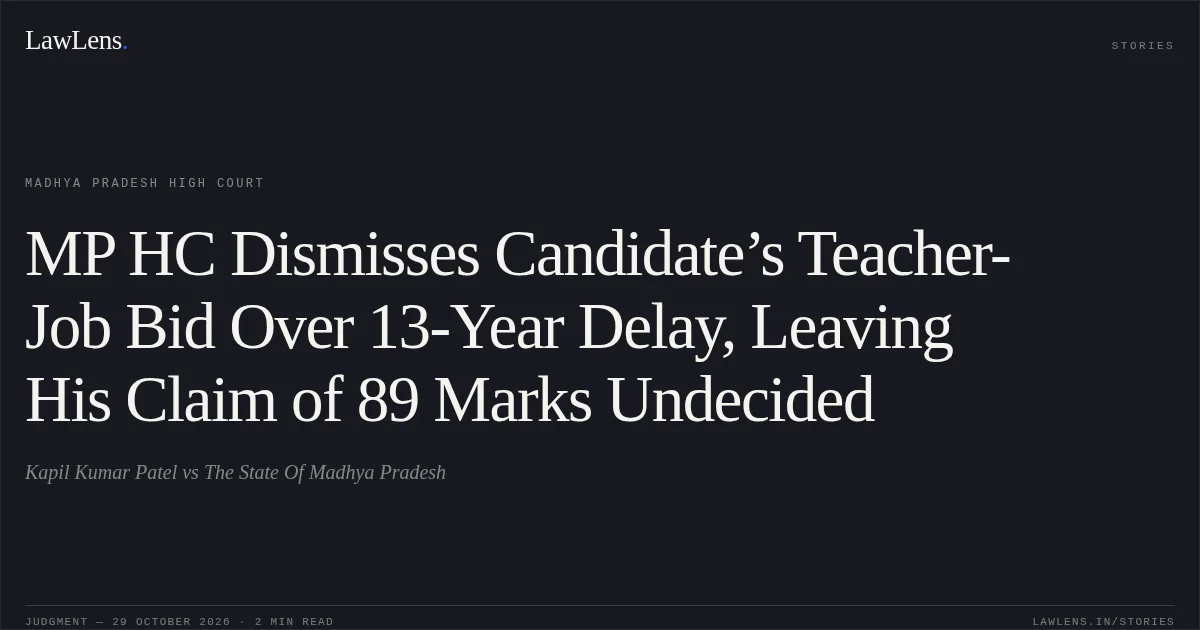
The petitioner sought appointment as Samvida Shala Shikshak Grade-III, asserting that he had scored 89 marks in the Eligibility Test under the OBC category and that candidates of the same category with lower scores had been appointed. He requested reconsideration against a vacancy arising from an appointment order dated 5 July 2013 and also sought a decision on his pending representation.
¶ 1The petitioner relied on Rule 7 of the Madhya Pradesh Panchayat Samvida Shala Shikshak (Niyojan Avam Samvida ki Sharten) Niyam, 2005, and the Recruitment Scheme dated 29 July 2011.
¶ 2The State opposed the petition on the preliminary ground of delay, laches and acquiescence.
¶ 3The Court dismissed the petition on that ground without determining the merits of the appointment claim.
¶ 5, 10–1102Issues
i.Whether the petitioner’s claim warranted the High Court’s discretionary interference under Article 226 despite the State’s objection of delay, laches and acquiescence
¶ 3, 5ii.Whether the petitioner was entitled to a direction for reconsideration of his appointment claim or for a decision on his pending representation
¶ 103Law Applied
Article 226 relief is discretionary, and a High Court may decline to exercise its extraordinary jurisdiction where delay or laches, considered with the surrounding circumstances, makes relief inappropriate; the discretion must be exercised judicially and reasonably (Karnataka Power Corpn. Ltd. v. K. Thangappan, (2006) 4 SCC 322).
¶ 8In assessing delay, courts should consider the length of delay, the litigant’s conduct and bona fides, and the prejudice or injustice that may result; a liberal approach to delay does not permit an unbounded or routine condonation (Esha Bhattacharjee v. Managing Committee of Raghunathpur Nafar Academy, (2013) 12 SCC 649).
¶ 6A litigant cannot rely on relief granted to a diligent claimant in another case to justify approaching the court after delay (State of Orissa v. Mamata Mohanty, (2011) 3 SCC 436).
¶ 7A party who has slept on a right may be denied discretionary relief (Ashok Kumar v. District Magistrate, Basti, (2012) 3 SCC 311).
¶ 904Reasoning
The Court considered the State’s preliminary objection and concluded, having regard to the facts and circumstances, that the petitioner’s claim did not warrant interference under Article 226.
¶ 5It relied on authorities establishing that delay and laches may justify refusing discretionary writ relief, and stated that it was not inclined to entertain the petition on that ground.
¶ 6–10The judgment does not specify the period of delay or separately analyse the petitioner’s explanation for it. It therefore did not decide whether his marks or the recruitment rules entitled him to appointment, or whether the representation should be decided.
¶ 10–1105Holding
The Court dismissed the writ petition on the ground of delay and laches.
¶ 11The petitioner obtained no direction for reconsideration of his appointment claim or for a decision on his representation; the merits of those claims were not adjudicated.
¶ 10–11Original Court PDF
Kapil Kumar PatelvsThe State Of Madhya Pradesh
Click to open original judgment
Original judgment, available to read, download and summarize on LawLens.in