01Facts
The petitioners claimed longstanding possession and cultivation of the disputed land through their predecessors, and said they had paid land revenue and water tax.
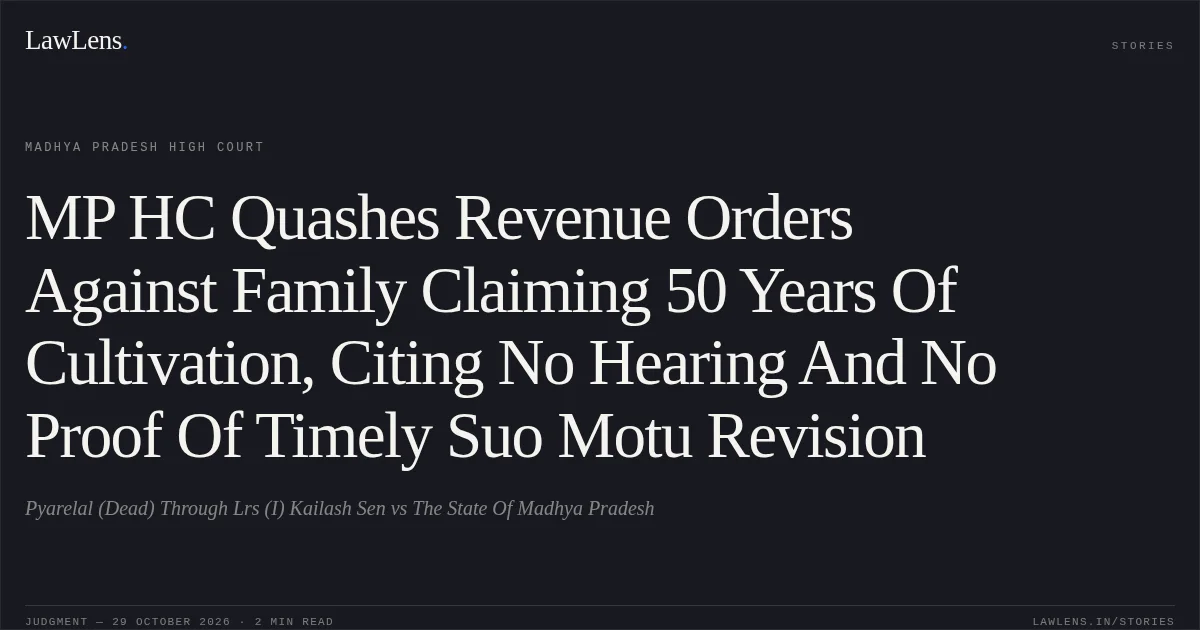
¶ 1–2The Collector, Vidisha, initiated suo motu revision and passed an adverse order on 26 February 2004; the petitioners challenged that order before the Additional Commissioner and the Board of Revenue, without success.
¶ 1–2They then sought writ relief against the revenue authorities’ orders, contending that the revision was initiated after an unreasonable delay and without notice or a hearing.
¶ 1–202Issues
i.Whether the Collector could exercise suo motu revisional powers under Section 50 of the Madhya Pradesh Land Revenue Code, 1959, after an unreasonable lapse of time.
¶ 6, 10–12ii.Whether the adverse order could stand when the petitioners were not given notice and an effective opportunity to be heard.
¶ 8–903Law Applied
Section 50 of the Madhya Pradesh Land Revenue Code, 1959, confers suo motu revisional powers, but where no specific limitation period is prescribed, those powers must be exercised within a reasonable time.
¶ 6–7The Full Bench decision in Ranveer Singh and Others v. State of M.P., 2010 (4) MPLJ 178, held that such powers should be exercised within 180 days from the revisional authority’s knowledge of the alleged illegality, impropriety, or irregularity, including where Government land or public interest is involved.
¶ 10Shaheed Anvar v. Board of Revenue and Another, 2000 RN 76, establishes that an affected party must receive notice and an opportunity to present objections before suo motu revision proceeds.
¶ 8The Court also relied on Mohammad Kavi v. Fatmabai Ibrahim, 1998 (1) MPWN SN 26; Situ Sahu and Others v. State of Jharkhand and Others, AIR 2004 SC 4918; and State of M.P. and Another v. Board of Revenue, Gwalior and Others, 2006 (2) MPLJ 580, for the principle that revisional powers must be exercised within a reasonable period.
¶ 3, 7Provisions in the judgment · 1 · Linked ones open on LawLens
MP Land Revenue Code 1959 Section 50
04Reasoning
The respondents did not establish that the petitioners received notice or an effective hearing before the Collector made the adverse order; the action therefore violated natural justice.
¶ 9The respondents also failed to show when the authority acquired knowledge of the alleged irregularity or that proceedings were initiated within the 180-day period described in Ranveer Singh.
¶ 10–12The Court treated that decision as explaining the governing legal principle notwithstanding that it was delivered after the proceedings in this case began.
¶ 10–12The claimed prolonged possession and resulting prejudice further supported the conclusion that the exercise of revisional jurisdiction could not be sustained.
¶ 1205Holding
The Court held that the impugned orders were unsustainable for both failure to provide an opportunity of hearing and failure to establish timely exercise of suo motu revisional powers.
¶ 13It allowed the petition and quashed the orders of the Collector, Additional Commissioner, and Board of Revenue contained in Annexures P/1 to P/4.
¶ 13, 15The Court did not determine the petitioners’ ultimate entitlement to the land or their claim concerning stamp duty and other charges.
¶ 14Original Court PDF
Pyarelal (Dead) Through Lrs (I) Kailash SenvsThe State Of Madhya Pradesh
Click to open original judgment
Original judgment, available to read, download and summarize on LawLens.in