Facts
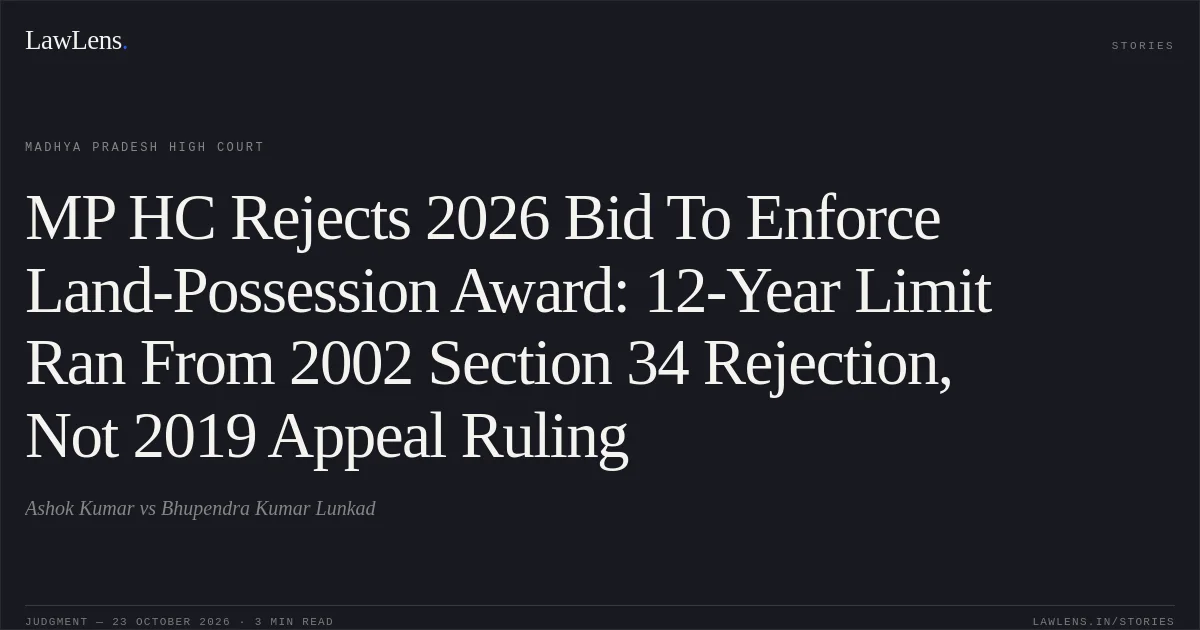
The parties referred their dispute in a pending civil suit to a sole arbitrator, who made an award on 10 January 2000 directing delivery of possession to the claimant.
Source reference: para. 2–8The trial court rejected the judgment debtor’s Section 34 objections on 7 January 2002 and passed a decree in accordance with the award; the decree was upheld in first appeal.
Source reference: para. 2–8In 2019, the High Court set aside the civil-court proceedings after the award as without jurisdiction, and granted liberty to challenge the award under Section 34 before the competent court.
Source reference: para. 2–8The award holder’s first execution proceeding, filed in 2024, was declined because the award was insufficiently stamped; after impounding the award, the holder filed the present execution proceeding.
Source reference: para. 2–8Issues
1. Whether an arbitral award merges into an order passed by a civil court under the Arbitration and Conciliation Act, 1996, such that the doctrine of merger applies
Source reference: para. 22(a)2. Whether, and from what date, limitation for executing an arbitral award runs where objections to the award have been dismissed
Source reference: para. 22(b)3. Whether an arbitral award may be executed only before the “Court” defined in Section 2(1)(e) of the 1996 Act, or before any court with territorial jurisdiction to execute it
Source reference: para. 22(c)Law Applied
Section 36 of the Arbitration and Conciliation Act, 1996, as it stood before the 2015 amendment, provided that an award became enforceable as a decree when the time to apply under Section 34 expired or a Section 34 application was refused; under the amended provision, filing a Section 34 application does not itself make the award unenforceable, absent a stay.
Source reference: para. 23, 28–29Article 136 of the Limitation Act, 1963 prescribes 12 years for execution of a domestic arbitral award, with time running from when the award becomes enforceable.
Source reference: para. 24In Government of India v. Vedanta Ltd., the Supreme Court held that Section 36 creates a limited legal fiction for enforcement: an award is not a civil-court decree for all purposes, and arbitral proceedings are not court proceedings.
Source reference: para. 24The doctrine of merger applies to appealable civil-court decrees, as discussed in Chandi Prasad v. Jagdish Prasad and Shanti v. T.D. Vishwanathan, but does not apply to an arbitral award merely because a court has ruled on a Section 34 challenge; an arbitral award is not merged into that court’s order.
Source reference: para. 26–28Reasoning
The award was made in 2000, and the Section 34 application was rejected on 7 January 2002. Because the unamended Section 36 applied, the court held that the award became enforceable on that date, notwithstanding the later appeals, as no stay of execution had been granted.
Source reference: para. 30The High Court’s 2019 decision setting aside the civil-court proceedings did not cause the award to merge into a later court order or restart limitation: the award remained an arbitral award, and the doctrine of merger did not apply.
Source reference: para. 26, 30Accordingly, the 12-year limitation period under Article 136 expired before the first execution proceeding was filed in 2024. The court therefore found it unnecessary to decide which court had jurisdiction to execute the award.
Source reference: para. 30–31Holding
The High Court held that the award became enforceable on 7 January 2002 and that execution had to be brought within 12 years of that date.
As the execution was first filed in 2024, it was time-barred. The Court allowed the civil revision, set aside the executing court’s order dated 21 September 2026, and rejected Execution Arbitration Case No. 05/2026 as barred by limitation.
Source reference: para. 30–33It left the question of the competent executing court open and made no order as to costs.
Source reference: para. 30–33Acts & Sections Cited
15 provisions across 4 statutes referred to in this judgment. Each provision opens on LawLens.
Arbitration and Conciliation Act, 19967
Code of Civil Procedure, 19085
Provincial Insolvency Act, 19201
Limitation Act, 19632
Original Court PDF
Ashok KumarvsBhupendra Kumar Lunkad
Click to open original judgment
Original judgment, available to read, download and summarize on LawLens.in