Facts
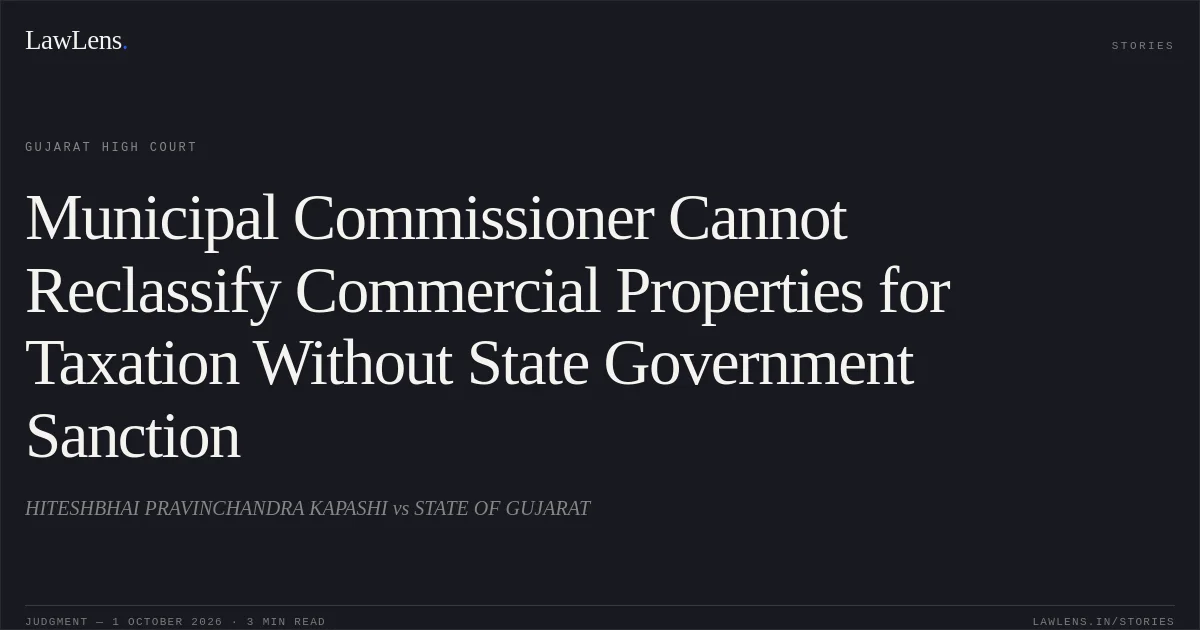
The petitioners challenged a Bhavnagar Municipal Corporation order dated 27 March 2015 that classified shops and showrooms with carpet areas exceeding 35 square metres as NU-1 properties, attracting a tax multiplier of 5, rather than NU-2 properties, attracting a multiplier of 3.
Source reference: para. 1–3, 15–21The underlying property-tax Rules had been framed and approved by the State Government under the Gujarat Provincial Municipal Corporations Act, 1949 (the “Act”).
Source reference: para. 1–3, 15–21The petitioners argued that the Commissioner lacked authority to alter those categories without State sanction and that retrospective tax demands were also unlawful, including where attachment action was taken without the required notice.
Source reference: para. 4–9The State stated that the 2015 order was clarificatory but acknowledged that the department had not been consulted; the Corporation maintained that the Commissioner could further classify properties.
Source reference: para. 10–13The State issued fresh Rules on 31 March 2020, after which the disputed carpet-area division was no longer applied.
Source reference: para. 38Issues
1. Whether the Commissioner could, without State Government sanction and Official Gazette publication, classify shops and showrooms exceeding 35 square metres as NU-1, thereby altering the State-approved NU-1 and NU-2 categories.
Source reference: para. 19–21, 31–372. Whether the Corporation could levy retrospective property tax on the petitioners, and what process and time limits governed any fresh retrospective assessment.
Source reference: para. 39–42Law Applied
Section 141AA(c) of the Act permits a general tax to be levied on a graduated scale, while Section 141B provides for determining tax rates by carpet area, classifying buildings as residential or non-residential, and adjusting rates by reference to specified factors; the statutory 40-square-metre threshold applies to residential buildings, not non-residential buildings.
Source reference: para. 22–30Under Sections 454 and 455, rules concerning property taxation—including rules that are added to or altered—require State Government sanction and final publication in the Official Gazette.
Source reference: para. 31–34The Commissioner’s authority under the approved Rules to include other buildings did not authorize him to change the prescribed categories by imposing a carpet-area threshold.
Source reference: para. 19, 36–37On retrospective assessment, the Court relied on Tokle Timber Mart v. State of Gujarat & Anr., SCA No. 16400 of 2015 (21 July 2016), which held that, under Rule 21A of the Taxation Rules, a notice for retrospective tax must be issued within one year of the relevant event coming to the Commissioner’s knowledge; absent the necessary factual basis, tax cannot be recovered for periods long before the special notice.
Source reference: para. 40The Court also directed the Corporation to consider its decision in SCA No. 18287 of 2015 before issuing fresh retrospective bills.
Source reference: para. 42(b)Reasoning
The 2013 Rules assigned shops and showrooms to the NU-1 or NU-2 categories, and the Commissioner’s power to include other buildings did not extend to shifting an existing category based on a newly imposed 35-square-metre threshold.
Source reference: para. 19–21, 35–37Because that threshold moved shops from NU-2 to the higher-tax NU-1 category, it altered the approved Rules and could not be introduced without State sanction under Section 455; the order was also not shown to have been published in the Official Gazette.
Source reference: para. 19–21, 35–37The Court did not finally determine the factual dispute over when the Corporation learned of the relevant developments or whether each petitioner had been served with notice.
Source reference: para. 41–42Instead, it permitted fresh tax bills, subject to consideration of the cited precedent and the petitioners’ right to pursue appropriate proceedings against any adverse retrospective assessment.
Source reference: para. 41–42Holding
The Court allowed the petitions and quashed the 27 March 2015 order and subsequent action taken pursuant to it.
It directed removal of seals and permitted the petitioners to use their properties upon payment of outstanding taxes from the dates specified for each petition in paragraph 39.
Source reference: para. 42The Corporation may issue fresh tax bills within 12 weeks of receiving the judgment; any adverse retrospective levy is not to be implemented for two weeks, and amounts already paid must be adjusted against the tax liability.
Source reference: para. 42The relief was confined to the petitioners; taxpayers who had paid without protest are not to have their cases reopened or reassessed.
Source reference: para. 43Rule was made absolute to that extent.
Source reference: para. 44Acts & Sections Cited
9 provisions across 1 statute referred to in this judgment. Each provision opens on LawLens.
Gujarat Provincial Municipal Corporations Act, 1949
Original Court PDF
HITESHBHAI PRAVINCHANDRA KAPASHIvsSTATE OF GUJARAT
Click to open original judgment
Original judgment, available to read, download and summarize on LawLens.in