01Facts
The petitioner, a Muslim unmarried daughter, sought enhanced maintenance from her Muslim father, the respondent.
¶ 1Her original application under Section 125 Cr.P.C. was allowed by the Judicial Magistrate First Class, Ghumarwin, on 09.10.2015, awarding Rs. 2,000 per month.
¶ 2-3The respondent did not challenge that order, which attained finality, and continued paying.
¶ 2-3, 6After Family Courts were established, the petitioner filed an application under Section 127 Cr.P.C. on 11.12.2017 seeking enhancement due to rising living costs.
¶ 4The Additional Principal Judge, Family Court, Ghumarwin, by order dated 12.08.2025 enhanced maintenance to Rs. 4,000 per month from the date of filing, but made it payable only until the petitioner attained majority.
¶ 1, 10The respondent contended that the Section 127 proceedings are an extension of Section 125 and that the daughter's entitlement ends at majority.
¶ 11The petitioner challenged the majority condition in revision.
02Issues
i.1. Whether the Family Court, exercising jurisdiction under Section 127 Cr.P.C., has competence to adjudicate maintenance claims with reference to personal law as well as Section 125 Cr.P.C.
¶ 7, 10, 15-16, 18ii.2. Whether a Muslim father's obligation to maintain an unmarried daughter under Section 125 Cr.P.C., read with Muslim personal law, ends on her attaining majority or continues until her marriage.
¶ 8-12, 18-19iii.3. Whether the Family Court's condition limiting maintenance to the period until the petitioner attains majority is sustainable.
¶ 2003Law Applied
Section 125 Cr.P.C. and Section 127 Cr.P.C. form the procedural basis for maintenance proceedings.
¶ 1, 5, 7Section 3(1)(b) of the Muslim Women (Protection of Rights on Divorce) Act, 1986, as construed in Noor Saba Khatoon v. Mohd. Quasim (1997) 6 SCC 233, holds that a Muslim father's obligation to maintain minor children under Section 125 Cr.P.C. is absolute and, for daughters, extends until marriage, and that the 1986 Act does not curtail this independent right.
¶ 12Jagdish Jugtawat v. Manju Lata (2002) 5 SCC 422 recognises that, when read with personal law and Section 20(3) of the Hindu Adoptions and Maintenance Act, 1956, a daughter's maintenance right under Section 125 Cr.P.C. may be upheld beyond majority to avoid multiplicity of proceedings.
¶ 13Abhilasha v. Parkash (2021) 13 SCC 99 reaffirms the father's obligation to maintain daughters until marriage under Mohammedan law, citing State of Haryana v. Santra (2000) 5 SCC 182.
¶ 14Section 7(1)(f) and Section 7(2)(a) of the Family Courts Act, 1984 vest the Family Court with jurisdiction over maintenance suits and Chapter IX Cr.P.C. proceedings.
¶ 15-16Provisions in the judgment · 7 · Linked ones open on LawLens
Code of Criminal Procedure, 1973 Section 125Section 127Section 482
Muslim Women (Protection of Rights on Divorce) Act, 1986 Section 3
Hindu Adoptions and Maintenance Act, 1956 Section 20Section 3
Family Courts Act, 1984 Section 7
04Reasoning
Jurisdiction under Section 125 and Section 127 Cr.P.C. vests in the Family Court following its establishment, and the Family Court may consider personal law alongside Section 125 Cr.P.C. to avoid multiplicity of proceedings.
¶ 7, 16, 18The impugned order was passed by the Additional Principal Judge, Family Court, and was therefore competent.
¶ 17Under Muslim law and the binding ratio of Noor Saba Khatoon and Abhilasha, an unmarried Muslim daughter is entitled to maintenance until her marriage, and the majority cap imposed by the Family Court was therefore legally incorrect and misconceived.
¶ 18-2005Holding
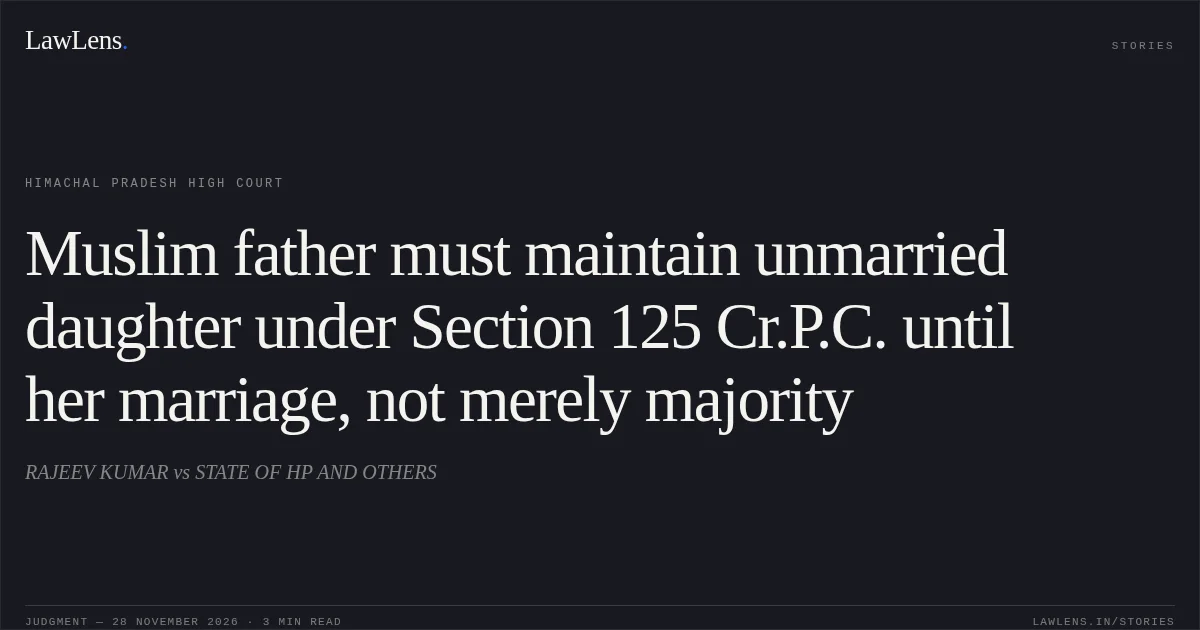
The Family Court has jurisdiction under Section 7 of the Family Courts Act, 1984 to decide Section 127 Cr.P.C. applications and to apply personal law, and a Muslim unmarried daughter's maintenance right extends until her marriage, so the majority condition was incorrect.
¶ 16-20The revision was allowed and the impugned order dated 12.08.2025 was modified so that the petitioner is entitled to Rs. 4,000 per month from 11.12.2017 until she gets married or becomes capable of maintaining herself; arrears are to be paid on or before 31.12.2026, and all other aspects of the order remain unchanged.
¶ 20Original Court PDF
RAJEEV KUMARvsSTATE OF HP AND OTHERS
Click to open original judgment
Original judgment, available to read, download and summarize on LawLens.in