Facts
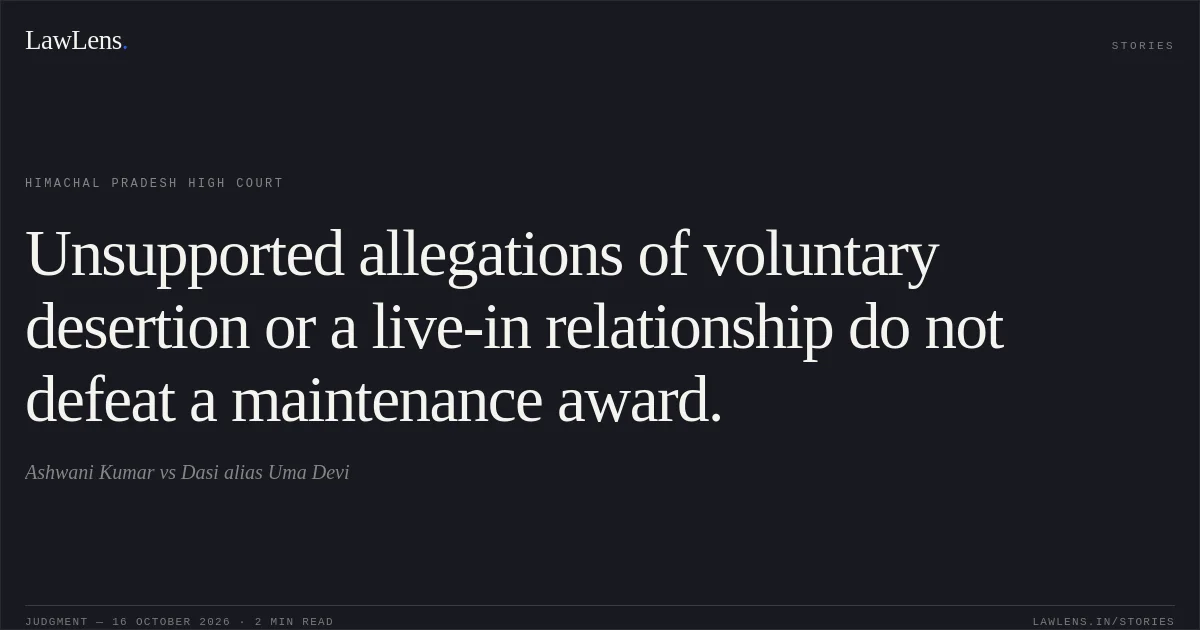
The respondent sought maintenance under Section 125 of the Code of Criminal Procedure, 1973. The Family Court, Mandi, allowed her petition and awarded maintenance of ₹5,000 per month from the date of filing.
Source reference: p. 1, para. 1The petitioner challenged that order, arguing that the respondent remained married to her first husband, had voluntarily left the petitioner, and was in a live-in relationship with another man.
Source reference: pp. 2–3, paras. 2, 10The respondent relied, among other things, on the parties’ 21-year relationship and a Pariwar Register entry recording her as the petitioner’s wife; she also alleged that the petitioner had assaulted and forced her to leave.
Source reference: pp. 3–4, paras. 3, 7The High Court considered the petitioner’s revision against the Family Court’s order.
Source reference: p. 4, para. 4Issues
1. Whether the respondent’s failure to obtain a formal divorce from her first husband barred her from receiving maintenance from the petitioner.
Source reference: pp. 2, 5–6, paras. 2, 6–92. Whether the respondent had voluntarily left the petitioner and was in a live-in relationship with Ashok Kumar, such that the maintenance order should be set aside.
Source reference: pp. 2, 6–8, paras. 2, 10–163. Whether the petitioner’s stated willingness to take the respondent back warranted interference with the maintenance order.
Source reference: p. 8, para. 17Law Applied
The Court considered Section 125 CrPC, under which maintenance may be awarded to a qualifying wife unable to maintain herself.
Source reference: no citationIn assessing the respondent’s claim despite the absence of a formal divorce from her first husband, the Court noted that the Family Court had relied on Supreme Court judgments; however, the judgment does not identify those authorities by name.
Source reference: p. 5, para. 6The Court also applied the evidentiary principle that a party asserting voluntary desertion or a live-in relationship must substantiate that allegation with evidence; a bare assertion is insufficient.
Source reference: pp. 6–7, paras. 11, 13–14Reasoning
The High Court found no basis to disturb the Family Court’s conclusion on the first-marriage issue: that court had addressed it by reference to Supreme Court judgments, and the petitioner did not establish that its findings were perverse.
Source reference: pp. 5–6, paras. 6, 9The Pariwar Register recorded the respondent as the petitioner’s wife, and the petitioner had not disputed that entry or her status as his wife in cross-examination.
Source reference: p. 5, paras. 7–8On desertion and the alleged live-in relationship, the petitioner produced no cogent evidence that the respondent had left voluntarily or was Ashok Kumar’s partner; the agreement he produced described her as a servant.
Source reference: pp. 6–8, paras. 11–16Given the evidence of assault and the parties’ long relationship, the Court rejected the petitioner’s claim that she had voluntarily deserted him.
Source reference: pp. 6, 8, paras. 12, 18It treated the petitioner’s offer to take her back as an attempt to avoid maintenance rather than a ground for interference.
Source reference: p. 8, para. 17Holding
The High Court answered the issues against the petitioner and dismissed the revision, finding no infirmity in the Family Court’s order awarding the respondent ₹5,000 per month from the date of her maintenance petition.
Pending miscellaneous applications were also disposed of.
Source reference: pp. 8–9, para. 19Acts & Sections Cited
1 provisions across 1 statute referred to in this judgment. Each provision opens on LawLens.
Code of Criminal Procedure, 19731
Original Court PDF
Ashwani KumarvsDasi alias Uma Devi
Click to open original judgment
Original judgment, available to read, download and summarize on LawLens.in