Facts
Ram Singh, the Bhumidhar of 96 bighas in Pandwala Kalan, died in 1965–66. Following his death, the land was mutated in 1966 in equal shares between his son, Chander, and his married daughter, Rajban
Source reference: p. 2Upon Rajban's death, her heirs (the Petitioners) sought mutation of her share, which was contested by Chander's sons (Respondents 2–5). The SDM/Revenue Assistant initially ruled against the Petitioners in 2000, but the Deputy Commissioner reversed this in 2001, citing a long lapse of time and the then-prevailing precedent of Gopi Chand
Source reference: p. 2-3In 2006, the Financial Commissioner set aside the Deputy Commissioner’s order, restoring the SDM's decision on the grounds that succession is strictly governed by statute, not revenue entries
Source reference: p. 3The Petitioners challenged this 2006 order via the present writ petition.
Source reference: no citationIssues
1. Whether a mutation entry, accompanied by long-standing possession and acquiescence, can create an inheritable interest or extinguish statutory claims of other heirs in the absence of a registered instrument
Source reference: p. 6, para 15(i)2. Whether the succession of a married daughter is governed by Section 50 of the Delhi Land Reforms Act (DLRA) or if the 1966 mutation is protected by the doctrine of prospective declaration of law
Source reference: p. 7, para 15(ii)3. Whether the devolution of Rajban's alleged interest falls under Section 51 or Section 53 of the DLRA
Source reference: p. 7, para 15(iii)Law Applied
the Court applied Sections 50, 51, and 53 of the Delhi Land Reforms Act (DLRA), 1954, which establish a sequential, gender-specific order of succession, notably excluding married daughters from the line of male lineal descendants
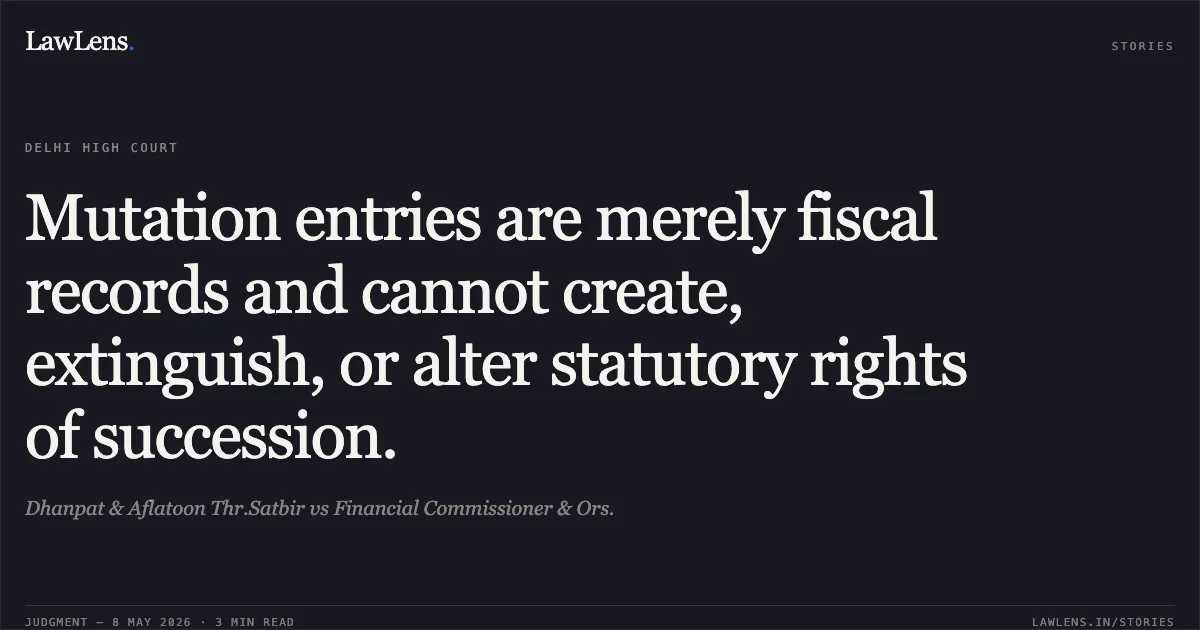
Source reference: p. 8-9, para 18revenue entries/mutations are purely fiscal and do not create or extinguish title, citing Sawarni v. Inder Kaur and Balwant Singh v. Daulat Singh
Source reference: p. 11, para 23Ram Mehar v. Mst. Dakhan, which clarifies that DLRA—not personal law—governs bhumidhari succession
Source reference: p. 15, para 34M.A. Murthy v. State of Karnataka, holding that judicial decisions are retrospective unless expressly stated otherwise
Source reference: p. 15, para 35Reasoning
The Court reasoned that the DLRA is a complete code for agricultural land succession. Under Section 50, as it stood, Rajban (a married daughter) was not an heir to Ram Singh; therefore, the 1966 mutation was legally erroneous at its inception
Source reference: p. 10, para 20The Court rejected the Petitioners' arguments regarding waiver, estoppel, and family settlement, noting that there is "no estoppel against statute" and that rights in immovable property cannot be transferred through mere silence or a fiscal entry without a registered instrument or a specifically proven family arrangement
Source reference: p. 12-13, para 27-30The Court distinguished Gopi Chand and applied Ram Mehar, clarifying that the Financial Commissioner correctly held that administrative misunderstandings or the passage of time cannot override the statutory line of devolution
Source reference: p. 15, para 34Consequently, because Rajban never held a legally cognizable interest, Section 53 (devolution of a female’s independent interest) could not be invoked by her heirs
Source reference: p. 10-11, para 21-25Holding
(i) mutation does not create title or rights of inheritance; (ii) succession to Ram Singh’s interest was governed strictly by Section 50 of the DLRA, which excluded married daughters; and (iii) the long-standing nature of the erroneous revenue entry did not grant the Petitioners any legal right to the land
The Court dismissed the writ petition, upholding the Financial Commissioner’s order dated 14th November 2006. The Financial Commissioner’s decision to restore the SDM’s order was found to be without jurisdictional or legal error
Source reference: p. 17, para 42-43Acts & Sections Cited
5 provisions across 2 statutes referred to in this judgment. Linked provisions open on LawLens.
Delhi Land Revenue Act, 19541
Delhi Lands Reforms Act, 19544
Original Court PDF
Dhanpat & Aflatoon Thr.SatbirvsFinancial Commissioner & Ors.
Click to open original judgment
Original judgment, available to read, download and summarize on LawLens.in