Facts
Jeppiaar Power Corporation Ltd. obtained term loans of ₹92.50 crores and ₹48.50 crores from Indian Bank, for which Jeppiaar Cements Pvt. Ltd. stood as corporate guarantor
Source reference: para. 2(a)Following default by the principal borrower, Indian Bank initiated proceedings under Section 7 of the Insolvency and Bankruptcy Code, 2016 (“IBC”) against the corporate guarantor, and CIRP commenced on 10.10.2019.
Source reference: para. 2(b)The CoC comprised Indian Bank, holding 96.65% voting share, and HDFC Bank, holding 3.35%
Source reference: para. 2(b)The CIRP period was affected by extensions and exclusion of the COVID-19 period. Applications seeking a 90-day extension and exclusion of 737 days were pending before the Adjudicating Authority
Source reference: paras. 2(c)–(d)Meanwhile, on 30.03.2022, Indian Bank sanctioned an OTS to the directors and personal guarantors of the principal borrower, with repayment initially due by 30.06.2022. The appellants made partial payment of ₹66.75 crores, while the balance remained outstanding at the relevant time
Source reference: para. 2(e)At the CoC’s 11th meeting on 13.06.2022, liquidation was proposed and voting remained open until 04.07.2022; neither CoC member voted in favour of liquidation
Source reference: para. 2(f)The Resolution Professional initially filed an application under Section 60(5) seeking directions, but subsequently filed an application under Section 33(1) for liquidation after communicating with Indian Bank and stating that the Tribunal Registry had advised that the application should be filed under Section 33(1)
Source reference: para. 2(g)The Adjudicating Authority ordered liquidation on 26.08.2022. After the liquidation order, the personal guarantors completed the OTS payments, and Indian Bank issued a no-objection certificate on 15.09.2022
Source reference: para. 2(h)Indian Bank later filed an application under Section 12A for withdrawal of CIRP, but it was dismissed because the corporate debtor had already entered liquidation
Source reference: para. 2(i)The suspended directors challenged the liquidation order.
Source reference: no citationIssues
Whether the liquidation order passed under Section 33(1) of the IBC was legally sustainable when the CoC had not approved liquidation and the Resolution Professional’s decision to seek liquidation was influenced by the Tribunal Registry and an individual CoC member outside a formal CoC meeting?
Source reference: paras. 6, 10Whether the Resolution Professional was required to consider seeking extension of the CIRP period so as to facilitate settlement and withdrawal under Section 12A, particularly when the OTS process was ongoing?
Source reference: paras. 11, 20–22Whether CIRP could be restored after an order of liquidation in exceptional circumstances to enable consideration of withdrawal under Section 12A?
Source reference: para. 8Whether liquidation was appropriate when the principal financial debts had substantially been settled and the possibility of resolving the insolvency through settlement remained available?
Source reference: paras. 7, 12–13, 23–25Law Applied
The Court applied Sections 12(3), 12A, 33(1), 33(2) and 60(5) of the IBC.
Source reference: no citationSection 12(3) permits extension of the CIRP period and, read with the outer limit of 330 days, allows the Adjudicating Authority to account for exceptional circumstances; the CIRP timeline is directory rather than mechanically mandatory where a viable resolution remains possible
Source reference: paras. 11–12, 21Section 12A provides a statutory settlement-based exit from CIRP and must be understood as an alternative mode of insolvency resolution alongside resolution under Section 31 and liquidation under Section 33
Source reference: paras. 17–21Liquidation is a remedy of last resort and should be ordered only after the possibility of successful resolution has been properly examined, consistent with *Swiss Ribbons Pvt. Ltd. v. Union of India*
Source reference: para. 12(a)The Court relied on *Arun Kumar Jagatramika v. Jindal Steel and Power Ltd.* for the recognised modes of insolvency resolution and distinguished *Asha Chopra v. M/s Hind Motors India Ltd.*, where reversal was sought after the liquidation process had substantially progressed
Source reference: paras. 12(c), 24The Resolution Professional must act independently, objectively and in the interests of all stakeholders, and cannot allow the Registry to dictate the substantive relief or privately obtain directions from an individual CoC member outside the formal CoC process
Source reference: paras. 10, 22Reasoning
The Court held that the issue was not merely whether the Adjudicating Authority possessed power under Section 33(1) to order liquidation, but whether that power had been invoked through a lawful and objective process
Source reference: para. 10The CoC had not approved liquidation, and the Resolution Professional had initially considered approaching the Adjudicating Authority under Section 60(5) for directions. Instead, he abandoned that course after the alleged advice of the Registry and a private communication from Indian Bank, although Indian Bank had not voted for liquidation in the CoC meeting
Source reference: paras. 6, 10This undermined the Resolution Professional’s statutory independence and deprived the Adjudicating Authority of material facts concerning the ongoing OTS and the possibility of settlement.
Source reference: no citationThe Court further found that the OTS payments were being made and were ultimately completed shortly after liquidation.
Source reference: no citationSince Section 12A can bring the insolvency condition to an end through settlement, it should be treated as an integral form of insolvency resolution rather than as an option irrelevant once the CIRP timeline approached expiry
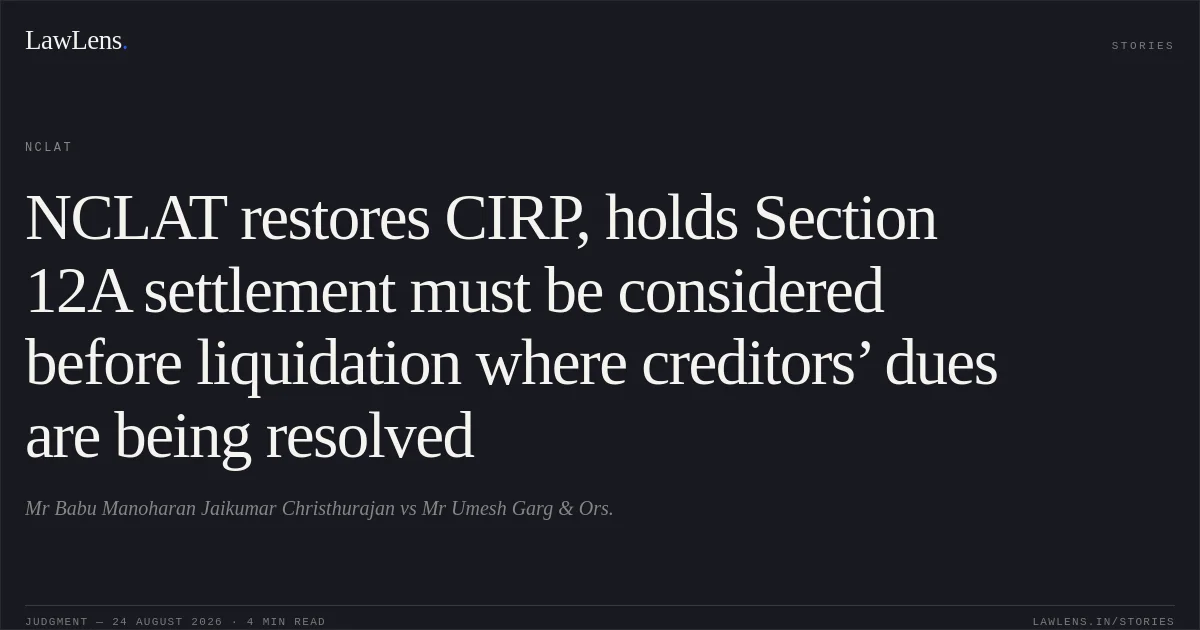
Source reference: paras. 17–21The Resolution Professional should therefore have objectively assessed whether an extension, including the available period up to 330 days, could facilitate settlement under Section 12A instead of prematurely seeking liquidation
Source reference: paras. 11, 21–22Ordering liquidation merely to address remaining operational debts, when the principal financial creditors had been paid or were being paid under the OTS, would defeat the Code’s preference for preserving a viable corporate debtor and avoiding liquidation where a less destructive resolution remained possible
Source reference: paras. 7, 12, 23–24In these exceptional facts, the liquidation order was reversible to restore CIRP and permit consideration of Section 12A.
Source reference: no citationHolding
The appeal was allowed.
The liquidation order dated 26.08.2022 passed by the Adjudicating Authority in I.A. No. 800/2022 in IBA/685/2019 was set aside
Source reference: para. 25CIRP was restored, and the Resolution Professional was directed to explore withdrawal under Section 12A of the IBC.
Source reference: para. 25All pending interlocutory applications were closed, and there was no order as to costs
Source reference: para. 25Acts & Sections Cited
6 provisions across 1 statute referred to in this judgment. Each provision opens on LawLens.
Insolvency and Bankruptcy Code, 2016.6
Original Court PDF
Mr Babu Manoharan Jaikumar ChristhurajanvsMr Umesh Garg & Ors.
Click to open original judgment
Original judgment, available to read, download and summarize on LawLens.in