Facts
The appellant-assessee, an individual engaged in diamond trading, was subjected to income-tax proceedings after information received from the DGIT (Investigation), Mumbai, indicated that the Rajendra Jain Group was providing non-genuine purchase bills, unsecured loans and accommodation entries.
Source reference: p.3, para. 3.1–3.2The Assessing Officer found that the assessee had transacted with entities connected with that group and passed assessment orders under Section 143(3) of the Income-tax Act, 1961, determining total income at ₹7,13,55,565 for Assessment Year 2014–15 and ₹12,95,17,336 for Assessment Year 2015–16.
Source reference: p.3, para. 3.1–3.2The Commissioner of Income-tax (Appeals) partly allowed the assessee’s appeals and restricted the disallowance of the disputed purchases to 5%, amounting to ₹35,53,477 and ₹64,42,351 respectively.
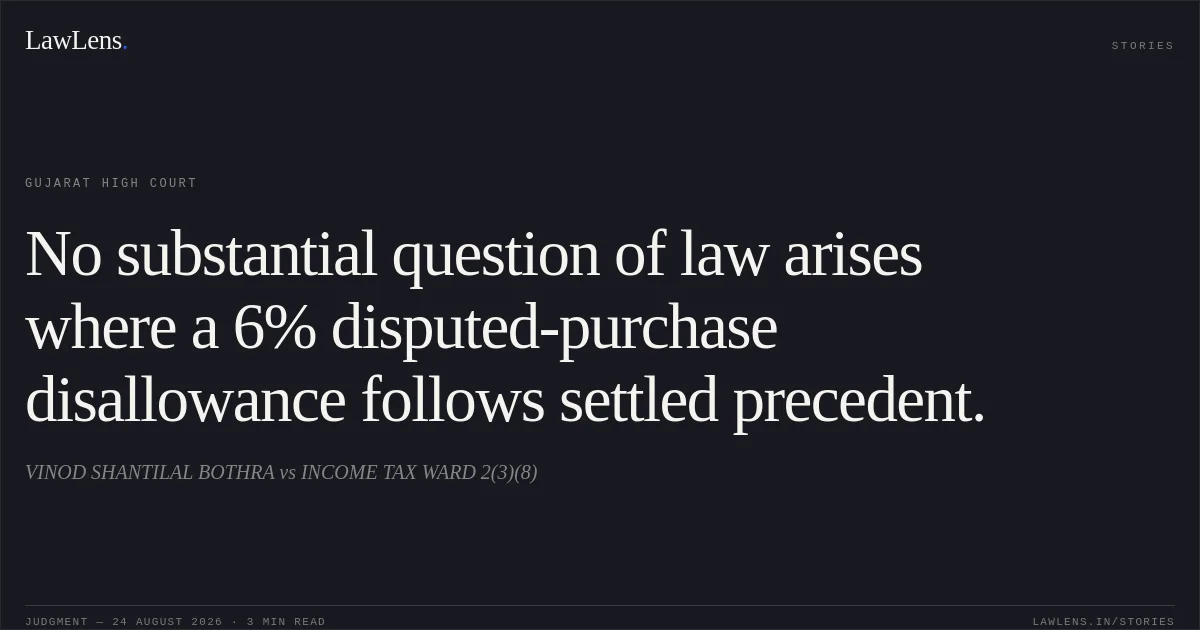
Source reference: p.4, para. 3.3On the Revenue’s appeals, the Income Tax Appellate Tribunal enhanced the disallowance to 6% of the disputed purchases.
Source reference: p.4, para. 3.4The Revenue’s challenge to that order in Tax Appeal No. 598 of 2023 was dismissed by the Gujarat High Court, which upheld the Tribunal’s adoption of a 6% disallowance in comparable circumstances.
Source reference: pp.5–10, para. 4The assessee thereafter filed the present appeals under Section 260A of the Act.
Source reference: p.2, para. 2Issues
Whether, on the facts and circumstances of the case, the Income Tax Appellate Tribunal was justified in upholding the order of the Commissioner of Income-tax (Appeals)?
Source reference: p.2, para. 2Whether the Tribunal was correct in law in confirming the rejection of the books of account under Section 145(3) of the Income-tax Act, 1961?
Source reference: p.2, para. 2Whether the Tribunal erred in law in not allowing various expenses claimed by the assessee without assigning reasons or basis?
Source reference: p.2, para. 2Law Applied
The appeals were governed by Section 260A of the Income-tax Act, 1961, under which the High Court interferes only where a substantial question of law arises.
Source reference: p.2, para. 2Section 145(3) permits rejection of the books of account where the Assessing Officer is not satisfied about their correctness or completeness, although the Court ultimately did not independently determine that issue.
Source reference: no citationThe Court applied the principle that, in cases involving allegedly non-genuine or accommodation-entry purchases, the entire purchase amount should not ordinarily be treated as taxable income where the corresponding sales or business activity are accepted; instead, only the probable income component or revenue leakage may be brought to tax.
Source reference: no citationIt relied on the comparable decisions in Pankaj A. Chaudhary, the Gujarat High Court’s decision in Tax Appeal No. 617 of 2022, and Mayank Diamonds, as well as Principal Commissioner of Income-tax-1, Surat v. M/s. Surya Impex, concerning transactions connected with the Bhanwarlal Jain/Rajendra Jain Group.
Source reference: pp.6–10, paras. 5–6Reasoning
The Court found that the issues raised by the assessee were materially covered by its earlier decision in Tax Appeal No. 598 of 2023, where a 6% disallowance of disputed purchases in similar accommodation-entry transactions had been upheld.
Source reference: pp.5–10, para. 4In that precedent, the Tribunal had considered the assessee’s turnover, gross-profit and net-profit figures, the absence of stock found during the search concerning the entry-provider group, and the need to tax only the income element rather than the entire purchase value.
Source reference: pp.7–9, para. 5The Court also noted that the same group and substantially similar questions had been considered in Surya Impex, where relief had been granted to the assessee.
Source reference: p.10, para. 6.1Since the facts of the present appeals were treated as identical to those already adjudicated, the Court held that no independent substantial question of law arose for determination.
Source reference: p.10, para. 7; p.11, para. 5Holding
The High Court declined to answer the proposed questions of law in view of its earlier judgment in Tax Appeal No. 598 of 2023.
Holding that the appeals did not raise any substantial question of law requiring interference under Section 260A, the Court dismissed both Tax Appeal Nos. 673 of 2024 and 674 of 2024.
Source reference: p.11, para. 5No further relief or costs were awarded.
Source reference: p.10, para. 7Acts & Sections Cited
3 provisions across 1 statute referred to in this judgment. Linked provisions open on LawLens.
Income Tax Act, 19613
Original Court PDF
VINOD SHANTILAL BOTHRAvsINCOME TAX WARD 2(3)(8)
Click to open original judgment
Original judgment, available to read, download and summarize on LawLens.in