01Facts
The petitioner joined as a Warden on 03.08.1977, was promoted through several posts, and was promoted as Assistant Superintendent on 29.11.2006. He retired as Deputy Superintendent Jail on 31.01.2016.
¶ 2He claimed that his ACRs were good and very good, and that he was due for promotion to Deputy Superintendent at Sr. No. 4 of the Gradation List, but his juniors were promoted on 11.08.2014.
¶ 3The ACR for 2008-09 contained a remark "Integrity is doubtful" in column 6. The remark showed cutting and overwriting, was made by interpolation, and was never conveyed to the petitioner.
¶ 6By order dated 13.01.2015, the General Administration Department held that the remark could not be treated as adverse for promotion. The Director General of Prisons re-intimated the remark only on 12.05.2015.
¶ 7Following the petitioner's representation, an inquiry by Special Secretary (Home) found cutting and manipulation in the ACR. The adverse remarks were expunged and the overall assessment was treated as "good" by report dated 31.12.2019.
¶ 8, 16By order dated 02.06.2021, the petitioner was promoted as Deputy Superintendent Jail w.e.f. 11.08.2014, but only notionally, so he received no actual pay or arrears.
¶ 3, 8The petitioner's earlier writ, CWP-19706-2015, was disposed of on 31.08.2023 with liberty to challenge non-grant of actual arrears.
¶ 4The State contended that pension was computed under Rule 6.24 of the Punjab Civil Service Rules (Vol. II) on last drawn pay, and that the "no work no pay" principle applied.
¶ 1202Issues
i.1. Whether adverse remarks in the ACR for 2008-09 that were not conveyed to the petitioner at the relevant time could be held against him to deny promotion from the date his juniors were promoted.
¶ 14–15, 17ii.2. Whether the petitioner is entitled to arrears of actual pay, consequential benefits, and retiral benefit fixation with interest from 11.08.2014, despite the "no work no pay" principle invoked by the respondents.
¶ 18–19, 2603Law Applied
The court relied on the principle, laid down in Prabhu Dayal Khandelwal v. Chairman, UPSC, that unconveyed adverse remarks cannot be held against an employee.
¶ 15It applied the normal rule of "no work no pay" as subject to exceptions, drawing on Union of India v. K.V. Jankiraman, (1991) 4 SCC 109, which holds that the rule does not apply where an employee willing to work is kept away for no fault of his own.
¶ 20It relied on State of Kerala v. E.K. Bhaskaran Pillai, (2007) 6 SCC 524, holding that the employee should receive full monetary benefits where the administration wrongly denied his due.
¶ 21It relied on Ramesh Kumar v. Union of India, (2015) 14 SCC 335, holding that the rule does not apply where the employer was at fault in not considering promotion.
¶ 22It also relied on North Delhi Municipal Corporation v. Ram Naresh Sharma and Dayanand Chakrawarthy v. State of U.P., (2013) 7 SCC 595, holding that the rule cannot be invoked by an employer that prevented the employee from working.
¶ 23It cited Commissioner, Karnataka Housing Board v. C. Muddaiah for the proposition that courts may direct benefits "as if he had worked" to prevent a party from profiting from its own wrong.
¶ 18The court invoked the constitutional equality principle under Article 14.
¶ 2404Reasoning
The court found it undisputed that the 2008-09 adverse remarks were not conveyed until 12.05.2015, after the juniors' promotion on 11.08.2014.
¶ 14Under Prabhu Dayal Khandelwal, these remarks could not defeat promotion. The inquiry report independently established that the remarks were manipulated and were expunged.
¶ 15–16The denial of promotion from the due date was therefore attributed to the department's own error, not to any fault of the petitioner.
¶ 17Because the petitioner was kept out of the post through the respondents' fault, the "no work no pay" plea failed. The court held that the petitioner was deprived of duties he was willing and eligible to perform, which falls within the exceptions in Jankiraman, Bhaskaran Pillai, Ramesh Kumar, and Ram Naresh Sharma.
¶ 18–23Allowing the department to rely on its own illegality would "perpetuate injustice."
¶ 18–19The court also noted that the juniors had enjoyed higher status and pay since January 2017, and that continuing that disparity would offend Article 14. The State counsel could not controvert this position.
¶ 24–25The Rule 6.24 pension argument was not separately addressed in the reasoning; the court found merit in the petitioner's submissions.
¶ 1305Holding
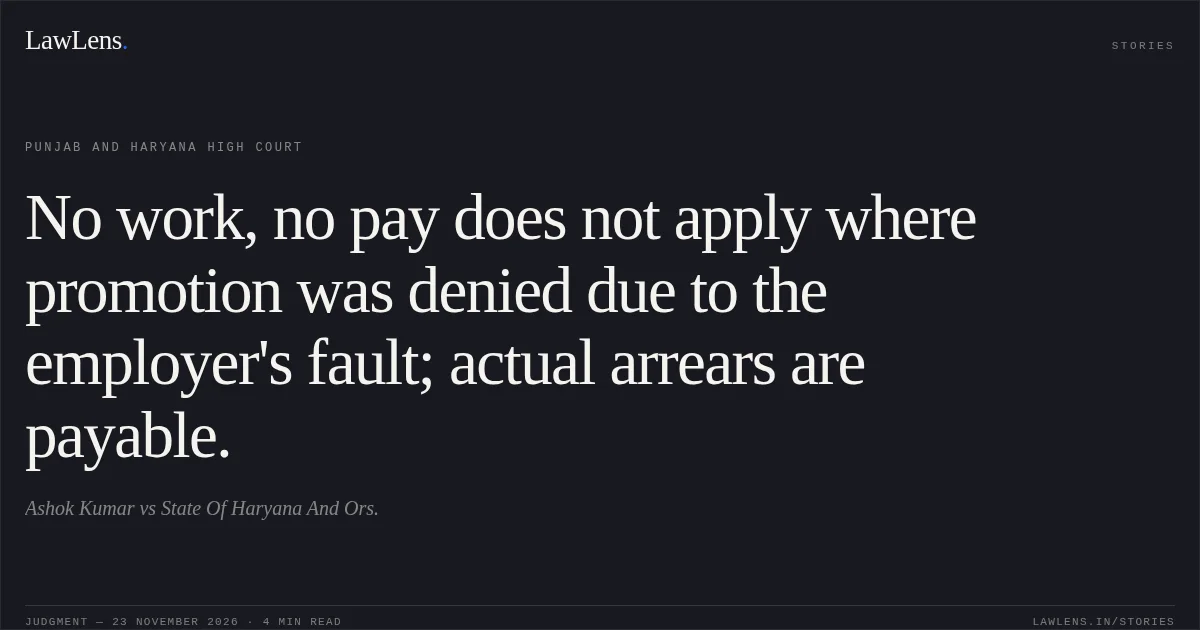
Unconveyed adverse remarks could not bar promotion from 11.08.2014, and the "no work no pay" principle does not apply where the employer's illegal action caused the denial of promotion and actual work.
¶ 15, 17–19The writ petition was allowed. Order dated 02.06.2021 was quashed to the extent it granted only notional promotion without arrears and consequential benefits. The respondents were directed to pay arrears of actual pay, all consequential benefits, and fix retiral benefits with interest from 11.08.2014, within five months. Failing compliance, interest at 6% p.a. is payable.
¶ 26Original Court PDF
Ashok KumarvsState Of Haryana And Ors.
Click to open original judgment
Original judgment, available to read, download and summarize on LawLens.in