Facts
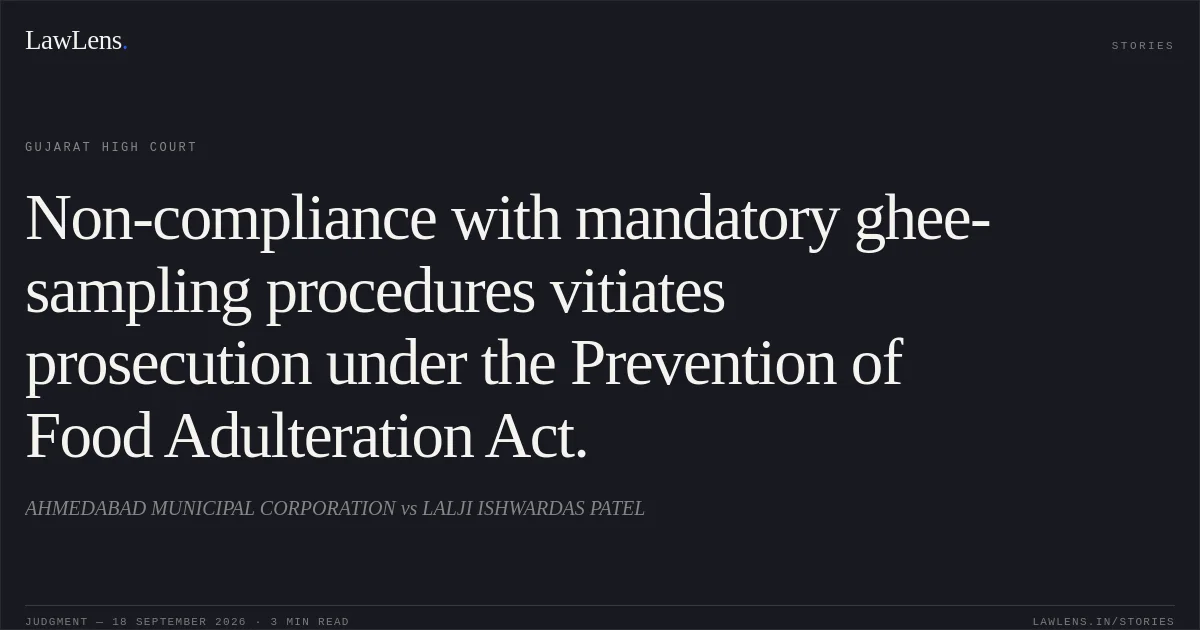
On 6 September 2010, an Ahmedabad Municipal Corporation Food Inspector visited the respondent’s dairy premises and purchased 600 grams of ghee for analysis after the respondent stated that he owned the business and prepared the ghee himself.
Source reference: p.2The sample was divided into three bottles and forwarded in accordance with the prosecution’s version. The Central Food Laboratory, Mysore, subsequently reported that the sample failed to conform to the prescribed standards because the rancidity test was positive and the fatty-acid composition did not correspond to ghee.
Source reference: pp.7–8Sanction was obtained and the respondent was prosecuted under Sections 7(1) read with 16(1)(a)(i) of the Prevention of Food Adulteration Act, 1954.
Source reference: pp.2–3The Metropolitan Magistrate acquitted him in Criminal Case No. 9766 of 2010 on 20 July 2012. The Ahmedabad Municipal Corporation preferred the present appeal under Section 378 of the Code of Criminal Procedure, 1973.
Source reference: pp.1, 3–5Issues
Whether the trial Court was justified in acquitting the respondent-accused of the offences under Sections 7(1) and 16(1)(a)(i) of the Prevention of Food Adulteration Act, 1954.
Source reference: para. 9Whether the prosecution proved compliance with the mandatory sampling requirements under Rules 14 and 4(4) of the Prevention of Food Adulteration Rules, 1955.
Source reference: paras. 13–16Whether the trial Court’s appreciation of evidence was illegal, perverse, or otherwise warranted appellate interference in an appeal against acquittal.
Source reference: para. 9Law Applied
The Court applied Sections 7(1) and 16(1)(a)(i) of the Prevention of Food Adulteration Act, 1954, concerning the prohibition and punishment of sale of adulterated food.
Source reference: p.1It further applied Rules 14 and 4(4) of the Prevention of Food Adulteration Rules, 1955, which prescribe mandatory safeguards for the proper collection, preparation, sealing, and sampling of food articles, including ghee.
Source reference: paras. 13–16Non-compliance with these mandatory requirements undermines the reliability of the sample and may vitiate the prosecution.
Source reference: para. 16On appellate review of acquittal, the Court relied on Chandrappa v. State of Karnataka, (2007) 4 SCC 415; Rajesh Prasad v. State of Bihar, (2022) 3 SCC 471; Babu Sahebagouda Rudragoudar v. State of Karnataka, (2024) 8 SCC 149; and Ramesh v. State of Karnataka, (2024) 9 SCC 169, reiterating that although an appellate court may reappreciate the evidence, the accused enjoys a double presumption of innocence and an acquittal should not be disturbed where two reasonable views are possible.
Source reference: paras. 17–20The Court also followed decisions of the Gujarat High Court holding that breach of Rules 14 and 4(4) in sampling cases is fatal to the prosecution.
Source reference: paras. 14–16Reasoning
Although the Central Food Laboratory report indicated that the ghee was not compliant with the prescribed standards, the prosecution failed to establish that the sample had been collected in strict conformity with the mandatory procedure.
Source reference: pp.7–8The Food Inspector and the accompanying witness admitted that the prescribed procedure for drawing a sample of ghee had not been followed, and the evidence did not establish that the container had been properly heated before sampling and sealing, as required by the Rules.
Source reference: para. 13; para. 16In the absence of proof of compliance with Rules 14 and 4(4), the analytical report could not safely sustain the conviction.
Source reference: para. 16The trial Court’s conclusion that the prosecution had failed to prove the charge beyond reasonable doubt was therefore a reasonable view supported by the evidence.
Source reference: paras. 16–22Applying the heightened restraint applicable to appeals against acquittal, the High Court found no perversity, illegality, or manifest error warranting interference.
Source reference: paras. 16–22Holding
The High Court held that the prosecution failed to prove the respondent’s guilt beyond reasonable doubt and that the trial Court had correctly acquitted him.
The appeal filed by the Ahmedabad Municipal Corporation under Section 378 CrPC was dismissed, and the judgment and order of acquittal dated 20 July 2012 were confirmed.
Source reference: para. 23The respondent’s bail bond was cancelled, and the record and proceedings were directed to be returned to the trial Court.
Source reference: para. 23Acts & Sections Cited
2 provisions across 1 statute referred to in this judgment. Each provision opens on LawLens.
Code of Criminal Procedure, 19732
Original Court PDF
AHMEDABAD MUNICIPAL CORPORATIONvsLALJI ISHWARDAS PATEL
Click to open original judgment
Original judgment, available to read, download and summarize on LawLens.in