Facts
In November 2000, the victim (Savita) was allegedly set on fire by her husband (Raju), brother-in-law (Shambhu), and mother-in-law (Bardi Devi) over dowry demands
Source reference: p. 2The victim was five months pregnant at the time; she survived and delivered a child, eventually filing an FIR in April 2001
Source reference: p. 2, 7On January 17, 2004, the Trial Court convicted all three appellants under Sections 307/34, 498A/34, and 342/34 of the IPC, sentencing them to various terms, including seven years of Rigorous Imprisonment (RI)
Source reference: p. 2-3During the pendency of the appeal, the victim reconciled with the appellants, resumed living with her husband, and bore two more children with him
Source reference: p. 3, 7The victim filed an affidavit stating she did not wish for further action against the appellants
Source reference: p. 3Issues
1. Whether the court can take into consideration a post-conviction settlement and reconciliation between a victim and the accused for the purpose of determining the quantum of sentence for non-compoundable offences
Source reference: p. 62. Whether the substantive period of custody already undergone by the appellants can be treated as sufficient punishment in light of the victim’s forgiveness and the preservation of matrimonial harmony
Source reference: p. 5, 8Law Applied
The Court primarily applied the sentencing principles concerning non-compoundable offences as elaborated in Gulab Das v. State of M.P. (2011), which holds that while offences under Section 320 CrPC cannot be compounded if they are non-compoundable, the fact of a settlement or compromise can be a mitigating factor in determining the quantum of sentence
Source reference: p. 6-7The court also balanced the deterrent theory of punishment against the restorative power of forgiveness, noting that “an eye for an eye will only make the whole world blind”
Source reference: p. 5Reasoning
The Court observed that while the crime was grave—leaving visible burn scars on the victim—the parties had undergone a radical change in circumstances over the 25-year period since the incident
Source reference: p. 4, 8The Court reasoned that since the victim had forgiven the appellants and successfully rehabilitated her marriage, any further incarceration would "ruin the cordiality" of the revived relationship and be detrimental to the welfare of the five children involved
Source reference: p. 8Relying on the precedent in Gulab Das, the Court determined that while the conviction remains valid (as the appellants did not challenge it), the interest of justice shifts toward maintaining family equilibrium
Source reference: p. 7-8The Court noted that the "phenomenon of time" and the "sense of forgiveness" displayed by the victim warranted a modification of the sentence to the period already undergone
Source reference: p. 5, 8Holding
The Court upheld the judgment of conviction dated January 17, 2004, for all three appellants
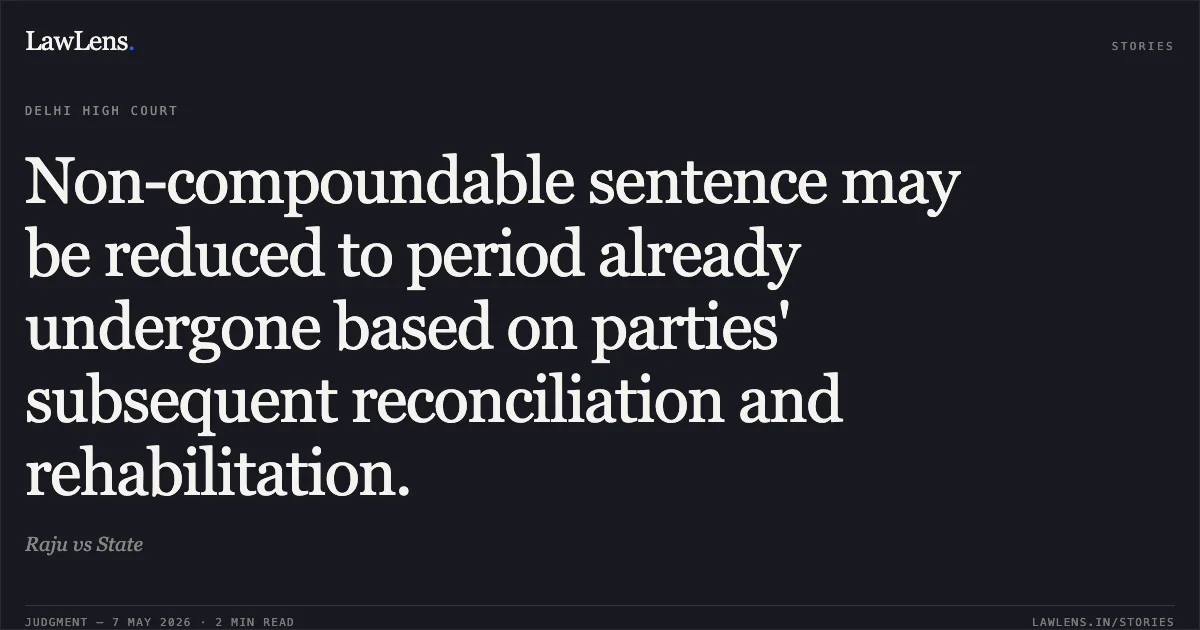
However, it answered the sentencing issue by modifying the punishment to the period of custody already undergone by each appellant, finding it sufficient to meet the ends of justice under the unique circumstances of their reconciliation
Source reference: p. 8The appeals were disposed of with the order that the sentence stands modified accordingly
Source reference: p. 8Acts & Sections Cited
3 provisions across 1 statute referred to in this judgment. Each provision opens on LawLens.
Indian Penal Code, 18603
Original Court PDF
RajuvsState
Click to open original judgment
Original judgment, available to read, download and summarize on LawLens.in